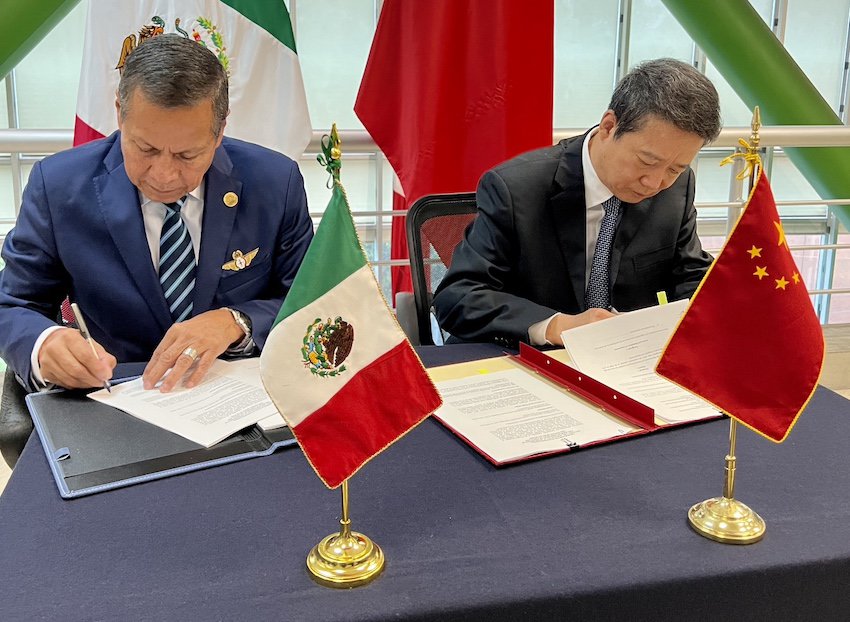
The national aviation agencies of Mexico and China have signed two new memoranda of understanding aimed at expanding air travel between the two countries, after a three-year suspension of direct flights during the COVID-19 pandemic.
Delegates from Mexico’s Federal Civil Aviation Agency (AFAC) and the Civil Aviation Administration of China (CAAC) met on Thursday to discuss the agreements. The first aims to increase bilateral cooperation in areas such as environmental protection, safety, capacity building and infrastructure development, while the second lays out a new air transport agreement covering passenger and cargo flights.
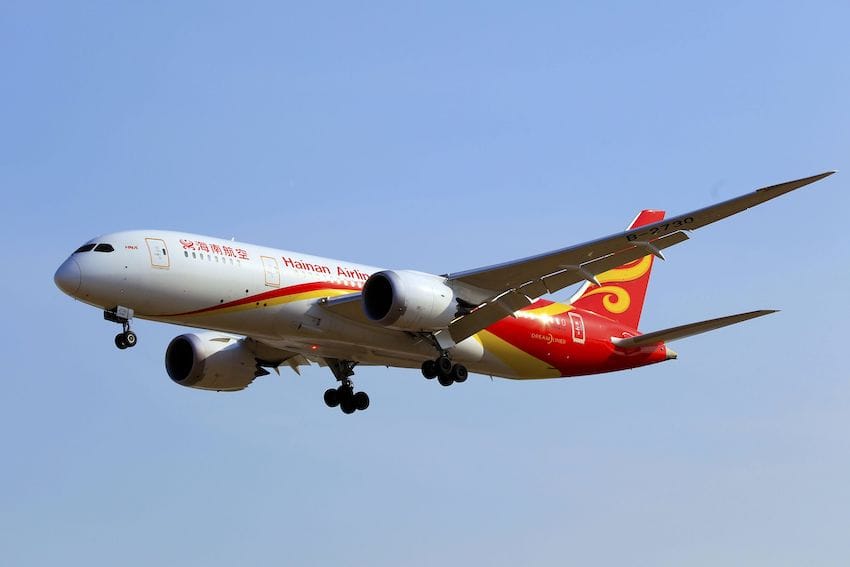
This agreement will allow more airlines to operate the China-Mexico route and expand destinations to five for passengers and four for cargo, from a previous maximum of two. It also lays out protocols for code-sharing, allowing both Mexican and Chinese airlines to increase joint operations.
During the meeting, two Chinese airlines expressed interest in resuming passenger flights to Mexico, while another agreed to increase cargo operations at Mexico’s Felipe Angeles International Airport (AIFA).
Direct flights between Mexico and China were suspended in January 2020, when China’s Hainan Airlines suspended flights to Tijuana due to maintenance at the destination. The flights were never reactivated after the COVID-19 pandemic struck later that year.
In May, the Pacific Airport Group (GAP), which operates 12 of Mexico’s regional airports, including popular destinations such as Puerto Vallarta and Guadalajara, pledged to reactivate Hainan Airline’s flights from Beijing to Tijuana and Mexico City before the end of summer of 2023.

Alejandra Soto, GAP’s director of institutional relations, also announced that negotiations were underway with Korean Airlines to operate a direct flight to Tijuana from Seoul, South Korea. Soto also said that with the establishment of a new Tijuana-Panama route, GAP hoped the Baja California airport would act as a travel hub between Asia and Central America.
Analysts who spoke to Reforma newspaper expressed optimism that the new agreements will boost trade between Mexico and China.
Aviation expert Carlos Torres said that increased cargo flights would allow Mexico to benefit more from the nearshoring phenomenon. A significant number of Chinese manufacturers have invested in Mexico in recent years, particularly in northern Mexican states close to the U.S. border.
Economist Fernando Gómez added that direct flights would also encourage more Chinese businesses to explore nearshoring opportunities in Mexico. Both analysts noted that Mexico is becoming a strategic trade hub in the context of the trade war between the two superpowers.
Chinese imports to Mexico have grown over recent years, reaching US $32 billion in the first four months of 2023, according to the Economy Ministry. Meanwhile, Chinese travelers to Mexico more than doubled to reach 68,206 in the first half of 2023, compared to 31,179 in the same period the year before, according to the Tourism Ministry.