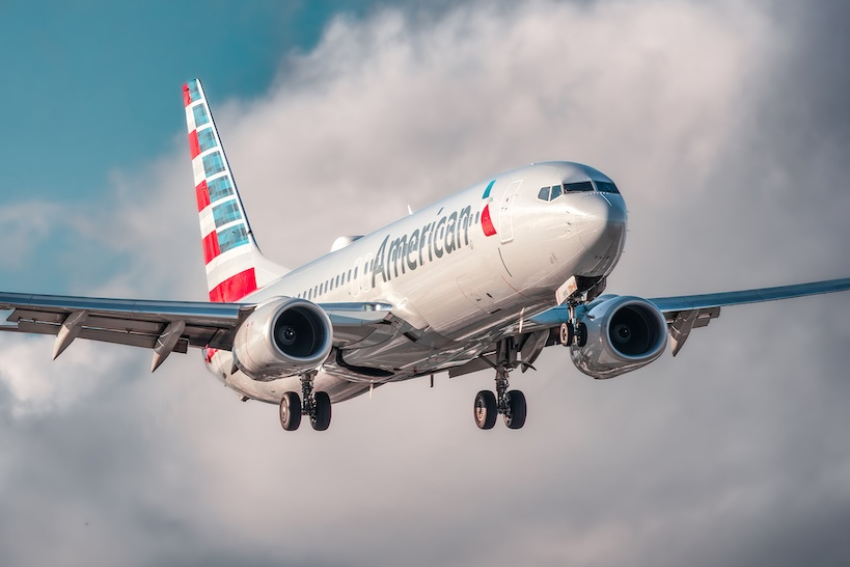
American Airlines is the air carrier transporting the most passengers between Mexico and the United States, accounting for nearly one in five of total passengers.
New data from the Federal Civil Aviation Agency (AFAC) reveals that travelers between the two countries prefer U.S.-based airlines, with American Airlines (17.8%) and United Airlines (15.5%) accounting for a solid one-third of all such passengers.
(Cuartoscuro)
The two leading Mexican airlines on those routes — Volaris (14.7%) and Aeroméxico (11%) — carry just over a quarter of the passengers.
Delta, at 8.8%, rounds out the top five.
American Airlines’ leadership in U.S.-Mexico travel caps an accelerated effort in recent years to expand its service to and from Mexico, positioning it to be the U.S. airline with the most flights, seats and destinations in Mexico.
“With the announcement of American’s 30th destination in Mexico — Puerto Escondido — we further solidify our position as the leading U.S. airline in the country with an operation and network that is unmatched,” José A. Freig, American’s Vice President of International, Contact Center Operations and Service Recovery said.
In March, the airline launched new service to the northern Mexican city of Tampico and in November, AA will be the only international flight service connecting the U.S. state of Oklahoma with Cancún.

The service expansion also includes routes from Dallas-Fort Worth to Morelia, Oaxaca and Durango; from Phoenix to Zihuatanejo; and a recently announced seasonal route expansion from Chicago to Querétaro, which was previously scheduled to end on January 5, 2026.
These new destinations join other recent routes launched by American Airlines, including to Tijuana, Tulum and Veracruz.
As a result of these additions, American Airlines will operate more than 880 weekly flights to Mexico, which represents a 10% increase in its local operations and a 13% increase in its seat capacity.
American Airlines’ growing presence in the Mexican market comes amid tensions between the U.S. government and Delta/Aeroméxico.
US Department of Transportation orders Delta-Aeroméxico alliance to end Jan. 1
Last week, the U.S. Department of Transportation (DOT) ordered both airlines to end their nearly decade-old joint venture by Jan. 1, citing “ongoing anticompetitive effects in U.S.-Mexico City markets that provide an unfair advantage to Delta and Aeromexico.”
American Airlines supported the DOT’s decision, stating that Mexico has breached a bilateral agreement by reducing slots at Mexico City International Airport (AICM) and shifting dedicated cargo to Felipe Ángeles International Airport (AIFA), thus affecting U.S. carriers.
Aeroméxico and Delta have said that if their alliance were to end, it would jeopardize 3,800 jobs in the U.S. Furthermore, it would cause losses of more than US $310 million in GDP and over $200 million in annual tourism spending.
With reports from El Economista, T21 and A2