
Irrational fears pose no actual danger. But the people who have them are still afraid.
Such is the paradox that confronts Los Cabos as tourism numbers dwindle in 2026, a trend at least partly based on perceptions with no basis in fact.
‘El Mencho’ and the Los Cabos paradox
“We have to take into account that the beginning of this year was marked by an atmosphere of insecurity that permeated the perception of the destination abroad,” explained Mauricio Salicrup, the Secretary of the Board of Directors of the Los Cabos Hotel Association, referring to the incidents of cars set ablaze in several areas of Mexico — although, notably, not in Los Cabos — following the arrest and death of CJNG cartel leader Nemesio “El Mencho” Oseguera Cervantes in the state of Jalisco on Feb. 22.
“Although the Los Cabos Tourism Board (FITURCA) promotes and clarifies the situation in Los Cabos compared to what happens in the rest of the country, it still affects us because there is always a decrease in tourism due to companies sending notices to their employees prohibiting travel to Mexico for safety reasons.”
A solid, if unspectacular year so far
Which is to say, despite Los Cabos’ superb safety record and peninsular isolation from mainland Mexico, the destination is losing business due to perceptions of Mexico as a whole among U.S. and other international travelers.
How much is it being hurt? Salicrup, in an interview with Sudcaliforniano, said there has been a 49% decrease in demand from U.S. travelers during the first quarter of 2026, a 23% loss of Canadian travelers and a 16% dip in the domestic market. Those numbers sound alarming and could certainly cause very rational fears for business owners in Los Cabos who depend on tourism. However, some context is needed.
Although there is no public data regarding reservations made with area hotels and resorts, there is ample data on the number of tourists who fly into Los Cabos, and by that standard, Los Cabos is having a solid, if unspectacular, year. So far, at least.

What the numbers say about international arrivals
The number of international tourists arriving in Los Cabos was up relative to 2025 in both January and February 2026 (by 2.6% and 4.2%, respectively), according to Grupo Aeroportuario del Pacífico (GAP), which operates Los Cabos International Airport.
Now, since the aforementioned incidents in which no tourists were hurt happened in late February, March is where one would expect to see a decline, and indeed that did happen. International arrivals were down by 7.1%, falling from over 545,000 in 2025 to 507,000 in 2026. But there was also a record number of spring breakers in March and, in the first week of April, robust 90% hotel occupancy for Semana Santa, so it’s not as if the sky is falling, especially since, for the year, Los Cabos has seen only a 0.7% dip in international arrivals.
The long-term fallout
Of course, Salicrup’s point is that the drop in demand is driven largely by insecurity fears, so that being the case, it’s too early to tell what diminishing reservations right now might mean for summer, or for the remainder of the year. Perhaps this is the start of a precipitous drop, or perhaps it all ends up being a tempest in a teacup.
In a recent interview with Travel Weekly, CruisingStores CEO Dwain Wall, whose company sells more than just cruises to Mexico, noted that bookings for the country had been down 40% in the weeks immediately following the images of burning cars being broadcast on American and Canadian televisions. But, with the exception of Puerto Vallarta — where insecurity was most glaringly obvious and where international arrivals plunged by 32% in March — he expects tourism in Mexico to bounce back pretty quickly, assuming nothing else happens this year to alarm tourists.
As for Los Cabos, Wall said, bookings had indeed softened but should pick up soon.
The domestic tourism decline in Los Cabos
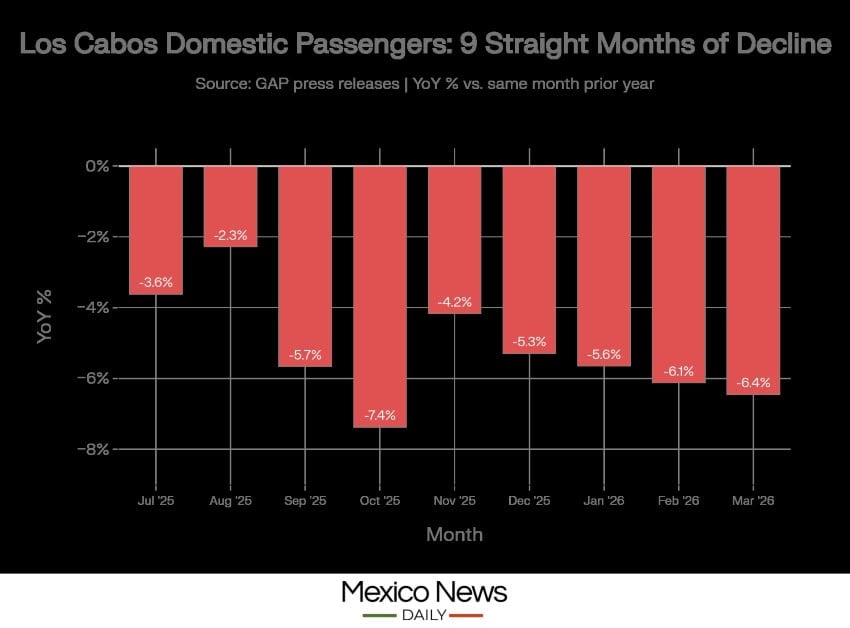
Despite the attention given to speculations on the international tourism market in Los Cabos, it’s the domestic market that has proven to be a clear and demonstrable problem. Domestic tourism has declined in Los Cabos for nine straight months relative to year-over-year (YoY) numbers.
In July 2025, per GAP numbers, domestic passengers were down by over 10,000 from the same month in 2024. In August, by over 6,000 from the previous year; in September, by more than 12,000; in October, by over 17,000; in November, 9,000; in December, 13,000; in January, 13,000; in February, 6,000; and in March, more than 15,000!
These numbers add up quickly and point to the real issue dragging down tourism in Los Cabos. While it’s true international arrivals have decreased by only 0.7% in 2026, overall tourism is down 2.5%, a much more significant number that is largely due to this ongoing domestic nosedive.
Why is domestic travel in Mexico down?
This is not just a Los Cabos issue. As Mexico News Daily reported earlier this year, the domestic tourism market in Mexico saw flatline growth in 2025 due to a combination of factors, including a weakening economy and an inflationary rise in prices for tourism goods and services.
But the squeeze is being felt acutely in Los Cabos, which has the highest average hotel prices in the country and is one of the most expensive destinations in general. Yes, average daily hotel rates have declined in Los Cabos in recent years, falling from a yearly average of US $458 in 2024 to “only” US $429 in 2025. But that’s still a lot to pay — nearly US $3,000 for a weeklong visit — particularly when one’s pesos have less purchasing power than they used to. And there are plenty of other attractive domestic destinations, some of which are likely closer to home, meaning that the plane fares are cheaper too.
Traditionally, international visitors have accounted for about two-thirds of annual tourism in Los Cabos, domestic visitors for about one-third. So maybe this domestic downturn didn’t seem like such a big deal when international tourism was thriving.
But it sure seems like a big deal now.
Chris Sands is a writer and editor for Mexico News Daily, and the former Cabo San Lucas local expert for the USA Today travel website 10 Best and writer of Fodor’s Los Cabos travel guidebook. He has also contributed to numerous other websites and publications, including The San Diego Union-Tribune, Marriott Bonvoy Traveler, Forbes Travel Guide, Porthole Cruise and Travel, and Cabo Living.