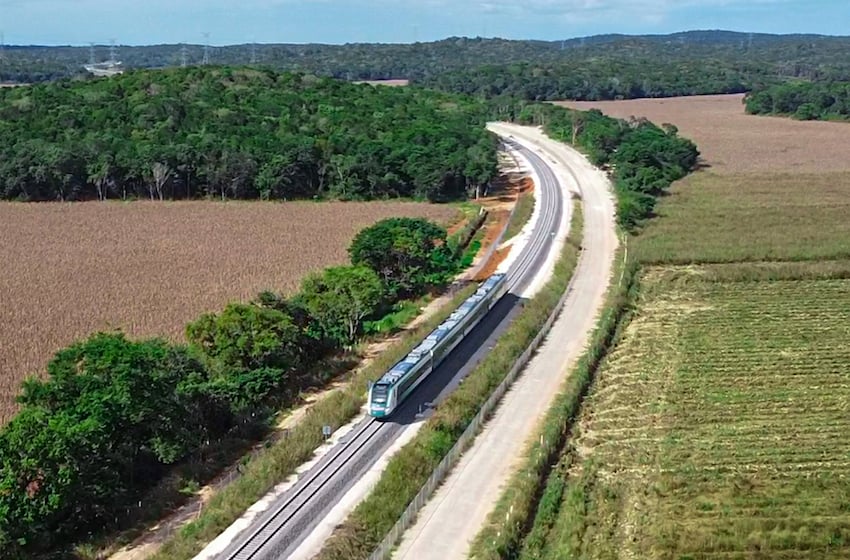
One year after becoming fully operational, and two years after it was inaugurated, the Maya Train is hemorrhaging funds and is likely to require government support for up to 20 years before it becomes profitable.
During the first nine months of 2025, total Maya Train income covered a mere 12.6% of its operating expenses, with the remainder coming from government subsidies and resources from a public trust fund.
🚆 Hace dos años, iniciamos nuestro primer viaje. Éramos una promesa ✨
🌱 Hace dos años, éramos el sueño de un pueblo. Y despertamos para vivir la aventura 🌄
💪 Hace dos años, parecíamos algo imposible. Y aun así, nacimos, avanzamos y vencimos la duda 🌿
🤍 Hoy, al cumplir… pic.twitter.com/1uwqnRqnAA
— Tren Maya (@TrenMayaMX) December 15, 2025

According to the company’s January-September financial statements, the Maya Train — with operating costs of 3.068 billion pesos (US $170.6 million) — received 3.345 billion pesos ($186 million) in public funding. During this time, it earned only 387 million pesos ($21.5 million) in ticket sales, souvenirs and other revenue streams.
“From a financial standpoint, this is a losing project,” Iberoamericana University professor Gerardo Herrera told the newspaper Reforma, adding that though passenger traffic is rising, it is not rising fast enough.
“The government has no choice but to subsidize it since at the current rate it will take between 10 and 20 years to become profitable,” he said, pointing out that this could come at a cost of 25 billion pesos (nearly US $1.4 billion) over the next decade.
Railroad consultant Carlos Barreda told Reforma that the sustainability of the Maya Train subsidies is a concern, contrasting what he called “a high-cost, tourism-focused service” with the benefits of an urban transportation system that “generates real economic development in the community.”
“Such economic benefits have not materialized,” he said.
Former President Andrés Manuel López Obrador inaugurated the Cancún-to-Campeche section of the Maya Train on Dec. 15, 2023, and the entire 1,554-kilometer-long railroad line was pronounced fully operational in December a year ago.
Four years and 1,554 kilometers later, the Maya Train is complete
Conceived as a mega-project that would benefit tourism, the railway was built at a cost of roughly 500 billion pesos (US $27.8 billion), nearly four times the original estimate.
Also promoted as a project that would address the economic and social backwardness of southeastern Mexico, the train operated at a significant loss last year. Maya Train general director Óscar David Lozano reported that revenues in 2024 represented just 9.6% of operating costs, leaving the company US $133 million in the red.
Still, proponents urge patience, insisting that the financial success of the train hinges on freight operations that are set to begin either late next year or in 2027, even as critics continue to question the viability of the project and demand that the environmental damage be repaired.
The train has experienced various mechanical failures, delays, air conditioning problems and unexpected stops due to insufficient operational testing.
Initial reviews have also highlighted the inconveniences. Most Maya Train stations are located far outside the main towns and tourist areas, requiring additional time and cost for a shuttle or taxi to reach the final destination.
Bus services have proven to be less costly, more reliable and more convenient, particularly since bus stations are located in city centers.
With reports from Reforma, El Imparcial and Serendipia