For decades, Mexico has maintained an ongoing love affair with Japanese culture — most commonly expressed through an addiction to ramen, anime and more. Indeed, Japan has been a fixture in Mexico’s imagination since 1897, when a small Japanese community known as the “Enomoto Colonization Party” arrived in Acacoyagua, Chiapas, to grow coffee as some of the earliest Japanese immigrants to reach Latin America.
Today, for those seeking to experience Mexico’s appreciation for Japanese culture in a truly unique form, there’s a hotel hidden in a corner of Mexico’s smallest state, Tlaxcala, that has been cultivating a Japanese-inspired retreat space for some years now: JapoNeza.
A Japanese retreat in the middle of nature
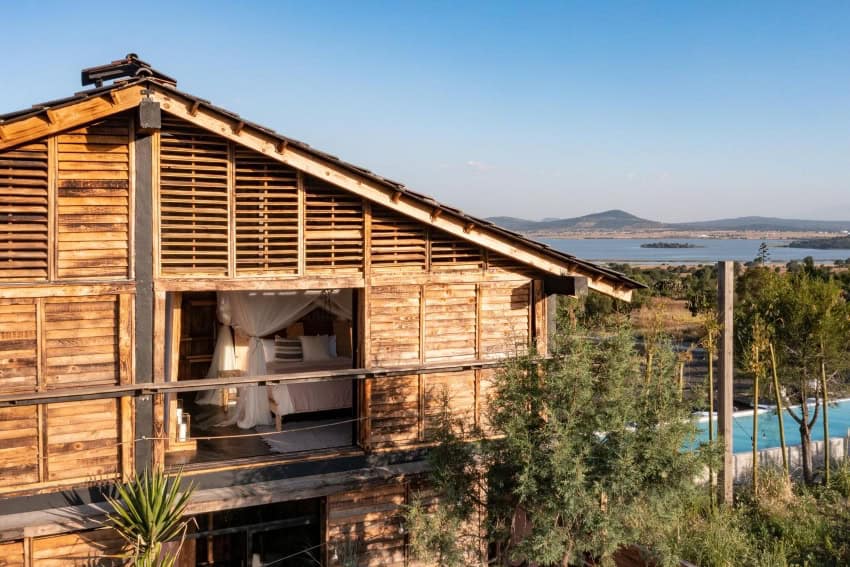
Picture this: an unobstructed view of the nearby Lake Atlangatepec. Horses running in the open, semidesert fields. In the far distance, La Malinche National Park awaits, looming boldly on the horizon. Tlaxcala is an overlooked destination, most certainly, offering the riches of pulque, haciendas and Indigenous heritage.
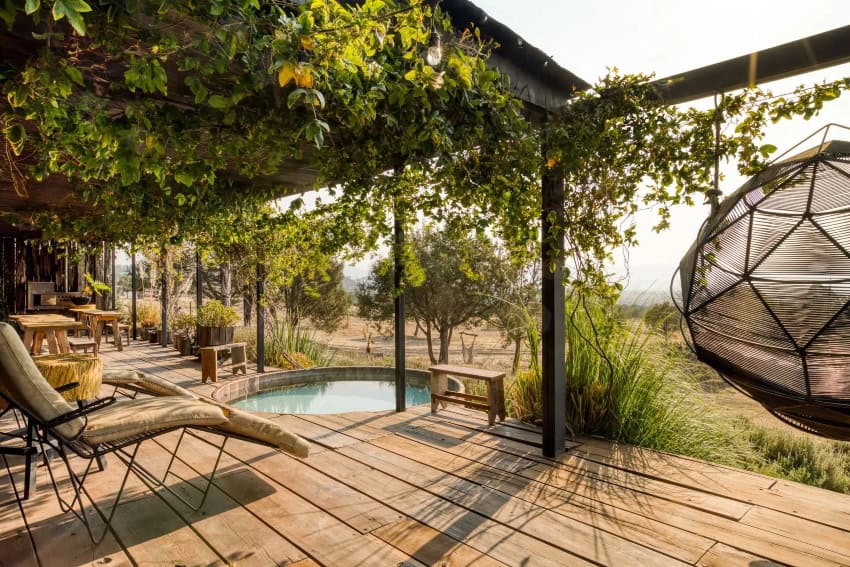
And then you enter your room. A private onsen — a Japanese thermal tub similar to a small jacuzzi that’s made from local cedar wood and covered in concrete — is at your disposal. You are immersed in Shinrin Yoku, a Japanese practice of therapeutic relaxation centered on immersing yourself in nature (in Spanish, translated as baño de bosque, or, in English, “forest bath”). There’s a cold-plunge pool too, all set inside the Japanese minimalist design of a boutique hotel.
“Here, you can watch the mountains while bathing. It’s a retreat,” says Claudia Terán, JapoNeza’s administrator. “You come here to be in silence, because all around us there isn’t anything. It’s just the lake and a mountain. No cars. Just our four horses. It’s completely silent.”
“We have a philosophy of being in contact with nature,” Terán elaborates on the concept of Shrinrin Yoku. “That’s our ambiance. You come here to enjoy an artisanal space completely made of wood. It was made in part by the local people, using local trees. Everything was salvaged from trees that fell naturally, so it’s rescued wood and 100% repurposed.”
“Everything is self-sustainable and recycled here,” she says. “The rooms and pools use solar panels. Whatever we can consume comes from us. We have chickens that produce organic eggs. We have a biodegradable system, and our water gets recycled to water the gardens. That’s part of the Japanese concept for us.”

Globally recognized
JapoNeza — which includes eight rooms spread across two buildings — has received multiple nominations for the best boutique hotel in Mexico, and has been recognized globally by international architecture associations. It’s also been featured in media outlets like Vogue.
It’s certainly not the first nor only such hotel in Mexico. In 1959, the Sumiya (today known as Grand Fiesta Americana Sumiya) was opened in Cuernavaca, Morelos. A large-scale effort, the Sumiya was a notable Japanese-style estate in its time, with a garden that showcased Mexico’s botanical wealth. Much later, in 2018, a modern approach to Japanese lodging was introduced with Ryo Kan in Mexico City’s Little Tokyo neighborhood. The space is an authentic ryokan (a traditional Japanese inn that includes kimonos, tatami mats and more). Outside of that, however, JapoNeza has become the only such venue that can offer a true Japanese retreat outside of the nation’s capital.
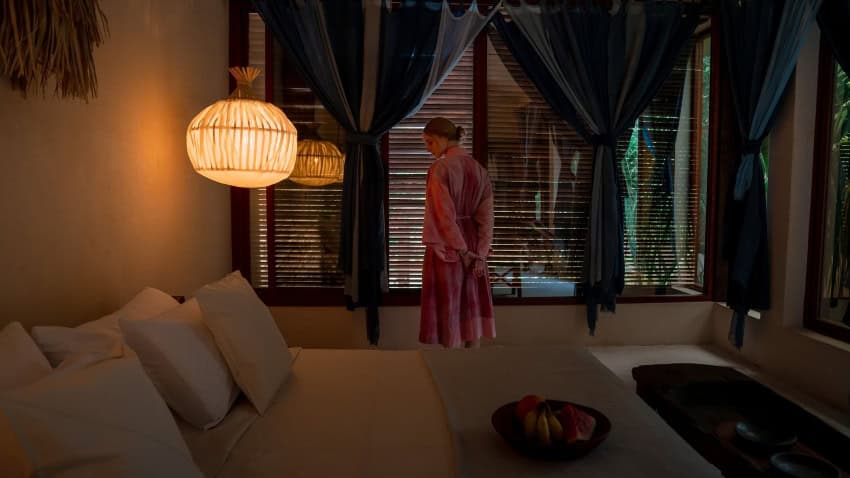
JapoNeza first opened in 2020, atop a plot of land that was once a ranch. The vision originated with Fausto Terán, a Mexico City resident who purchased the land and designed the hotel himself after feeling inspired and connected to Japanese aesthetics, which derived from his years of martial arts training and trips to Japan.
A Japanese aesthetic
“The techniques on how to burn the wood, to protect it against termites, is a Japanese technique that Fausto learned in Japan,” says Laura Terán, his sister, who helps to manage the hotel’s daily operations.
For a state like Tlaxcala, which generally feels undervisited by tourists — often passed over by domestic and international travelers alike — JapoNeza stands out as a destination experience, ideal for those looking to escape the frenetic pace and overcrowded saturation of larger, more popular areas in favor of quiet contemplation.
The hotel’s kitchen features a combination of Mexican and Asian dishes, often made from scratch and using locally-grown ingredients — sometimes mixed in one bowl to create a singular fusion.
“We make mixed food,” Terán says. “Pollo al Tocatlán [a regionally popular steamed chicken dish], but we include mushrooms and nopales. We have Japanese noodles, prepared with Asian sauces, but we will add spinach and whatever we have in season from our farm. We also make ramen in a Mexican way, using a pozole verde that is made with pepitas de calabaza, and then we add seaweed.”
After an energizing bowl of Mexican ramen, you can ride one of the horses across Mexico’s landscape or bathe in an open-air onsen. Or both.
Now also in Mérida
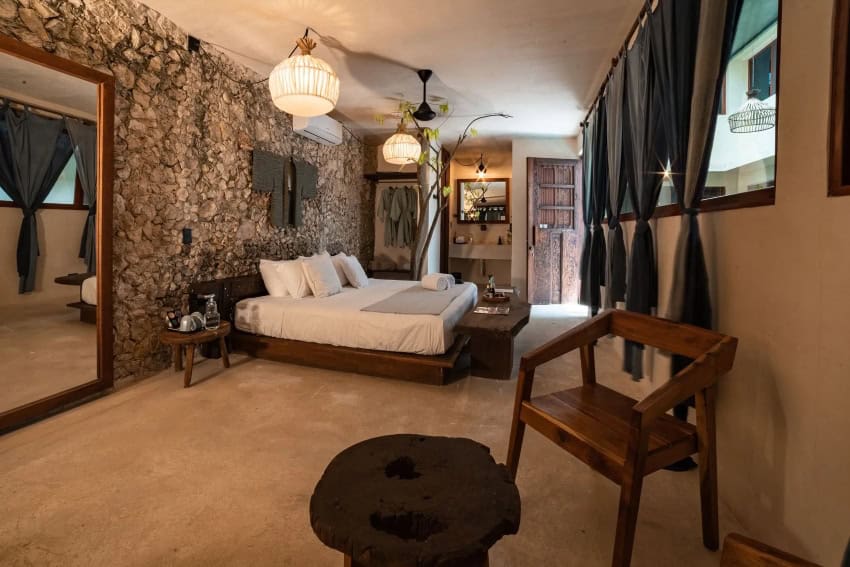
It’s no surprise that the niche hotel has gained popularity with travelers looking for something different in central Mexico. In 2023, the Tlaxcala hotel expanded eastward, reaching the historic center of Mérida, near the shores of the Yucatán peninsula.
Though it is ensconced in a busier urban location than its original counterpart in rural Tlaxcala, it’s still dedicated to the same Japanese principles of sustainable ecoconservatism and minimalistic design.
“[Merida] is different, of course, but shares the same concept regarding natural appreciation,” Terán says. “No trees were cut down to construct the hotel. Instead, the hotel was built around the trees that existed, and they are now part of the rooms. The roots are respected.”
Some differences — besides being in an immediately more populous area — include more outdoor opportunities to cool off. (Note that the Mérida location is for adults only; Tlaxcala, in contrast, welcomes families and larger groups).
“The heat of Merida, it’s intense,” Terán points out. “The showers are outside, for example, to keep cool and refreshed.”
Cultural connections
In terms of finding and maintaining the cultural bridge between Japan and Mexico — two nations that, on the surface, can seem at odds — Terán has ideas. And perhaps the two cultures are not as distant as one might initially assume, she says.
“Japanese culture represents order, the appreciation of natural life,” she says. “With the Mexican field worker, we have that in common. I work with many Mexicans who take care of the land, and I can see their love for their animals. It’s about contemplation and being in touch with what’s around us. That’s a commonality.”
Alan Chazaro is the author of “These Spaceships Weren’t Built For Us” (Tia Chucha Press, 2026), “Notes from the Eastern Span of the Bay Bridge” (Ghost City Press, 2021), “Piñata Theory” (Black Lawrence Press, 2020), and “This Is Not a Frank Ocean Cover Album” (Black Lawrence Press, 2019). He is a graduate of June Jordan’s Poetry for the People program at UC Berkeley and was selected as a Lawrence Ferlinghetti Poetry Fellow at the University of San Francisco. His work can be found in NPR, The Guardian, SLAM, GQ, L.A. Times, and more. He is currently based in Veracruz.