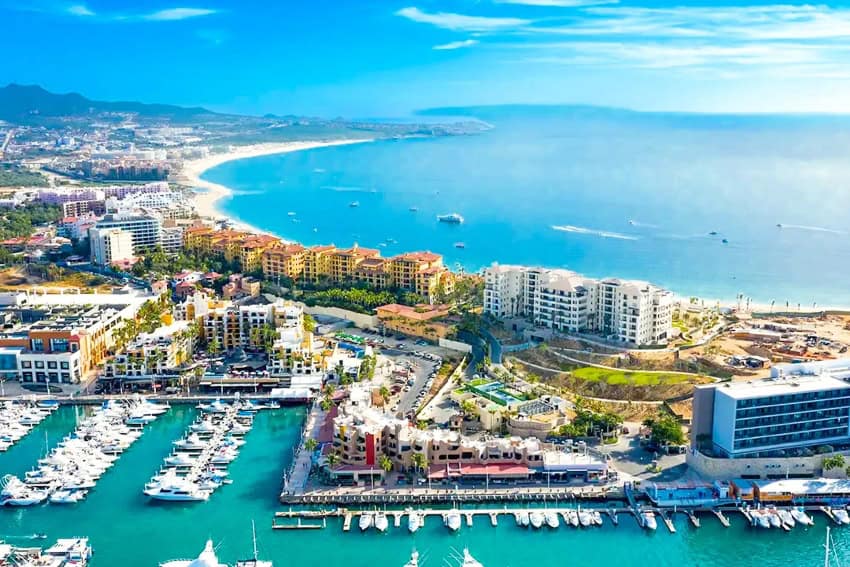
In May, Mexico’s National Institute of Statistics and Geography (INEGI) reported that tourism had increased in the country by 11.9% in March. This despite the high-profile death of CJNG cartel leader Nemesio “El Mencho” Oseguera Cervantes during a Feb. 22 military operation in Jalisco, an event that set off a firestorm of retaliatory blockades, car burnings and other arson attacks; images that were widely disseminated in the U.S.
The figures made no sense at the time of their release, because it was already clear that international air arrivals were down. In fact, they’ve continued to plummet ever since in many of Mexico’s most notable tourist destinations. INEGI didn’t lie. But their numbers suggested a false narrative: that tourism was still thriving.
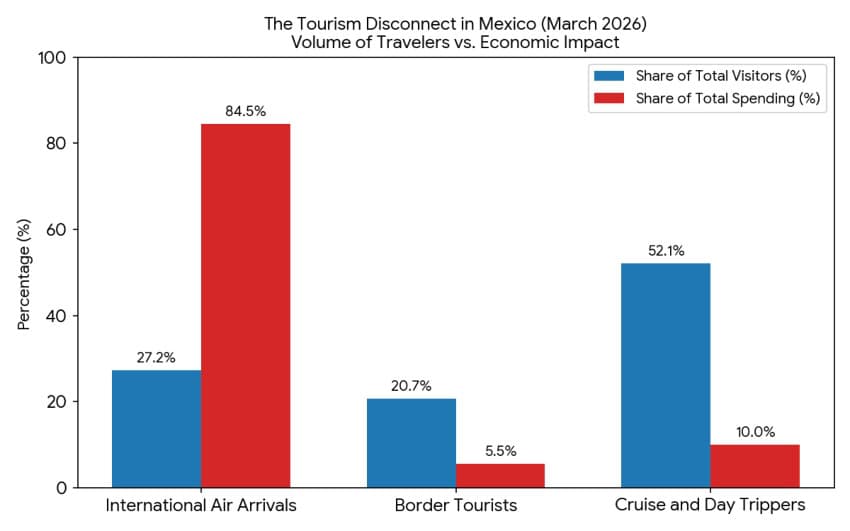
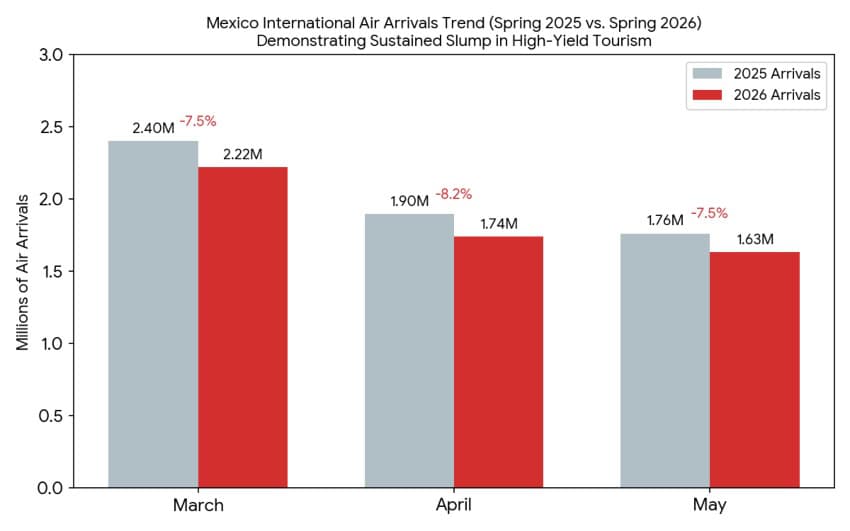
What actually happened in March is that it was a banner month for border-crossing daytrippers and cruise ship passengers in Mexico; or “short-timers.” But among the tourists who actually matter most in terms of significant economic impacts — the 27% of international air arrivals who contributed 84% of all tourism dollars during the month — their numbers dipped by 7.5% in March relative to the same month in 2025, and that trend is ongoing.
The slump in international visitors
International air arrivals were down 8.2% in April and 7.5% in May. That’s nationwide, and although June did give a World Cup bump to host cities in Mexico — Guadalajara, for example, saw an 11.9% bump in June — in major resort destinations like Los Cabos, Puerto Vallarta and Cancún, the downward slide continues.
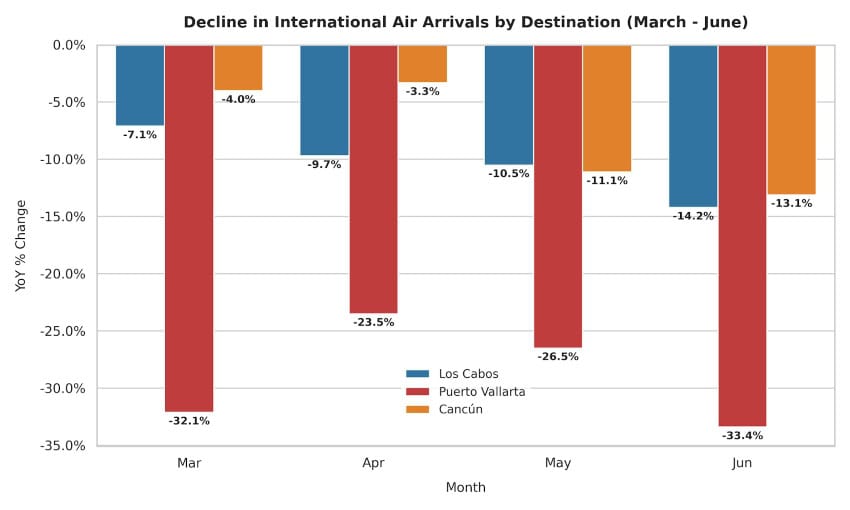
Los Cabos, since posting mild gains in international arrivals in January and February (2.6% and 4.2%, respectively), has seen its numbers decrease month over month: by 7.1% in March, 9.7% in April, 10.5% in May and 14.2% in June.
In Puerto Vallarta, site of arson attacks in the wake of the “El Mencho” killing in February, the high-value tourism situation is even more dire. International arrivals dropped by 32.1% in March, 23.5% in April, 26.5% in May and 33.4% in June.
Cancún, the country’s most popular resort destination, has seen the same troubling trend, albeit to a slightly lesser extent, with international air arrivals falling by 4% in March, 3.3% in April, 11.1% in May and 13.1% in June.

Why tourism is down in Los Cabos
Of course it’s simplistic to link this downward spiral in international air travelers to Mexican resort destinations solely to cartel-related arson attacks being shown on American network television. But yes, it’s a factor, admitted Rodrigo Esponda, managing director of the Los Cabos Tourism Board (FITURCA), in a recent interview with Sudcaliforniano.
In the case of Mexico generally and Los Cabos specifically, however, he pointed out two other contributing factors to the dwindling numbers of tourists. “The geopolitical context, where the cost of jet fuel has increased, has impacted the cost of air travel, and this has led to a decrease in travel by Americans,” he noted, while also acknowledging Los Cabos’ own terrible moment in the media spotlight after the hit-and-run accident that injured 17 during World Cup celebrations, and resulted in the death of the driver following his beating by the crowd.
The trend from a nationwide perspective
Bad press, as Esponda highlights, has certainly been part of the overall trend of fewer Americans flying to Mexico since March. And since Americans make up 60% of all tourists to Mexico, any shift in consumer behavior has consequences for Mexico’s travel industry as a whole.
But other reasons are driving this trend, too, from inflation to a “strong” peso relative to the dollar. There are also U.S. airline capacity cuts, a response to the rise in jet fuel prices that Esponda referenced. In May, Delta axed service from Seattle to Cancún, Los Cabos and Puerto Vallarta. Southwest has cut 11 international flights this year, including Baltimore, Chicago and Indianapolis to Los Cabos; St. Louis to Puerto Vallarta; and Chicago, Colorado Springs and Milwaukee to Cancún.
Alaska Airlines has also announced it’s dropping flights from its schedule, including the Las Vegas to Los Cabos and Puerto Vallarta routes, and the Los Angeles to Cancún route.
What the summer tourism doldrums look like in downtown Cabo San Lucas and San José del Cabo
It’s not just the shrinking number of international tourists that are increasingly making Cabo San Lucas and San José del Cabo feel like ghost towns. As I’ve noted before, the rising popularity of all-inclusive hotels across the hospitality industry has also played a significant role in squeezing downtown bar and restaurant owners.
In San José del Cabo, “Thursday is the only day with consistent activity, driven by the traditional Art Walk,” Edgar Román, vice president of membership for the local Chamber of Commerce, recently told the Gringo Gazette. “From Friday through Wednesday, businesses experience a considerable decline in customer traffic.”
Unfortunately, Art Walk ended in June, so even Thursdays look bleak until the popular seasonal activity resumes in November. Restaurant sales are down an estimated 35% in Los Cabos across the industry, although some have done better, relatively speaking, than others.
“We’re down 30% for this year,” the owner of a perenially popular downtown restaurant in Cabo San Lucas told me, “and we were down last year, too.”
“We are all doing our best to maintain sustainable working conditions for our staff until things improve,” said Román, who is also executive chef and owner of Don Sánchez. “We know this isn’t a great season for anyone, and we’ve had to rely on savings to weather the slowdown.”
From bad to worse
But there’s only so much you can rely on savings before they run out. More than 20 restaurants have closed locally since last year, among them long-standing favorites like Pancho’s, Lorenzillo’s Lobster House and Alcaravea Gourmet.
As for the Los Cabos Tourism Board, after seven years of publishing monthly data on tourism statistics, it has not published anything since February. That’s when you know things are bad.
Chris Sands is a writer and editor for Mexico News Daily, and the former Cabo San Lucas local expert for the USA Today travel website 10 Best and writer of Fodor’s Los Cabos travel guidebook. He has also contributed to numerous other websites and publications, including The San Diego Union-Tribune, Marriott Bonvoy Traveler, Forbes Travel Guide, Porthole Cruise and Travel, and Cabo Living.