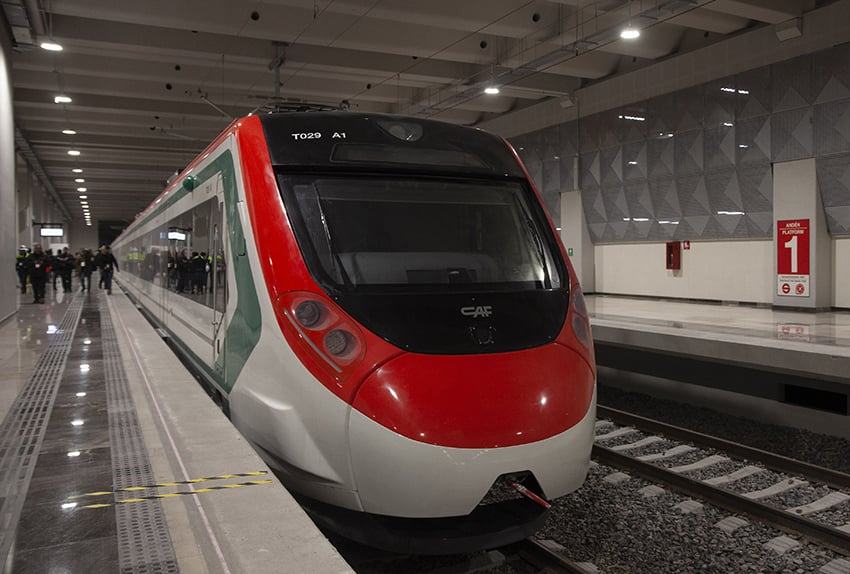
The long-awaited train to the Felipe Ángeles International Airport (AIFA) should be operational in time for Holy Week next year, President Claudia Sheinbaum declared after examining the final 23.7-kilometer stretch of the railway line.
Sheinbaum was given a tour of the Lechería-AIFA section of the route on Sunday by Andrés Lajous, the director of the Railway Transport Regulatory Agency, visiting the six stations and the AIFA terminal, while also taking the first test ride.
Primer viaje en tren de Lechería al Aeropuerto Internacional “Felipe Ángeles”. Iniciamos la etapa de señalización y pruebas; muy pronto, todas y todos nos subiremos al tren. pic.twitter.com/EgY36aTO9U
— Claudia Sheinbaum Pardo (@Claudiashein) December 21, 2025
In a social media post, Sheinbaum shared video footage of the experience and said the signaling and testing stage had just gotten under way.
While three pedestrian bridges are currently under construction, Sheinbaum said the new line should be ready for public service before the end of the first quarter of 2026. Holy Week is from March 29 through April 5.

The final stretch of the train line will link the Buenavista station in Mexico City with AIFA, allowing passengers to travel the 30-kilometer distance in 43 minutes. The airport is located near Zumpango, México state.
Originally presented in 2020, completion of the project has taken three years longer than expected. Then-President Andrés Manuel López Obrador had announced the new train would be ready just a few months after AIFA was inaugurated in March 2022.
Ten months ago, Sheinbaum said the train line would be ready in July but construction lagged for a variety of reasons.
Additional infrastructure projects were required, Sheinbaum said Sunday, especially to make improvements to the living conditions of the surrounding population and some right-of-way adjustments were necessary.
“Some homes had to be relocated … several people were even given new housing,” she said.
Once operational, trains will depart every 15 minutes, with an average operating speed of 65 kilometers per hour and a maximum design speed of 130 km/h. Each of the 10 trains has a capacity for 719 passengers and will be utilized on a rotating basis. Seven trains will operate simultaneously, two will be in reserve, while the 10th will undergo maintenance.
In addition to connections with the Buenavista-Cuautitlán Suburban Train, the new line will feature connections with Line B of the Mexico City Metro, with Lines 1, 3 and 4 of the capital’s Metrobús and with the Mexibús in México state.
Operating hours will be from 5:00 a.m. to 12:30 a.m., and will eventually use a standardized payment system using the Mexico City transport system’s integrated mobility card.
The cost of the trip remains under consideration.
With reports from Expansión Politica, Animal Político and Imer Noticias