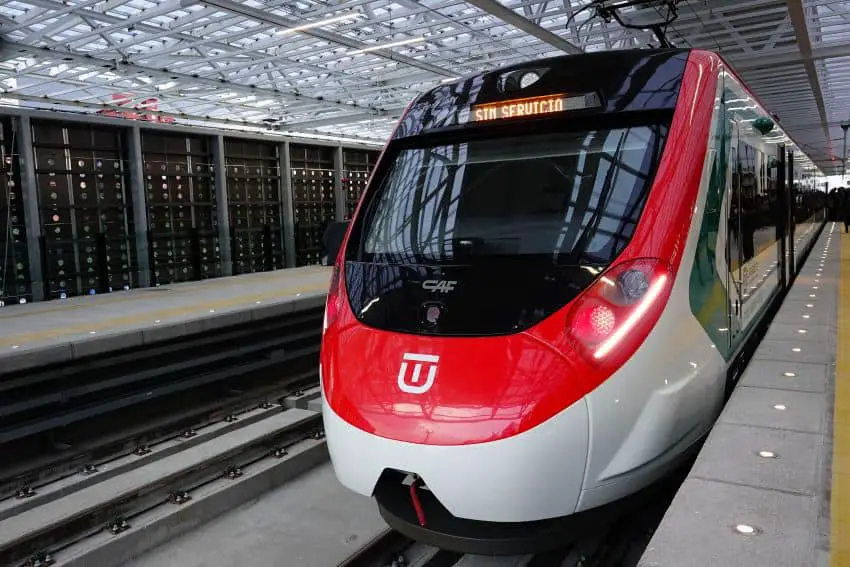
President Andrés Manuel López Obrador and President-elect Claudia Sheinbaum inaugurated the Lerma-Santa Fe stretch of the Mexico City-Toluca commuter train on Saturday, 10 years after construction commenced.
The first leg of the journey, which takes passengers from Zinacantepec to Lerma, México state, began operations in September 2023.
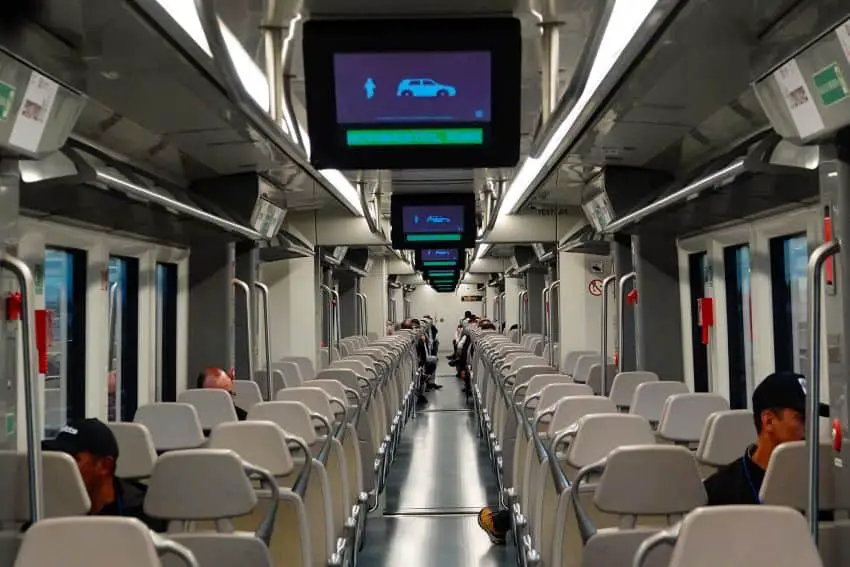
López Obrador, joined by Sheinbaum and México state Governor Delfina Gómez, embarked on a journey from the Zinacantepec station to the Santa Fe station in Mexico City at 4:40 p.m. on Saturday. The inaugural journey took 50 minutes compared to the 1.5 hours it takes by car.
The Lerma-Santa Fe stretch is the longest segment of the route, spanning 20 kilometers and bringing the total length to 49 out of the planned 57.7 kilometers. The journey between these stations is intended to take roughly 20 minutes at 80 kilometers per hour.
Despite being open to the public, a video shared on social media shows unfinished work at the Santa Fe station.
When will the CDMX-Toluca train be finished?
According to López Obrador, the remaining Section 3 of the commuter train, from the Santa Fe station to the Observatorio station will be completed by the end of 2024, under the government of Claudia Sheinbaum. With the Santa Fe station now open, only two stations remain to be completed.
Once completed, the train known as “El Insurgente,” will connect the Metropolitan Area of Toluca in México state with western Mexico City. It expects to serve 230,000 users per day, spanning a total length of 57.7 kilometers with 7 stations (2 terminals and 5 intermediate terminals).

Inauguramos la estación Santa Fe del Tren El Insurgente que comunica al Estado de México con la Ciudad de México. El tramo de la estación Lerma a la alcaldía Cuajimalpa transportará a más de 200 mil pasajeros al día.
El mayor reconocimiento es para las y los trabajadores de la… pic.twitter.com/A7s7Ao8svO
— Andrés Manuel (@lopezobrador_) September 1, 2024
Where are the train’s stations?
The El Insurgente is comprised of the following stations.
Section 1 is limited to the greater Toluca area. It spans 36 kilometers and features four stations: Zinacantepec, Toluca Centro, Metepec and Lerma.
Section 2 is primarily a 4.6-kilometer tunnel through the Sierra de las Cruces.
Section 3 is a 17-kilometer stretch running through western Mexico City and stopping at three stations: Santa Fe, Álvaro Obregón and Observatorio, with connections to Mexico City’s Metro, the local Metrobús and its passenger bus terminal.
How much will it cost to ride the train?
The transportation system announced an inaugural fare of 60 pesos for the Zinacantepec to Santa Fe trip. The regular price will be 90 pesos.
Fares for the commuter train will depend on users’ starting point and destination. Users can access El Insurgente with the city’s Integrated Mobility Card.
Why has construction of the train been delayed?
Construction on the rail line began in 2014 during Enrique Peña Nieto’s administration. While it was initially expected to be finished in 2017, it has been plagued with delays, including deserted tenders, accidents during construction and budget constraints. Community resistance to parts of the track also created setbacks.
The delays have pushed the train’s cost up 241% from 36 billion pesos (US $1.8 billion) to 123 billion (US $6.21 billion).
With reports from Infobae, La Jornada, El Financiero and Plaza de Armas