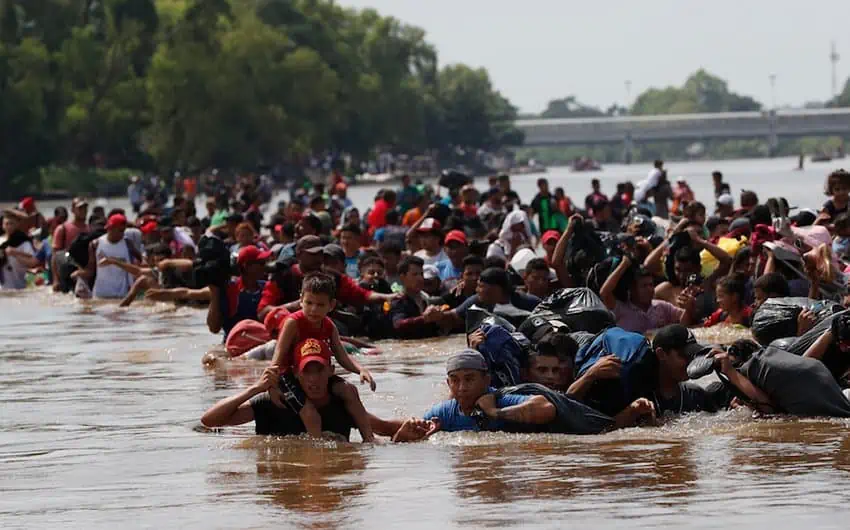
A Honduran migrant was killed yesterday after allegedly being shot in the head with a rubber bullet during a clash with Mexican police at the southern border.
The death of 26-year-old Henry Díaz Reyes occurred as a group of migrants launched an assault on a border barrier that prevented them from entering Mexico via a bridge across the Suchiate river between Guatemala and Chiapas.
Migrants threw rocks and used sticks against the police after they toppled the metal barricade. Police responded with the use of tear gas which was effective in dispersing the migrants.
The latter also threw rocks at a Black Hawk helicopter that hovered above the scene.
In a video of the clash, migrants can be heard shouting “they’re shooting, they’re shooting!” after explosions ring out.
Guatemalan firefighters later confirmed that Díaz had been killed by a blow to the head.
Mexican authorities rejected the migrants’ claim that he was shot by Federal Police, who have been deployed to bolster security in the southern border region as Central American migrants fleeing poverty and violence continue to seek entry to Mexico en route to the United States.

Interior Secretary Alfonso Navarrete Prida told a press conference yesterday that police deployed to the border didn’t have firearms or any weapons that could fire rubber bullets.
The migrants, however, did have weapons, including guns and Molotov cocktails, Navarrete charged.
“The Mexican government rejects the acts of violence on the border with Guatemala, and reiterates that the only way to enter Mexico is to obey immigration laws,” he said.
Today Navarrete said there is information indicating that criminal groups have penetrated the caravan. Further information is expected from Guatemala authorities regarding what firearms they have and what their intentions are. They have evidence of individuals preparing molotov cocktails, leading to speculation that there might be additional violent incursions at the border.
Prior to yesterday’s clash, the caravan broke through a Guatemalan police barricade, responding to the use of tear gas with whatever objects came to hand.
They then asked Mexican officials to give them temporary permission to enter the country and travel north.
But immigration officials insisted that they enter by the rules so as to be processed by agents.
Three hundred migrants were permitted entry but many more remained on the Guatemalan side of the border last night.
This morning, several hundred tried to cross the Suchiate river to enter Mexico but were blocked by Federal Police, the Associated Press reported.
More continued to make the attempt this afternoon. Hundreds of men, women and children were intent on crossing at shortly after noon while Federal Police officers waited on the other side.
Agency reports indicated that some were carrying molotov cocktails.
Meanwhile, the first caravan of migrants arrived today in Santiago Niltepec, a town in Oaxaca’s Isthmus region located about 58 kilometers from the city of Juchitán.
The mayor of Zanatepec, where the caravan stayed last night, said the community had organized vehicles to help transport the migrants.
“We are helping our brothers from other countries with food, water, and transportation,” Ramiro Nolasco said. “It is going to be very little, compared to what they need.”
The municipality itself provided 20 of its vehicles, from police patrol cars to ambulances.
President Peña Nieto announced a program Friday called “Estás en tu Casa” (You are at Home), offering shelter, medical attention, schooling and jobs to the Central American migrants on the condition that they formally apply for refugee status with the National Immigration Institute (INM) and remain in either Chiapas or Oaxaca.
Navarrete Prida said yesterday that 1,895 migrants had applied for refugee status and that temporary identity numbers, which allow for residence and employment, had been issued to more than 300 people.
Most migrants, however, remain determined to reach the Mexico-United States border where they intend to apply for asylum despite U.S. President Trump’s threats against the caravan.
“Many Gang Members and some very bad people are mixed into the Caravan heading to our Southern Border,” Trump wrote on Twitter today.
“Please go back, you will not be admitted into the United States unless you go through the legal process. This is an invasion of our Country and our Military is waiting for you!”
United States officials said today that the military is preparing to send around 5,000 additional troops to secure the country’s southern border. The deployment is expected to start on November 5.
Source: Milenio (sp), Associated Press (en)