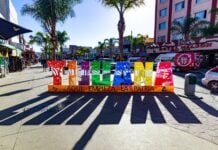
For most of the Baja California peninsula, a white Christmas is but a dream. It’s downright warm in Los Cabos, for instance, where the average temperature on the holiday is 82 degrees Fahrenheit. In La Paz and Loreto, it’s a little cooler, but still in the 70s, while Ensenada, Mexicali and Tijuana all enjoy temperatures in the 60s, on average.
But there are a few places where it does snow, with the mountain range of San Pedro Mártir being the most likely to see snowflakes during the holiday season. During winter storms, the temperature can even drop below zero. Home to the highest peak on the peninsula, Picacho del Diablo, at over 10,000 feet in elevation, and an astronomical observatory at over 9,000 operated by Institute of Astronomy as the Universidad Nacional Autónoma de México (UNAM), it’s not only possible that there’s a white Christmas in San Pedro Mártir, but that Santa’s sleigh is sighted by the observatory’s high-powered telescope in the skies above.

Indeed, since San Pedro Mártir is also the oldest national park in Baja California, and is home not only to bighorn sheep and California condors, but also mule deer, it’s also possible in the event of a reindeer emergency that Santa could source a somewhat appropriate replacement.
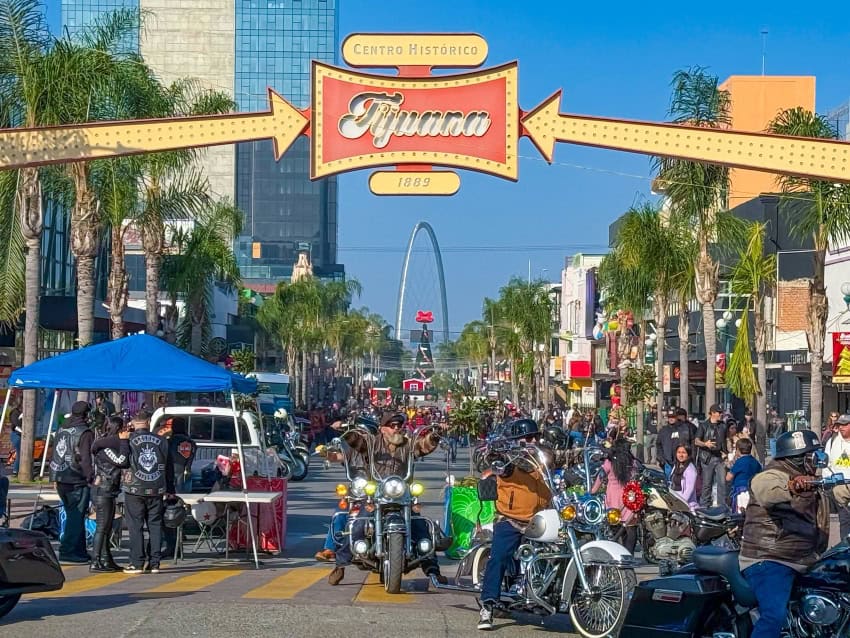
But let’s be clear. In Tijuana, the “Gateway to Mexico” and the most populous city on the 760-mile-long Baja California peninsula, no one waits for Santa Claus. The children there don’t look for sleighs, but for men on Harley-Davidsons.
Outlaw bikers deliver toys in Tijuana
The Solo Ángeles motorcycle club was founded in Tijuana in 1959 by a former member of the Hell’s Angels. But as a member of the club once noted as a distinction: “Far from being ‘Hells Angels,’ they are ‘Only Angels.’”
That’s certainly true when it comes to giving away toys to disadvantaged children for Christmas. Since the mid-1980s, the Solo Angeles have organized an annual Tijuana Toy Run. This year marked the 40th anniversary of the event, with 5,000 toys delivered to kids after some members of the club, along with many motorcyclists from the U.S., caravaned to Avenida Revolución in the heart of downtown Tijuana.
Some 2,000 motorcyclists were part of the caravan this year. Through the decades, the number of toys delivered has probably been in the hundreds of thousands, a testament to the long-running charitable commitment of the club as well as to other participating motorcyclists from Tijuana and Southern California.

“We wish all the children of Tijuana the very best, and we will always be here participating and doing our part, as people should,” Jesús Moreno, the president of Solo Ángeles, told La Jornada.
The Baja California peninsula’s food angels
In addition to charitable organizations for gift giving, there are also many around the Baja California peninsula whose mission is to ensure everyone has enough to eat, and not just for the holidays either. This is a year-round commitment.
Each organization has its own story. For Feeding Los Cabos Kids (FLCK), it began with a single traveler. When Donna Brnjic visited Los Cabos in 2004, she immediately noticed that beyond the touristy areas of the destination, many children seemed to be hungry. Her solution was to take $100 and buy as much food as she could, which she then handed out.
Fast forward two decades, and FLCK is a non-profit ministered by Cabo Church, with 14 community kitchens serving some 20,000 meals monthly. The overhead of such an endeavor has become enormous — it costs US $24,000 per year to fund one kitchen — but thanks to generous donations (yes, donating is tax-deductible) and the work of volunteers, FLCK continues with its good work.
The same could be said for Alianza para la Seguridad Alimentaria (The Alliance for Food Security), headquartered in La Paz, although it operates on an even larger scale: feeding 80,000 people per month through its network of 90 independent community kitchens. This non-profit organization was founded in 2013 to address food insecurity in Baja California Sur. It does so, in part, through its Banco de Alimentos Sudcaliforniano, which utilizes food banks to distribute food to community kitchens located in poorer areas of the state.
In addition to donations, much of the food is recovered from hotels, supermarkets and restaurants. It’s food that is still good, but would be wasted were it not donated.
Seasonal blessings at peninsular churches
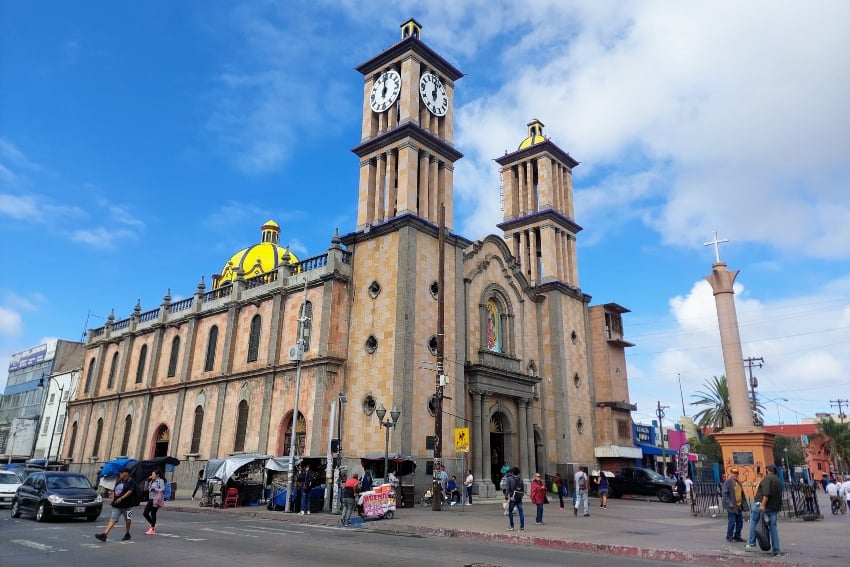
As in the rest of overwhelmingly Catholic Mexico, the holidays are a busy time at regional churches, from El Día de la Virgen de Guadalupe on Dec. 12 to El Día de Reyes on Jan. 6. The Baja California peninsula also offers some beautiful and historic churches to accompany the spiritual grace, from Tijuana’s Santuario de la Virgen de Guadalupe in the north, with its origins in the late 19th century, to Parroquia Misión de San José del Cabo in the south, which is related only in spirit to the city’s historical mission, but pays tribute with a tiled mosaic portraying the martyrdom of Jesuit missionary Nicolás Tamaral in 1734.
It should be noted, however, that the peninsula is welcoming to visitors of all religious persuasions — with the houses of worship to prove it — and to those with none at all. Churches representing many Protestant denominations may be found, for example, as can Jewish synagogues, Muslim mosques and even Buddhist temples.
Which is to say, there are no prerequisites for visitors, other than an open mind, an open heart and an appreciation for the spirit of the season.
Chris Sands is the former Cabo San Lucas local expert for the USA Today travel website 10 Best and writer of Fodor’s Los Cabos travel guidebook. He’s also a contributor to numerous websites and publications, including Tasting Table, Marriott Bonvoy Traveler, Forbes Travel Guide, Porthole Cruise, Cabo Living and Mexico News Daily.