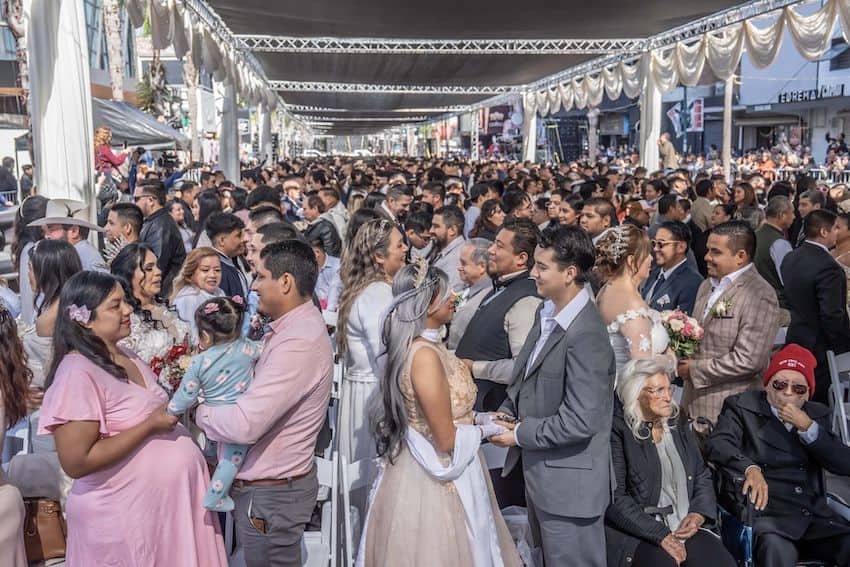
Approximately 10,000 couples got hitched on Saturday during collective wedding ceremonies in states across Mexico.
The states of Nuevo León and Mexico City led the way with 2,500+ and 2,378 partners tying the knot in their respective Valentine’s Day events.
Nuevo León Governor Samuel García and his wife Mariana Rodríguez witnessed the union of more than 2,500 couples in a ceremony held at the Nuevo León Gymnasium in the state capital of Monterrey.
During a brief speech, García emphasized the importance of marriage as “a life project based on companionship, respect, and commitment,” and affirmed that the state’s growth is a reflection of the daily efforts of its families.
In Mexico City, Mayor Clara Brugada told those assembled in the National Auditorium that her government supports those who “decide to build a life as a couple based on equality, respect and autonomy.”
“Today, 2,378 couples decided to unite their lives in this collective marriage … This government, like you, believes in the value of publicly declaring your love,” she said. “We believe in a loving city of rights.”
View this post on Instagram

Elsewhere, 1,900 couples tied the knot in the state of Baja California, nearly 1,000 “exchanged vows” in México state and more than 500 got hitched in the state of Jalisco. Major cities in Oaxaca, Quintana Roo and elsewhere also took part, ratifying between 50 and 400 marriage certificates stamped Feb. 13 and 14.
Popularity of ‘collective weddings’ in Mexico
Only civil marriages are recognized by the government in Mexico, but the process can be time-consuming (filing of identification documents and providing up to four witnesses) and expensive.
Some estimates suggest that more than 50% of couples living together in Mexico do not have documented marriages. The national statistics agency INEGI reported last year that there are 5.4 marriages per 1,000 adult residents nationwide, while in Mexico City, there are only 3.4 marriages per 1,000 adult residents.
View this post on Instagram
Collective weddings are organized by individual state and municipal Civil Registry offices to address this issue by providing a free official civil procedure and formally regularizing marriages. Additionally, a regularized marriage is beneficial for a couple’s children, allowing both parents to secure access to government services.
These events take place throughout the year. For instance, the state of Chihuahua will host a mass wedding on Feb. 19, the state of Coahuila will do the same on Feb. 27 and the state of Aguascalientes will celebrate a collective wedding ceremony on March 27.
Typically, participating couples are required to submit all official documents (e.g., birth certificates, proof of local address, legal ID) and register ahead of time.
Although there is no documented “first” collective wedding celebration in Mexico, such events have grown in popularity over the last 20 years, particularly as a way to provide free and legal certainty to spouses.
With reports from Excelsior, Reporte Indigo, Punto Norte, La Crónica de Jalisco, El Universal and El Heraldo de México