The government finally admitted what it had denied for weeks: The oil that began washing up along 700 kilometers of Gulf of Mexico coastline in February did indeed originate from Pemex facilities.
An official investigation revealed that a leak had been detected in early February, but was deliberately hidden by operational divisions within the state-run oil company.
As a result of Pemex’s internal analysis of the events, three high-ranking company officials were fired and a complaint was submitted to the Federal Attorney General’s Office to determine criminal liability.
When complaints by fishermen and residents of Veracruz about oil slicks in the Gulf and tar balls washing up on shore became public in early March, Pemex issued a statement saying that “after conducting technical inspections at our facilities, no leaks or spills have been detected.”
The official narrative — voiced by President Claudia Sheinbaum and Veracruz Governor Rocio Nahle (a former Energy Minister) — pointed to a private vessel and even natural seepage as possible causes.
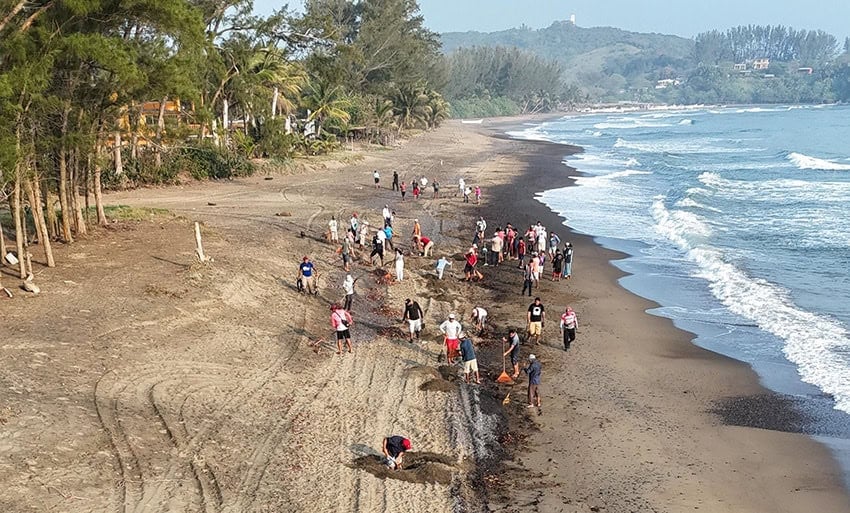
While the federal government and state authorities fought to contain the oil slick and clean up the nearly 700 kilometers of despoiled Gulf Coast beaches ahead of the busy Holy Week holiday season, environmental organizations and independent reports criticized the official denials.
In late March, environmental organizations brandishing satellite imagery accused the government of covering up the disaster, mismanaging the response and stalling the official investigation required by law.

Sheinbaum responded by minimizing the damage and criticized the NGOs’ report as “unscientific.”
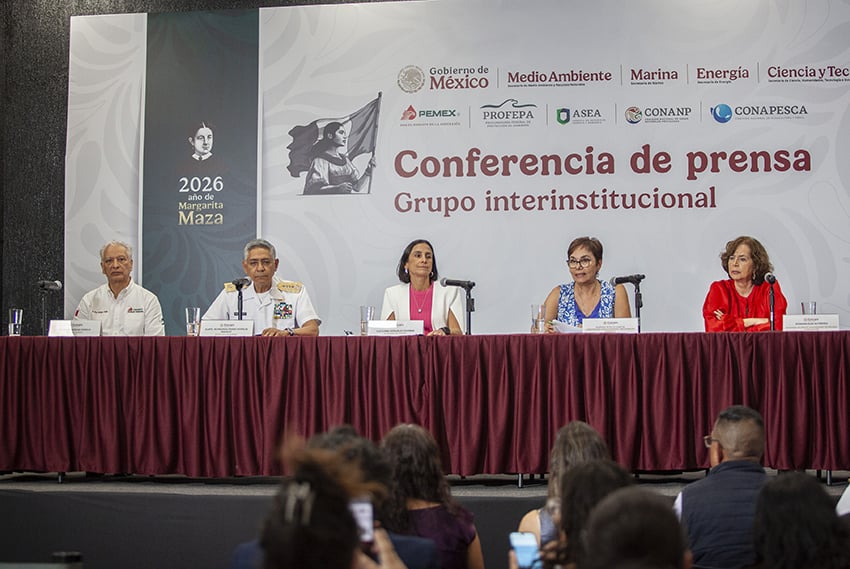
On Thursday, the Interinstitutional Group tasked with investigating the oil spill reported that Pemex had been able to confirm there had been a leak in a pipeline near the Abkatún complex in the Bay of Campeche on Feb. 6.
Pemex CEO Víctor Rodríguez — a member of the Interinstitutional Group — admitted that the leak continued for days before being contained and that a series of “operational irregularities” allowed the situation to worsen.
Did the government cover up February’s Gulf of Mexico oil spill?
Not only was the problem never reported to upper management, he said, it was “systematically denied” by the operational directors on site.
The discovery of the original leak — initially attributed to a tear in a pipeline — was followed by blunder after blunder that top management was only made aware of recently, according to Rodríguez.
Among the operational indiscretions identified by Rodríguez were:
- The loss of mechanical integrity of an oil pipeline, as well as the failure to report repair work to either general management or upper management
- The effort to conceal the documentation related to 350 m³ of oily water that had been captured by containment barriers
- Contradictory reports that indicated the issue was a simple “tearing” even as 11 company vessels were deployed to contain, recover and disperse hydrocarbons
- The decision to not immediately stop the flow in the pipeline, which contributed to prolonging the duration and magnitude of the spill (The main valve was not closed until Feb. 14 even though overflights detected the spill eight days earlier)
Insisting on its commitment to transparency, accountability and environmental protection in a press release, Pemex said it has fired its deputy director of safety, occupational health, and environmental protection; the marine control coordinator; and the spill and waste leader over their roles in the disaster.
With reports from El Universal, Reforma, Animal Político and La Jornada