It’s easy to criticize the performance of the Mexican economy. The Economist magazine did so earlier this week with an article titled “Mexico’s broken economy,” complete with a picture of a man on a horse in front of a table with local beer bottles and Coca-Cola cans. It quoted a professor from Georgetown University in Washington, D.C., who said that the “unreliable supply of electricity is also constraining growth.” I have diligently read and always respected The Economist for nearly 30 years, but found this particular article to be intellectually lazy, superficial and incomplete.
I am by no means suggesting that the Mexican economy is performing at the level it should be — in fact, it is far from it. That being said, I had the opportunity in the past week to attend two separate large business conferences in Mexico City and left feeling upbeat, excited and optimistic.
My wife and I first started meeting with foreign ambassadors and foreign chambers of commerce in Mexico two years ago. It was near the end of both the AMLO and Biden presidencies, and the mood was somber. It was clear that commerce, especially with other countries, was not a priority for AMLO. Ambassadors told us that they stopped encouraging political and business leaders from their home countries to come to Mexico as there quite simply “was no interest from the government” to meet with, listen to or collaborate with foreign leaders. AMLO was clearly focused on Mexican domestic projects like the Maya train, the AIFA airport and the Dos Bocas refinery. He didn’t want to make time for foreigners.
On the U.S. side, I remember hearing the former U.S. ambassador, Ken Salazar, speak at a business meeting. An extremely affable person, he seemingly prioritized his relationship and support for AMLO and his initiatives over what the U.S. political and business community wanted and needed. He talked about how he had recently been to Oaxaca to see the building of the new train and highway projects there. He emphasized the growth and equality that this could bring to the poorer southern areas of the country. Don’t get me wrong, the domestic projects prioritized by AMLO are most certainly game-changing investments for the people living in those parts of the country. But their impact and results will be felt over decades, not years. They are simply not the kind of investments that can “move the needle” for the country in the short or even medium term.
Which brings me back to the meetings of this past week. The first one, the American Chamber of Commerce of Mexico annual meeting, began with a presentation by the new U.S. ambassador, Ron Johnson. Ambassador Johnson started affably enough, even speaking in Spanish for a bit, but then quickly got down to business. He switched to English and while remaining charming, rattled off the areas that the U.S. government was focused on that ultimately would, in his words, even further deepen the relationship between the U.S. and Mexico. His language wasn’t threatening like his boss President Trump’s oftentimes is. Rather, he was direct and crystal clear. Reducing the levels of violence, drug trafficking, human trafficking, cartel influence and unfair trade practices ultimately would be very good for both countries and very positive for the business community.
It felt a little bit like a parent lecturing a child. It hurt a little bit to hear the message, but you knew he was right. The tough love that the U.S. was giving to Mexico, in his telling, would make Mexico a better partner of the United States, and in turn make Mexico better. Now I understand that many people will be cynical upon hearing this, but it’s impossible to suggest that the levels of violence in Mexico have not been a significant drag on the people of Mexico, the business community and the economy as a whole.
At AmCham annual gathering, US ambassador to Mexico strikes optimistic note on USMCA

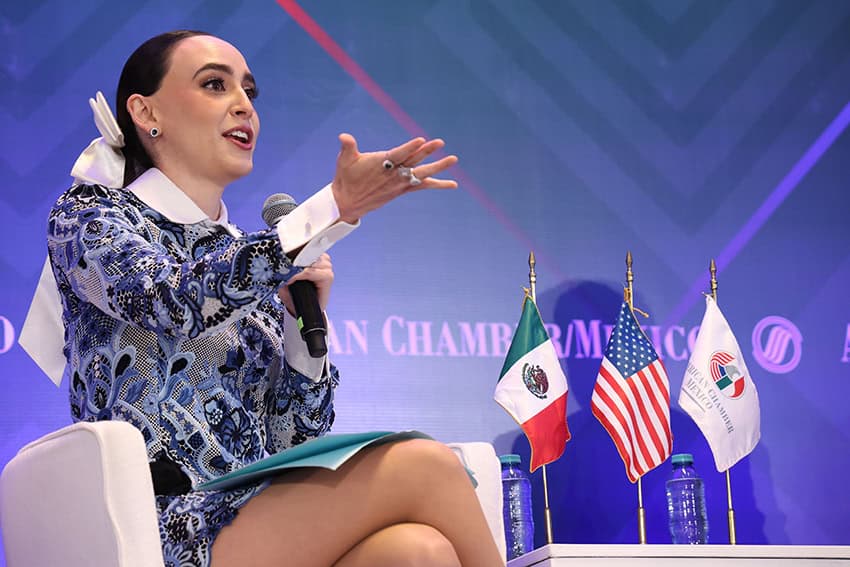
Next up was Altagracia Gómez, the 33-year-old Mexican businesswoman who leads President Sheinbaum’s Business Advisory Council, a group that provides vital input from the business community into government policy decisions. Altagracia was poised, calm and professional as she updated the audience on the progress of Sheinbaum’s ambitious Plan México initiative. She talked about roadblocks to progress and how they were going to overcome them. She talked about what the government was doing to accelerate approvals and better support the business community. As I listened to her give the update, I couldn’t help but think that I was witnessing the style and tone of a businessperson, not a politician. It was refreshing — inspiring really.
Just a few days later, I was invited to attend the first-ever Forum of Binational Trade Chambers in Mexico. Under the leadership of the Indian Embassy in Mexico and in close collaboration with Mexico’s Minister of the Economy, Marcelo Ebrard, a total of 23 chambers of commerce were brought together to form a new working group. The idea of the forum, as well as future meetings, is to work together to set common goals in support of the Plan México program. The goal is for the chambers to work in closer cooperation and collaboration to share best practices, lessons learned, and further enable growth of companies from their home countries in Mexico.
Minister Ebrard kicked off the forum with an update on the progress on the USMCA trade agreement between Mexico, the U.S., and Canada. He talked about the work done to improve trade relations with the European Union, Latin American countries and countries in the Middle East and Asia. Similar to Altagracia just days earlier, he had a calm, confident, optimistic tone. In a time of such global stress, his comments were reassuring. He emphasized and gave examples of how the government was working hard to improve the business climate in Mexico and working closely with the U.S. and other countries to do so.
Mexico has a long way to go to achieve its true economic growth potential. The per capita GDP of the United States — a measure of average economic output per person — is still an incomprehensible 6.4 times that of a person in Mexico. (For a point of reference, U.S. per capita GDP is 1.6 times larger than that of Canada). The previous administrations in both the U.S. and Mexico did not prioritize their business communities or trade between the two countries, and yet commerce still flourished. Both countries are now each other’s leading trading partners, and foreign direct investment is hitting record highs on both sides of the border. Just this week, two large multinationals committed to investing an additional US $1.5 billion in Mexico.
Government policy doesn’t move fast, but what I witnessed firsthand this past week in terms of engagement and commitment from the Mexican and U.S. governments, foreign embassies and chambers of commerce should go a long way towards helping bring some favorable animal spirits to the business community in Mexico. Let’s hope this positive momentum continues!
Travis Bembenek is the CEO of Mexico News Daily and has been living, working or playing in Mexico for nearly 30 years.