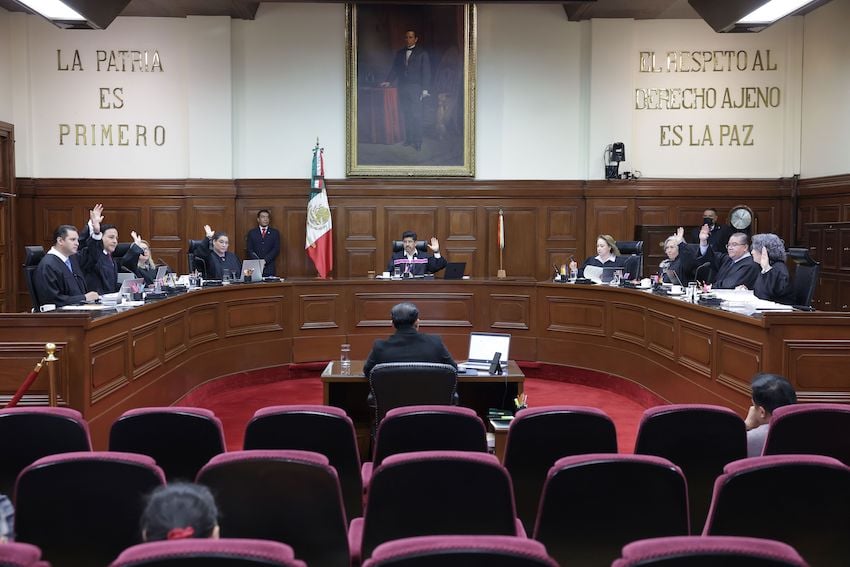
Mexico held its first-ever judicial elections last June, with citizens electing almost 900 judges, magistrates and Supreme Court justices who assumed their duties on Sept. 1.
President Claudia Sheinbaum asserted that the elections — the product of a 2024 judicial reform — were necessary to rid Mexico’s judiciary of corruption, nepotism and other ills.
But just over five months after the new judges were sworn in, Mexico’s court system is “in disarray,” and companies operating in the country are “increasingly steering clear” of it, Bloomberg News reported last Thursday.
The “in disarray” description, Bloomberg said, came from a dozen current and former judicial employees as well as business leaders.
The news agency’s Feb. 12 report depicts a court system plagued by backlogs and populated by inexperienced judges.
It refers to concerns about bias and incompetence in the new judiciary, and considers the impact of the status quo on investment at a time when Mexico is seeking to attract more foreign capital within the context of Plan México, an ambitious economic initiative that aims to make Mexico the world’s 10th largest economy by 2030.
‘Inexperienced judges, erratic rulings’ and ‘a newly politicized system’
Bloomberg reported that “companies operating in Mexico are increasingly steering clear of the courts, opting instead for arbitration or mediation as legal uncertainty clouds the country following a sweeping overhaul of the judiciary.”

“Others are rethinking investment plans altogether, wary of inexperienced judges, erratic rulings and what many see as a newly politicized system,” wrote the news agency, which didn’t mention any companies by name.

Bloomberg also reported that “decisions marred by glaring errors or perceived bias are discouraging companies from filing lawsuits, while some investments are being delayed or shelved amid doubts about whether contracts will be enforced.”
Longstanding concerns about the politicization of the judiciary due to the election of many judges seen as sympathetic to the ruling Morena party were heightened by an El Universal investigation that found that the “new” Supreme Court (SCJN) has handed down at least six rulings in favor of reforms and decrees promoted by former President Andrés Manuel López Obrador (AMLO).
Published last month, the El Universal report said there hadn’t been any SCJN ruling against reforms or decrees sponsored by AMLO or Morena lawmakers.
“Is that democracy? I don’t think so,” Javier Laynez, a former Supreme Court justice who resigned ahead of the controversial judicial elections, told Bloomberg.
“Is that an independent power? I don’t think so either,” he said.
Laynez: Businessmen are ‘extremely worried’
Bloomberg reported that “the growing unease over the courts” adds to Mexico’s challenges to attract investment. Insecurity, infrastructure bottlenecks, tariffs and trade uncertainty ahead of the USMCA review are already actual or potential hindrances to investment.
Laynez said that “businessmen don’t speak openly about” concerns related to legal instability as a result of the judicial reform, but added:
“Those I talk to are extremely worried. The reform weighs heavily on investor sentiment.”
Foreign direct investment in Mexico hit a record high last year, but other forms of investment have declined.
“The highly controversial reform of the judiciary and the perception of less independence in its rulings seem to have scared off investment, which is reflected in the decline in gross fixed investment,” Gerardo Trejo Veytia, vice president of sustainability at the Mexican Employers Federation (Coparmex), told Bloomberg.
The news agency reported that “Coparmex says investment levels are now as low as those seen during the pandemic.”

Bloomberg also noted that “a central bank survey of economists found that ‘lack of rule of law’ rose from third to second place between 2023 and 2025 among the main obstacles to doing business in Mexico, trailing only crime.”
Before she took office in October 2024, Sheinbaum said that investors had “nothing to worry about” with regard to the judicial reform. She has consistently defended the reform put forward by her predecessor and political mentor, and described last year’s judicial elections as a “complete success,” even though turnout was just 13%.
In late 2024, Sheinbaum said that Mexico was “perhaps” the most democratic country in the world given that it would hold judicial elections in 2025.
Asked last month whether she saw “any bias” toward Morena in Mexico’s Supreme Court, the president said that the SCJN itself would have to respond, before pointing to the openness of its decision-making.
Learning to be a judge on Zoom
Bloomberg reported that courts across Mexico “are struggling with resignations, backlogs and rulings that legal experts describe as deeply flawed, as inexperienced judges grapple with complex cases.”
Citing reporting from Expansión, Bloomberg noted that at least nine newly elected judges have resigned, most without giving a reason for their decisions.
“Those who have stayed are often scrambling to learn the basics,” the news agency wrote.
Alejandra Ramos, an experienced former judge who failed to win a position at last year’s judicial elections, has stepped in to try and fill the void in knowledge via the teaching of the aforesaid basics to newly-elected judges over Zoom, the videoconferencing platform.
Most of the judges-cum-students to whom she delivered “lectures fit for a second-semester law school course,” according to Bloomberg, were “complete novices” when they logged on for Zoom classes late last year, said Ramos.
María Emilia Molina, a former federal judge, is not at all impressed with the new judiciary.
“The rulings are now horrendous, the legal grounds no longer exist,” she told Bloomberg.
“There are judges who don’t understand anything about the cases and end up asking the lawyers to reach an agreement,” Molina said, highlighting that some of the judges used to be primary school teachers or political activists — albeit ones with law degrees.
The problem of inexperienced and incompetent judges is not likely to disappear even if the current crop of new judges manages to get up to speed, over Zoom or by other means, as a second round of judicial elections is scheduled for 2027.
SCJN defends the judiciary
In a statement to Bloomberg News, the SCJN said that “the assertion that there is a widespread lack of experience” within the judiciary “does not correspond to institutional reality.”
“The judiciary has evaluation and control mechanisms in place to ensure that those who exercise judicial functions do so with responsibility and professionalism,” added Mexico’s top court, which is led by Chief Justice Hugo Aguilar Ortíz.
The SCJN also told Bloomberg that it has “worked to strengthen legal certainty and ensure strict compliance with the constitutional and legal framework.”
According to Bloomberg, the court added that it “has promoted ‘unprecedented dialogue’ with business chambers to hear their concerns, with the aim of providing certainty for the development of the economy.”
Deputy Olga Sánchez Cordero, a Morena lawmaker and former Supreme Court justice who served as interior minister during AMLO’s presidency, told Bloomberg that extensive training is taking place to make sure new judges can perform their duties competently.
“A lot of training is needed. They’re studying hard,” said Sánchez, who served as a SCJN justice between 1995 and 2015.
She also said that “it will take time for the judicial reform to mature and produce results across the board.”
With reports from Bloomberg