The European Union gave the green light on Monday to a new trade pact with Mexico, just one week before their first bilateral summit in 11 years.
The European Council (EC), representing 27 member states, adopted two decisions authorizing the signing of the Modernized Global Agreement and the Interim Trade Agreement between the two parties. The Mexico-EU agreement negotiations began back in 2016.
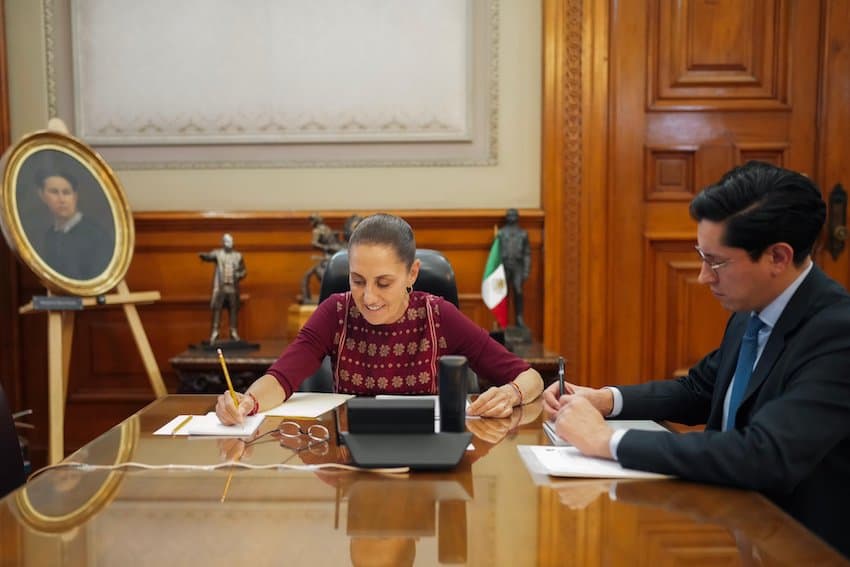
The agreement is expected to be signed during a summit in Mexico on May 22, to be attended by President Claudia Sheinbaum, European Council President António Costa and European Commission President Ursula von der Leyen.
Following the signing, all EU member states and Mexican states must ratify the agreement for it to enter into force.
“These agreements represent a fundamental step in modernizing the EU-Mexico partnership, replacing the existing framework established in 2000 and reflecting the evolution of bilateral relations towards a comprehensive strategic partnership,” the Council of the European Union stated in a press release.
Currently, Mexico is the EU’s second-largest trade partner in Latin America, while the EU is Mexico’s third-largest trade partner. Bilateral trade surpassed US $96 billion in goods in 2024 and nearly $31 billion in services in 2023.
The agreement is expected to benefit Mexican businesses by boosting market access by eliminating most remaining customs tariffs, improving access to public procurement markets and establishing investment and services opportunities.

The agri-food, machinery, pharmaceuticals and transport equipment sectors are expected to benefit significantly from the new rules.
According to the executive president of the Mexican Association of Automotive Distributors, Guillermo Rosales, the accord will open new doors for Mexico’s automotive industry.
“The agreement will allow both parties to be in a better position to confront the undeniable trend currently in place in the United States regarding restrictions on free trade, the imposition of tariffs, and, in general, obstacles to free trade as we knew it.”
It will also strengthen cooperation on critical raw materials and includes advanced rules on customs and trade facilitation, intellectual property protection, public procurement, digital trade and competition.
The agreement also addresses areas such as digital transformation, security and justice. It includes a comprehensive chapter on trade and sustainable development, with binding commitments on labor rights, environmental protection and climate action.
The new trade agreement is expected to benefit more than 45,000 EU companies that export to Mexico, most of which are small and medium enterprises (SMEs).
The EU and Mexico plan to maintain regular high-level dialogue on human rights, security and justice, as well as how to address, prevent and combat corruption.
With reports from El Economista, Expansión and CGTN