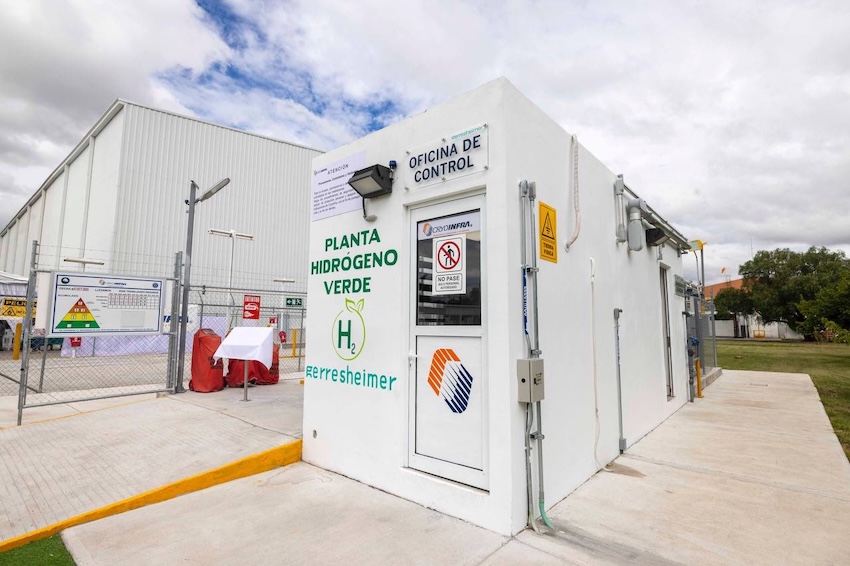
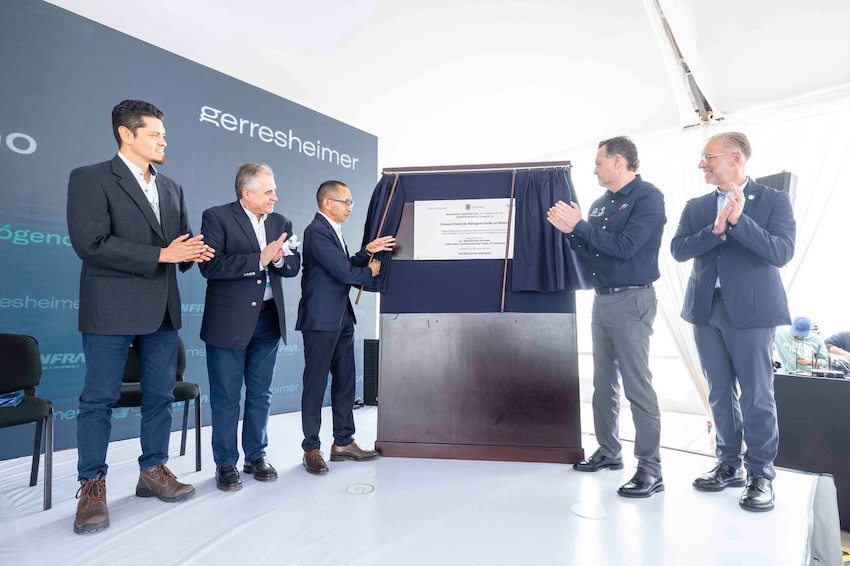
The central state of Querétaro, known for its emphasis on sustainable industry, has inaugurated Mexico’s first green hydrogen plant, the result of a partnership between a German and a Mexican company.
The project, teaming Gerresheimer, a German company already manufacturing in Mexico pharmaceutical glass used in packaging medications, and the Mexican company Cryoinfra, processors of cryogenic gases, required an investment of 100 million pesos (US $5.3 million). It seeks to reduce carbon emissions, strengthen the circular economy, and pave the way for new energy technologies.
Hydrogen is primarily produced through water electrolysis, in which hydrogen and oxygen molecules are separated. Unlike “gray hydrogen,” which is produced using traditional energy sources, green hydrogen uses electricity from clean sources such as solar or wind power, and is itself a clean energy source.
The new plant is located at the Gerresheimer complex, where the German company produces 2.6 billion units of pharmaceutical glass annually. According to the company’s general manager in Querétaro, José Antonio Vega López, it is the largest such manufacturing plant in the Americas.
The new green hydrogen plant is expected to support Gerresheimer’s production by producing 500 cubic meters of green hydrogen per day for the pharmaceutical glass forming process, replacing fossil fuels and reducing CO₂ emissions by 100 tons per year.
Not only will operational emissions be reduced to zero, but the new dual function plant ensures a smaller logistical carbon footprint since the hydrogen for the pharmaceutical glass manufacturing will already be at its destination.
Fernando Trejo Álvarez, regional subdirector of Cryoinfra, which developed and installed the electrolysis plant, said that this project helps to reduce emissions, diversifies the use of clean energy, “and sets a precedent for more companies in Querétaro and throughout Mexico to invest in green hydrogen.”

“We are pushing for more jobs and more investment, but in line with the protection of natural resources, which are becoming increasingly scarce,” Trejo added, as he noted that green hydrogen is one of the energies of the future.
Querétaro authorities say that philosophy applies to the state as a whole. “The energy we use comes from green sources, such as solar and wind, which sets us apart from other economies in the country,” state Sustainable Development Minister Marco Antonio del Prete Tercero said at the inaugural event, led by Querétaro Governor Mauricio Kuri.
Mexico is an optimal region for renewable energy production, the Mexican Association of Hydrogen, Storage, and Sustainable Mobility (AMH2) has said. This is due to its hydrogen production costs, which are 64% lower than in other countries. This favorable scenario has led AMH2 in collaboration with Mexico’s Ministry of Energy (Sener), to fund 18 clean hydrogen projects in an effort to reduce greenhouse gases and nurture a nascent green hydrogen industrial sector in the country.
With reports from El Economista, Cluster Industrial and AI Regula Solutions