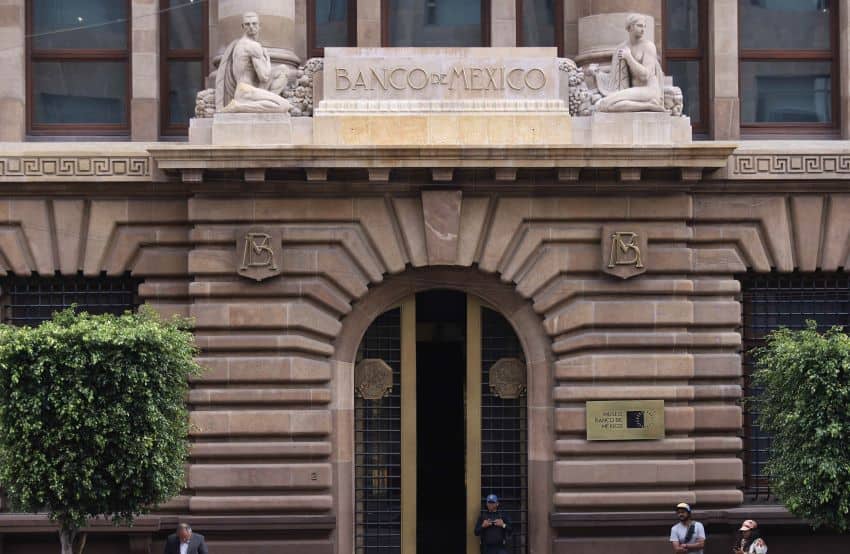
Mexico’s central bank slowed its pace of monetary easing Thursday, cutting its benchmark interest rate by 25 basis points after four straight 50-basis-point cuts this year.
Still, the 4-1 vote lowered the rate to a three-year low of 7.75%.
The decision to cut the rate by only 25 basis points was largely expected after the five-member governing board indicated that smaller reductions were likely.
Deputy Governor Jonathan Heath was the lone dissenter, voting to hold the interest rate at 8%, the second consecutive meeting in which he has voiced a preference for more caution.
The four straight 50-basis-point cuts that the central bank (Bank of Mexico or Banxico) had approved before Thursday’s meeting came after the overnight interbank interest rate sat at 10% before the bank’s February meeting.
News agency Reuters pointed out that Banxico is battling the twin challenges of lowering inflation while stimulating the economy. This represents a difficult balancing act as “weak economic growth and uncertainty tied to trade tensions and geopolitical developments” offset recent positive inflation news.

Official data released before the bank’s meeting showed inflation had slowed in July to 3.51%, its lowest level in nearly five years, as shrinking produce and energy prices offset acceleration in consumer goods prices.

In arguing to hold the interest rate at 8% last month, Heath had called for prudence, arguing that it was “unrealistic to expect inflation to fall on its own just because of stagnant economic forecasts.”
Mexico’s economy grew by 0.7% in the recently completed second quarter, following an anemic 0.1% mark in the first quarter. A Banxico poll indicates that analysts forecast growth of just 0.3% by year’s end.
Banxico’s post-meeting statement said the decision “took into account the behavior of the exchange rate, the weakness of economic activity, and the possible impact of changes in trade policies worldwide.”
In a research paper, BBVA banking group said the statement’s forward guidance “retained the strategic ambiguity introduced in June, reinforcing a data-dependent approach, with no explicit preference for the next move.”
While Thursday’s Banxico statement did suggest the board would consider rate changes going forward, it withheld specific language regarding future cuts that had been included in previous announcements.
BBVA said the absence of new language in Banxico’s statement suggests the Board of Governors will be cautious going forward, but that they “remain open to continuing the easing cycle, albeit at the current more gradual pace of 25 basis points.”
Inflation data will also influence future decisions. Although Thursday’s inflation news was positive, the outlook was mostly unchanged since core inflation remained high at 4.23%.
Banxico did adjust its forecast for headline (total) inflation in the third quarter, lowering it to 3.8% from 4.1%. However, the bank raised its forecast for Q3 core inflation (which excludes energy and food) from 3.8% to 4.1%.
Banxico’s next Board of Governors meeting is scheduled for Sept. 25.
With reports from Reuters, El Economista and El Financiero