Mexico received a mixed report from the Organization for Economic Cooperation and Development (OECD) this week, as the intergovernmental policy forum joined other recent prognosticators in lowering the GDP growth outlook for the rest of this year but boosting the forecast for next year from 1.7% to 1.8%
In cutting Mexico’s expected 2026 growth rate from 1.3% to 0.8%, the OECD cited economic policy uncertainty, trade tariffs and fiscal consolidation.
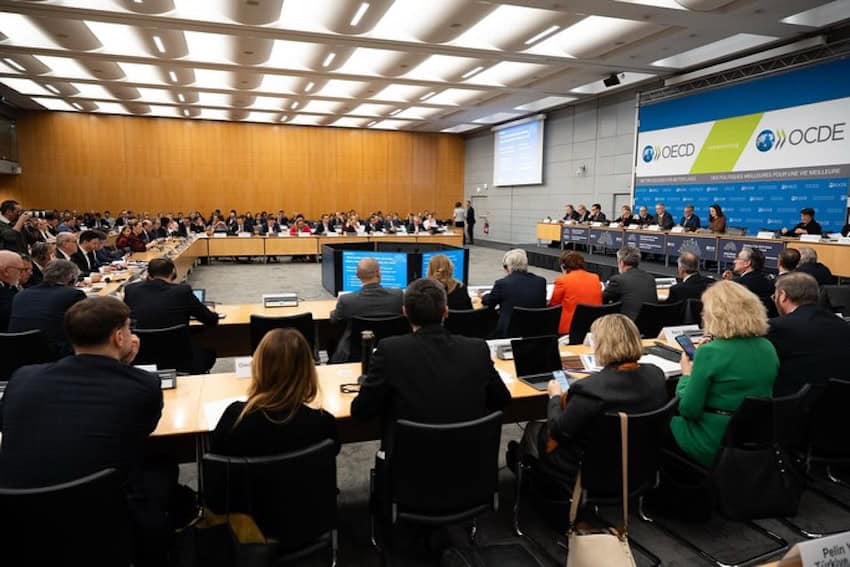
(OECD en español / Facebook)
The forecast was included in the OECD’s June Economic Outlook for Mexico, in which it projected that the Mexican economy will maintain moderate growth, supported mainly by domestic demand and private consumption, and favored by low unemployment.
It added that lower interest rates “will gradually boost private investment, but recovery will be gradual against a backdrop of persistent national and international uncertainty.” The forecast also sees inflation gradually moderating to 3.2% by 2027.
While the report acknowledged the solid growth that marked the end of 2025, it pointed out that Mexican economic activity weakened sharply at the beginning of 2026, registering a 0.6% quarterly contraction of gross domestic product.
The latest Economic Outlook represented a 0.5% reduction from the OECD’s previous forecast, issued in March. At that time, the organization suggested Mexico needed to continue reducing the fiscal deficit through good-faith measures on both the expenditure and revenue sides. It also advocated for the development of “a sound medium-term fiscal framework” to preserve fiscal stability.
The OECD also urges boosting revenues and improving the quality of public spending to “safeguard fiscal sustainability and create more room for productivity-enhancing public spending.”

Spanish economist Alberto González Pandiella, head of the Economic Department for Mexico at the OECD, told El Economista newspaper that the US-Mexico-Canada (USMCA) trade talks are critical for establishing economic certainty.
González said it behooves Mexico to extend the USMCA rather than accept an annual review process. A mandatory review is presently underway, the result of which could be a 16-year extension of the USMCA or a compulsory annual review process.
He said that while exports will continue to be resilient to regulatory, trade and USMCA uncertainty (and Mexico set a new record for exports last year), investments will be negatively impacted, especially if annual reviews are required.
But investments are the engine needed to boost greater economic growth in Mexico, González said, adding that “investment clearly continues to be hampered by external uncertainty, such as that related to trade, as well as by internal factors.”
González identified the controversial judicial reform of 2024 and the disappearance of autonomous federal agencies that were responsible for promoting and supervising the development of strategic sectors, such as energy and telecommunications, as domestic factors fueling uncertainty.
The OECD forecast also hinted at the necessity of addressing Pemex, the nation’s struggling oil company, which was cited by two credit agencies that downgraded Mexico’s sovereign rating last month. (In its statement announcing the reduction, Moody’s warned that “continued support for Pemex will continue to limit fiscal consolidation.”)
The OECD called for Mexico to increase the share of electricity generated from renewable sources so as to “accelerate decarbonization, strengthen energy security and enhance the country’s attractiveness to investors.”
With reports from Milenio, Infobae and El Economista