
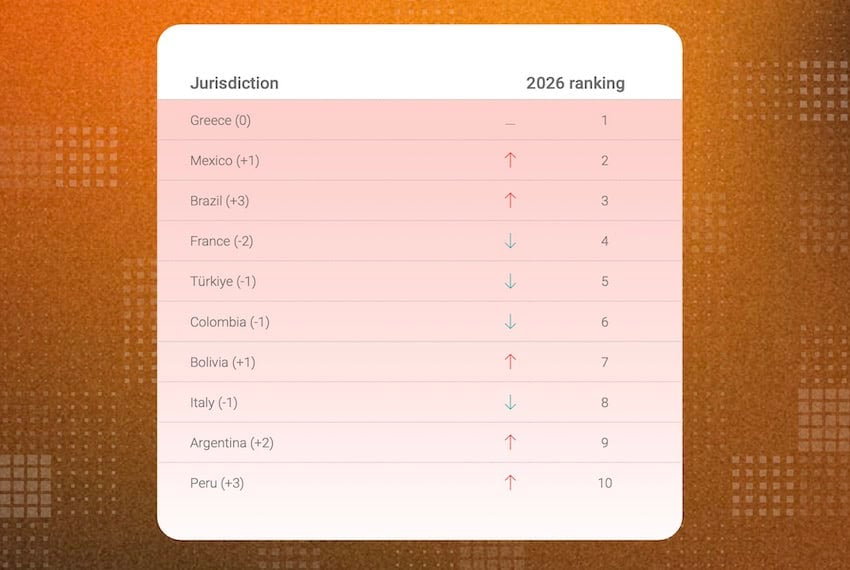
TMF Group, an administrative services provider, launched the 13th edition of the Global Business Complexity Index (GBCI) on Tuesday, ranking Mexico as the second-most complex country for doing business.
The GBCI analyses 81 jurisdictions representing over 90% of the world’s economy, ranking them from most (1) to least complex (81) for doing business. Based on 292 indicators per jurisdiction, the index assesses challenges businesses face across accounting and tax, entity management and human resources requirements.
“World political fragmentation and economic spread mean that businesses are adding jurisdictions to their supply chains, increasing the complexity of their governance,” wrote TMF Group’s CEO, Mark Weil, in the report. “It also means that they have to deal with more uncertainty in those regulations.”
“Investors seek simplicity, but above all, certainty in the rules they operate under. We encourage governments to improve their ranking by acting on both,” Weil added.
Top and bottom 5 jurisdictions in 2026 (1 = most complex, 81 = least complex)
- Greece
- Mexico
- Brazil
- France
- Turkey
- Netherlands
- Hong Kong, SAR
- Jersey
- Denmark
- Cayman Islands
Denmark, Hong Kong and the Netherlands have historically ranked as low-complex jurisdictions and remain in the bottom five this year, thanks to their stable, simple regulatory environments and robust digital infrastructure.
Several Latin American countries ranked among the most complex jurisdictions this year, with Mexico in second position, Brazil in third and Colombia in sixth.
Skill shortages are reshaping talent strategies globally, with around 80% of jurisdictions reporting difficulty in attracting and retaining talent, mainly in Europe and the Asia Pacific (APAC), according to the report. While current pressures are not as severe in North America as in other regions, it is the region with the highest increase in the perceived level of challenge.

Technology, on the other hand, is making doing business easier in APAC (86% said it was having a positive impact on administrative processes and compliance) and EMEA (81%), while South America (60%) and North America (71%) show lower rates of agreement.
What makes Mexico’s business environment highly complex?
TMF Group cited frequent regulatory changes, unpredictable administrative requirements, evolving digital requirements and unclear expectations by the tax authorities as the main reasons for Mexico’s high ranking.
While Mexican authorities are embracing digitalization, many procedures still require physical presence or wet-ink signatures. Nevertheless, the Sheinbaum administration has made strides toward simplification, such as the recent creation of a one-stop shop for foreign trade, which will soon integrate 132 administrative procedures into one.
Moving forward, TMF Group expects Mexico’s accounting and tax to undergo the most change, with an increased government focus on tax collection. The adoption of electronic accounting systems could also improve processes.
With reports from Globe Newswire