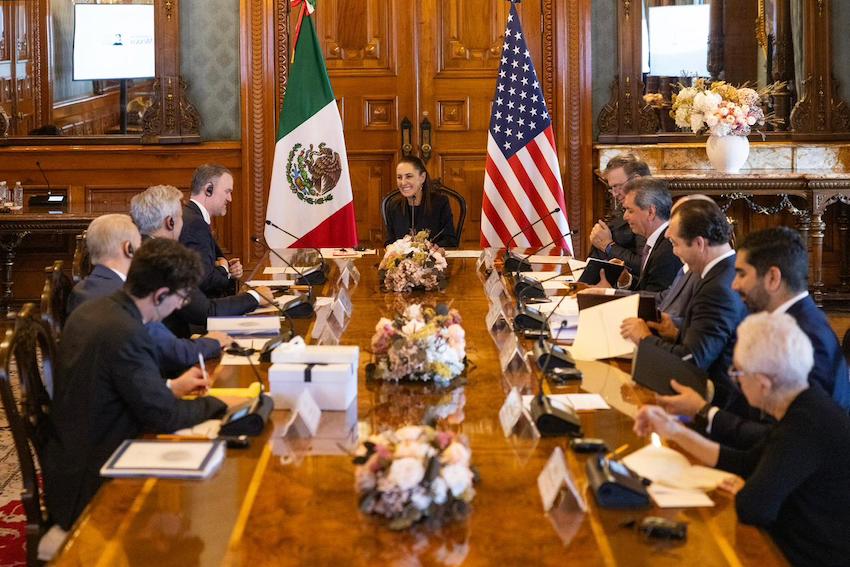
After meeting with U.S. Trade Representative Jamieson Greer in Mexico City on Monday, President Claudia Sheinbaum declared that talks with the United States related to the review of the U.S.-Mexico-Canada Agreement (USMCA) are advancing “positively.”
Sheinbaum chaired a meeting at the National Palace attended by Greer, U.S. Ambassador to Mexico Ron Johnson, Mexican Economy Minister Marcelo Ebrard, Finance Minister Édgar Amador Zamora and other officials.
“I received at the National Palace the delegation from the United States, headed by Ambassador Jamieson Greer, Trade Representative, for the conversations with Mexico regarding the review of the USMCA. We continue to advance positively,” the president wrote on social media.
Later on Monday, Ebrard and Greer — the top USMCA negotiators for Mexico and the U.S. — issued a joint statement that outlined the objectives for bilateral trade talks this week.
“Ambassador Greer and Secretary Ebrard directed their teams to advance important technical discussions this week on economic security and complementary trade actions, strengthened rules of origin for key industrial goods, collaboration on critical minerals, and to resolve outstanding bilateral trade irritants,” the statement said.
The English-language statement issued by the Office of the United States Trade Representative said that Greer, who has returned to the United States, and Ebrard “also agreed to hold a first official bilateral negotiating round for the USMCA Review the week of May 25, 2026, in Mexico City.”
Mexican and U.S. officials met in Washington, D.C., last month, to commence USMCA review trade talks. No Canadian representatives participated in those discussions.

In their statement, Ebrard and Greer said that “the USMCA Joint Review” — involving all three countries — will take place on July 1. The three North American trade partners have to decide whether they want to renew their free trade pact for an additional 16 years — i.e., to 2042. Mexico is confident that the USMCA will be extended, even though U.S. President Donald Trump has made disparaging remarks about the pact. Even if Mexico, the U.S. and Canada don’t agree to extend the agreement during the upcoming review process, it would not be terminated until 2036.
Gracias por su visita Embajador Greer !!! Buen retorno a Washington , DC. Hoy avanzamos mucho !! pic.twitter.com/i0heueXWSv
— Marcelo Ebrard C. (@m_ebrard) April 20, 2026
There is a range of “trade irritants” between Mexico and the United States. Mexico’s primary complaint is that Trump has imposed tariffs on a range of Mexican goods, including steel, aluminum and vehicles. Among the United States’ concerns is Mexico’s energy sector framework, which favors state-owned firms over private and foreign companies.
Citing industry sources, Reuters reported on Tuesday that Greer “told Mexico’s auto and steel industries they should not expect the renegotiation of the U.S.-Mexico-Canada Agreement to remove President Donald Trump’s tariffs on their sectors”.
US more concerned about deficit with China than deficit with Mexico
Another trade irritant for the United States is that it has a large deficit with Mexico — US $196.9 billion in 2025, a 14.8% annual increase. Trump has cited the deficit as one reason for his decision to impose tariffs on Mexican goods, and last year, he and Sheinbaum agreed to work to narrow the trade imbalance.
Nevertheless, Greer said on Monday that the U.S. is more concerned about its trade deficit with China than its trade deficit with Mexico, according to a report by the newspaper El Economista.
The U.S. trade representative made the remark during talks with Mexican officials at the headquarters of the Mexican Banking Association (ABM), El Economista reported, citing sources who were at the meeting.
China’s trade surplus with the United States was $202.1 billion in 2025, exceeding Mexico’s surplus with its northern neighbor by $5.2 billion. China thus had the largest trade surplus with the U.S. of any country in 2025, even though its surplus declined 31.6% last year.
The United States has good reason to be more concerned about the deficit with China than the deficit with Mexico. The U.S. and China are, of course, geopolitical rivals, but beyond that, there are other reasons why the Trump administration wants to reduce the reliance on imports from China. One key issue is that Chinese exports to the U.S. contain very little U.S. content. According to an analysis by the SAI consultancy firm that was cited by El Economista, at the end of the last decade, exports from China to the U.S. had just $4 of U.S.-made content for every $100 of goods sold, whereas Mexican exports to the U.S. had $40 of U.S.-made content for every $100 — ten times more.
At the ABM headquarters, Greer highlighted that Trump wants to “re-industrialize” the United States, according to El Economista, but recognized that Mexico is a key supply chain partner. Indeed, the two countries are said to be part of a “co-production system.”
Greer meets with business groups
During his visit to Mexico City, Greer also participated in meetings with the Business Coordinating Council — a leading Mexican private sector group — and the American Chamber of Commerce of Mexico (AmCham), which represents U.S. companies in Mexico and seeks to facilitate economic integration between Mexico and the United States. Ebrard attended both meetings as well.
AmCham president Oscar del Cueto said that there is a “genuine interest” from both the Mexican and U.S. governments to “know the private sector’s positions” on issues related to the USMCA.
American Chamber of Commerce names CPKC’s Oscar Del Cueto as new president
“From AmCham, we see the review of the USMCA as an opportunity to continue advancing in this [bilateral] integration while looking after the competitiveness of each of our economies,” he said.
“We don’t have to divide the cake, we can make a bigger cake together,” del Cueto said.
AmCham said in a statement that during the meeting with Greer and Ebrard, it “highlighted four common objectives” for both Mexico and the United States:
- Re-industrialize the United States and Mexico in order to better compete with Asia.
- “North Americanize” supply chains.
- Build energy and critical minerals security.
- Strengthen Mexico’s economy as part of a stronger North America.
“To achieve this, we proposed that Mexico receive preferential tariff treatment, that the duration of the USMCA be extended as soon as possible to provide certainty for investment, and that we work toward the vertical integration of our region to balance the trade deficit and strengthen our economic resilience,” AmCham said.
With reports from El Economista