The media business is not an easy one, and it is only getting more difficult every day. AI firms shamelessly steal our content with no compensation. The shift to digital platforms has allowed the big tech companies to take the majority of advertising dollars. Social media firms have turned far too many people on to the dopamine-addicting formats of their platforms.
Yet the response of many media outlets, even well-established ones, has been to increase their own levels of “clickbait content.” I have seen many shameless examples regarding Mexico leading up to the World Cup soccer tournament. Let me explain and provide some examples.
Just recently, I wrote about a poorly written story from the UK’s The Economist magazine that gave an update on Mexico’s economy with a lead story photograph of a man on a horse with Mexican beer bottles in the foreground. Little or no mention was made of Mexico’s record levels of exports, or of the fact that Mexico is now the #1 supplier of goods to the United States (dethroning China’s decades-long reign) or of the fact that Mexico is hitting record tourism levels. Instead, the tired stereotypes of a man on a horse with a sombrero and beer to depict the Mexican economy. Pretty lame.
So this week’s The Economist article about Mexico and the World Cup is a similar doozy. From top to bottom, I believe that it is shameful journalism. Let‘s start with the title of the article: “The World Cup will test Mexico’s control over its territory.” Really?
The subtitle then says: “Donald Trump, who says the government is too weak to combat the drug gangs, will be watching.” The lead photo shows a man ready to fire a machine gun while flying in a helicopter over a soccer stadium. It’s not clear from the photo if he is of the Mexican military or of a cartel, but the combination of that photo with the title literally seems to suggest that cartels might fly over the World Cup stadiums and shoot people! Or that the military would need to fly over the stadium to protect fans from cartels. The article goes on to say things like:

-“Mexico is the third most dangerous country ever to host the competition.” (With no mention that the country has successfully held two previous World Cup tournaments)
-“Forty-four people were murdered on average every day in May.” (With no perspective on how that number is actually down significantly under President Sheinbaum’s term and no perspective that the average in the United States is close to 60 per day).
The article says that cartels actually “are not the biggest security risk facing the tournament and have little incentive to disrupt it.” And that the “most plausible terrorist threat to the competition comes from a lone attacker or a small group targeting fan zones…” The very next sentence then says, “But such attacks are rare in Mexico….they are more common in the United States, where it is easier to get guns.”
You are forgiven for being confused at this point as to what the real risk is, as I am sure most readers were confused as well. But it wasn’t just The Economist that was peddling clickbait. The Wall Street Journal had an article titled “World Cup puts Mexico’s Cartel Crisis on a World Stage.”
This article’s lead photo had not one but five machine guns pointing out of a helicopter window flying over a stadium. To their credit, the photo caption said that it was “Police conducting a recent aerial patrol,” but still, such a dramatic photo seems a bit over the top. The article goes on to discuss the very real issue of the thousands of missing persons throughout Mexico who have not been found. An issue that deserves real attention, accountability, and results. That being said, the linking of it to World Cup coverage seems like an odd choice.
The New York Times has gotten in on it too. Recent headlines have included “Security is Tight as a Mexico Win Opens a Historic World Cup” as well as “Thousands Protest Outside World Cup Opening Ceremony in Mexico City.” Another one: “Artisanal or Exploitative? Unraveling the Story of Mexico’s World Cup Jerseys.”
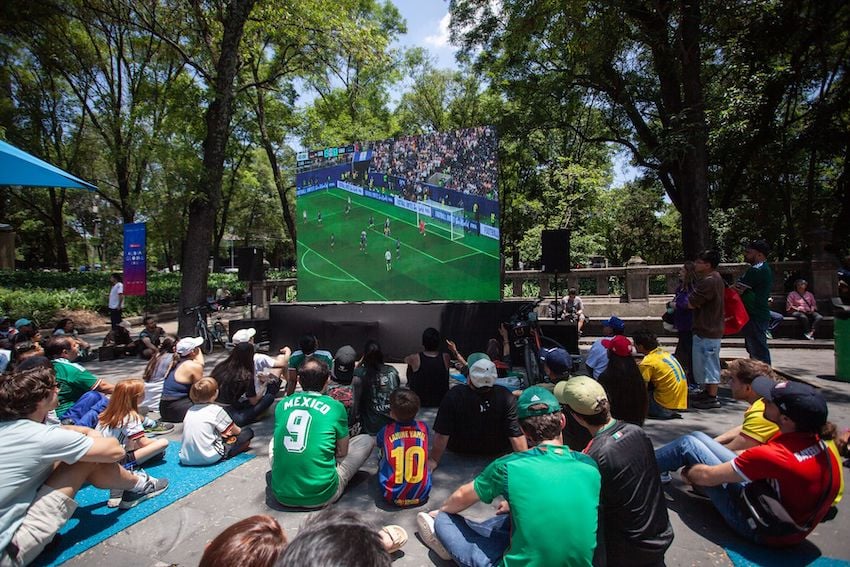
Don’t get me wrong, these media outlets have had some good quality coverage as well, but it’s hard not to notice the focus on the negativity here in Mexico. I don’t see them writing about the U.S. or Canadian World Cup cities with the same negative slant. Thankfully (and I can’t believe I am saying this!), it has been social media (in addition to MND!) showing the true spirit and reality of the World Cup in Mexico for the vast majority of the country. Families watching the game together and celebrating.
Massive groups of people in the big cities singing and dancing and celebrating together. Some of the videos that I most enjoyed were of Mexicans celebrating with Koreans after their win in Guadalajara or of the hundreds of thousands of people celebrating on Reforma Avenue at the Angel of Independence in Mexico City after Mexico’s first win.
As with anything in life, we choose what to see. I don’t claim to think that the World Cup is perfect, or that Mexico is perfect — nothing and nowhere is. But I think that there is so much good happening in this country, by the many wonderful people of this country, during the tournament that it is a shame not to focus more on that aspect as well.
The team at MND is working very hard to bring you a 360-degree perspective on the World Cup in Mexico. We are highlighting the risks and challenges, but also bringing you the beautiful moments on the pitch and in the streets, neighborhoods and homes across the country.
The tournament’s first few days in Mexico so far have been wonderful…let’s hope it continues!