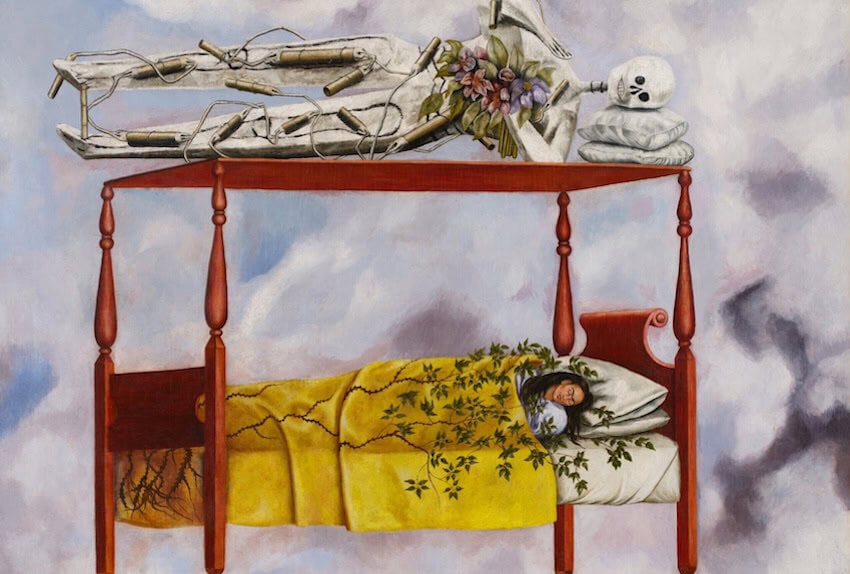
Frida Kahlo made history this week as her haunting 1940 self-portrait, “El sueño (La cama)” — which translates to “The Dream (The Bed)” — sold for US $54.7 million (hammer pricxe plus commission), shattering all previous auction records for works by female artists and further cementing her legacy as an icon of both art and resilience.
Bidding at Sotheby’s in New York lasted a brisk four minutes before the hammer fell, marking an unprecedented moment not only for Kahlo but for the broader art world.
A wild week for the secondary art market — and especially for Sotheby’s, which needed some good news.
This evening, a Frida Kahlo painting achieved the record for the highest price for a painting by a woman at auction, not just at Sotheby’s but in history.
$54.7 million (hammer… pic.twitter.com/UFpuabDWUf
— Yashar Ali 🐘 (@yashar) November 21, 2025

The Thursday sale exceeded projections, which had placed the work’s value between US $40 and $60 million, and easily eclipsed the previous high for a woman artist — Georgia O’Keeffe’s “Jimson Weed/White Flower No. 1,” which fetched $44.4 million in 2014.
“El sueño (La cama)” also topped Kahlo’s own auction record, set in 2021 when “Diego y Yo” sold for $34.9 million.
The buyer of “El sueño (La cama)” remains anonymous, with the auction house confirming the work will be featured in major exhibitions in New York, London and Basel, Switzerland, through 2028.
According to the New York Times, the painting came from a distinguished private collection, where it had remained for approximately 45 years. The previous owner reportedly acquired it at a Sotheby’s auction in 1980 for US $51,000.
Created in the midst of personal turmoil and medical hardship, the painting depicts Kahlo asleep in a carved bed under a canopy topped by a skeleton entwined with dynamite and flowers — a stark meditation on mortality and pain, rendered with unmistakable emotional candor.
The bed, a recurring theme in Kahlo’s art, symbolized both refuge and confinement, shaped by years of illness and recovery after a long metal rod tore through her midsection when a bus she was riding slammed into a trolley car. Only 18 at the time, she suffered severe fractures in her pelvis, ribs, shoulders and spine.
As Sotheby’s explained, “The bed’s structure becomes both a physical support and a metaphysical scaffolding, a stage on which death literally hovers above life. ‘The Dream (The Bed)’ undoubtedly offers a spectral meditation on the border between sleep and death.”
Though described by scholars as distinctly surrealist in tone, Kahlo herself denied the label, famously declaring, “I never painted dreams. I painted my own reality.”
Researchers have a new diagnosis for Frida Kahlo, 70 years after her death
The blockbuster sale comes as “Fridamania” has resurged, with the opening of Casa Roja (Red House) — a new Frida Kahlo museum in Mexico City — as well as recent exhibits in Chicago and, for the first time, in China.
It also comes amid ongoing debates over missing Kahlo works at top Mexican institutions. A newly published report alleges the disappearance of several paintings and drawings from Casa Azul, the original Frida Kahlo museum in Mexico City, sparking calls for transparency from the artist’s estate and the Mexico’s Ministry of Culture.
Kahlo’s art market remains robust, with collectors vying for any piece — no matter how small or minor.
Last year, Christie’s sold a small, 15-inch painting of knickknacks — a 1931-32 work titled “Window Display on a Detroit Street” in English — for US $7.2 million.
And in addition to the US $34.9 million received for her 1949 work “Diego y Yo” in 2021, her intimate “Portrait of Cristina, My Sister” sold for US $14.785 million in 2023 — zooming past pre-auction estimates of US $8 to $12 million.
Kahlo painted the simple composition at age 21, when she was just beginning to eschew the styles of the masters and embrace techniques and colors that would become her trademarks.
With reports from Milenio, El País, The Guardian and NPR