During Panquetzaliztli, as the Mexica (a group of Indigenous Mexicans that also included the Aztecs) called the month of December during the height of their empire, legend said that Huitzilopochtli, the powerful god of war, appeared once more among those who worshipped him. As he was the patron deity of Tenochtitlán, the ancient inhabitants of the Mexica capital worshipped him for 20 days, raising banners on tree branches and at their most important temples, hence the name in Nahuatl meaning “the raising of banners.”
Throughout these sacred days, the Mexica gathered around their temples to await the arrival of the winter solstice. Toward the end of the festivities, families shared lavish dinners in their homes and molded corn figurines in honor of the god of war.
The festivals honoring Huitzilopochtli served as a template for Catholic priests to impose their own December festivities on the Mexica during the colonial period. They either combined or replaced the Mexica Empire’s existing traditions with those used in Europe.
Incredibly, this violent evangelization gave rise to the piñata.
What are the piñata’s origins?
When the Spanish invaded Mexica territory, one of the Catholic December traditions the friars imposed, according to the Mexican Agricultural and Fisheries Information Ministry, was the Aguinaldo Masses — a series of nine consecutive masses in anticipation of Christmas that later became the posadas, which still exist today.
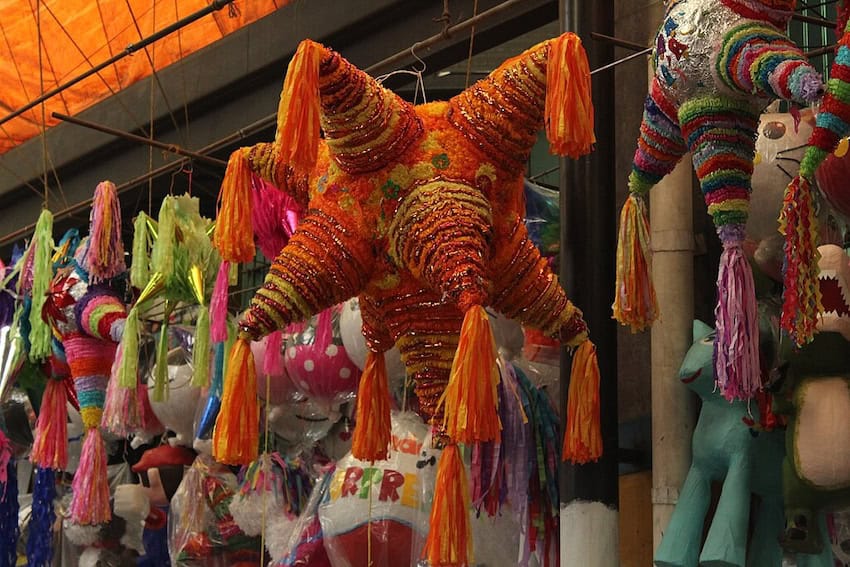
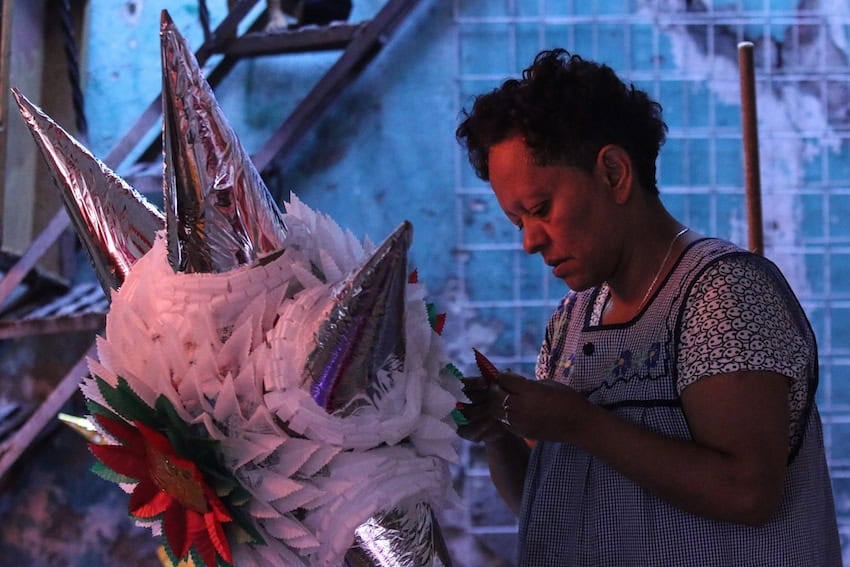
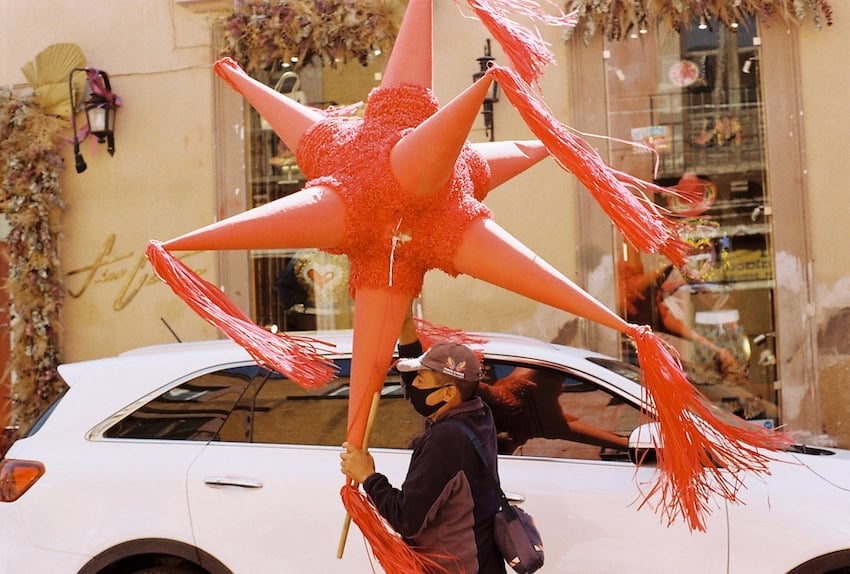
During these Aguinaldo Masses, the friars introduced the use of the piñata, which existed in Spain but was also similar to an existing Mexica ceremony to celebrate Huitzilopochtli. Originally, the piñata was made entirely of clay. A common pot was covered with colorful tissue paper, which represented superfluous pleasures. The piñatas were topped with seven conical points, symbolizing the seven deadly sins of the Christian faith: lust, gluttony, envy, pride, greed, wrath and sloth.
After the Christmas Mass, these sins would be destroyed with sticks while the person was blindfolded. When the clay broke, sweets, seasonal fruits and coins would spill out of the piñata as a reward for overcoming earthly temptations. These, in turn, allude to the riches of the kingdom of heaven, which would come to faithful Catholics after death.

How did the piñata originate?
Although Mexico is stereotypically associated with piñatas and sombreros, this traditional element of the end-of-year festivities did not originate here. On the contrary, there is considerable debate about who originally came up with the piñata. Marco Polo’s accounts suggest that he saw them in China during his voyages, suggesting a Chinese origin. However, those same records also refer to the Mongols as monsters and beasts.
Etymologically, the word piñata has Italian roots, originating from the Italian word pignatta, which translates to “fragile pot.” Historian Adrián Murillo documents that, during the Middle Ages, the Spanish used this word to refer to the act of breaking a small pot on the first Sunday of Lent.
The piñata of this era, however, was not decorated with colors, nor did it have its classic conical points.
The piñata-breaking ritual still works today as follows: Everyone at the posada forms a circle around it. The children take turns hitting it with a stick, while the others sing in unison to cheer them on. Sometimes, the child is blindfolded to make the piñata harder to hit. The blindfold is said to represent the Catholic faith, while the stick alludes to the power of God. When the song ends, it’s someone else’s turn.
Colonial evolution
According to Mexico’s Ministry of Agriculture and Rural Development, the colonial version of the song went like this: “I don’t want gold / Nor do I want silver / What I want is to break the piñata.” Today, however, this song is no longer in use.
Contemporary posadas still center around breaking a piñata. And while Mexicans today do buy papier-mâché piñatas for children’s parties, those piñatas are generally shaped like animals or cartoon characters. These days, piñatas with the seven spikes are only seen in December.
Although the original piñatas were clay pots, it’s increasingly rare to see clay piñatas at posadas, for a very modern reason: It’s safer to break a papier-mâché structure than a clay one, which for centuries has injured more than one unsuspecting person.
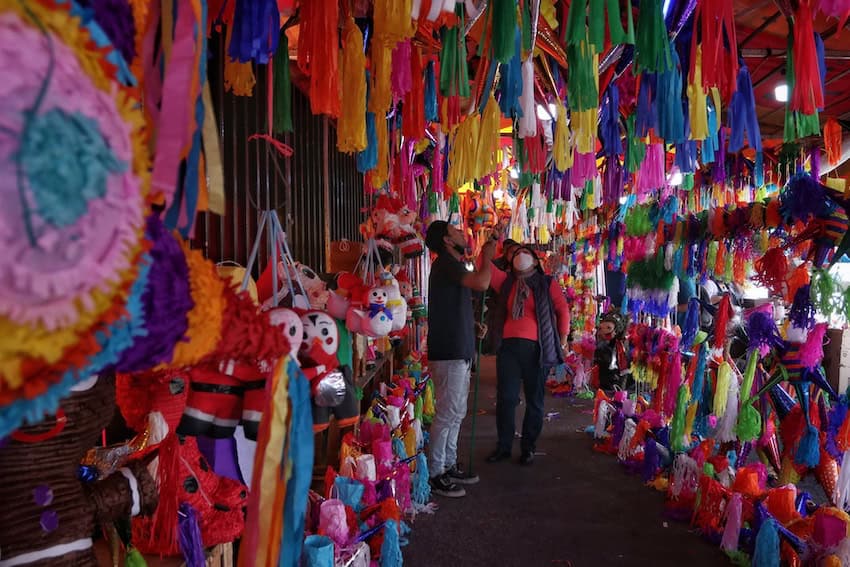
Perhaps, from the unearthly realm of Teteocan, Huitzilopochtli smiles ironically, watching people hit a papier-mâché structure, hoping to receive the riches of Christianity’s celestial kingdom. After all, they continue to gather during the sacred days that, millennia ago, were dedicated to worshipping the god of war.
Andrea Fischer contributes to the features desk at Mexico News Daily. She has edited and written for National Geographic en Español and Muy Interesante México, and continues to be an advocate for anything that screams science. Or yoga. Or both.