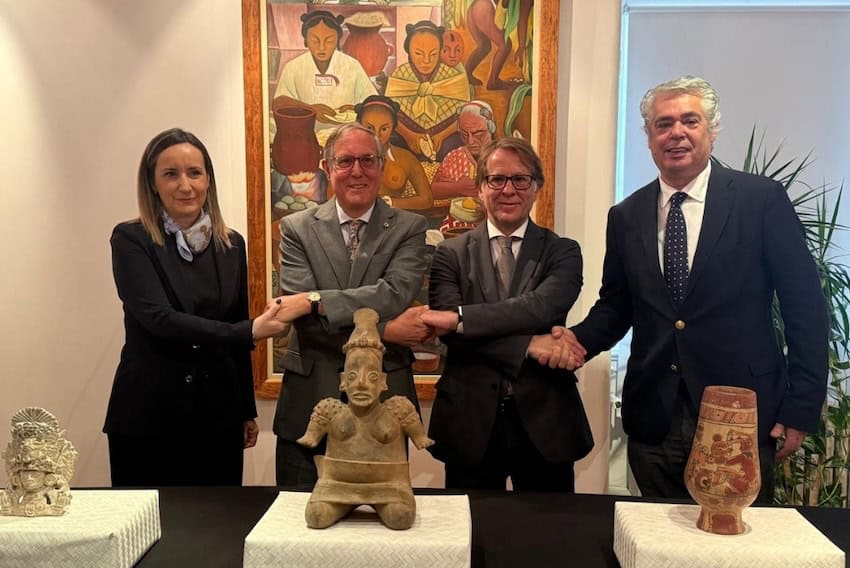
In another win for Mexico’s efforts to recover archaeological artifacts from abroad, Portugal has made its first-ever restitution of pre-Columbian objects to Mexico, as both countries commit to combat illegal trafficking of cultural property.
The pieces include a female figure from western Mexico associated with fertility rituals, a polychrome Maya vessel from the Classic period and a Zapotec urn representing the god Cocijo, deity of rain and fertility.
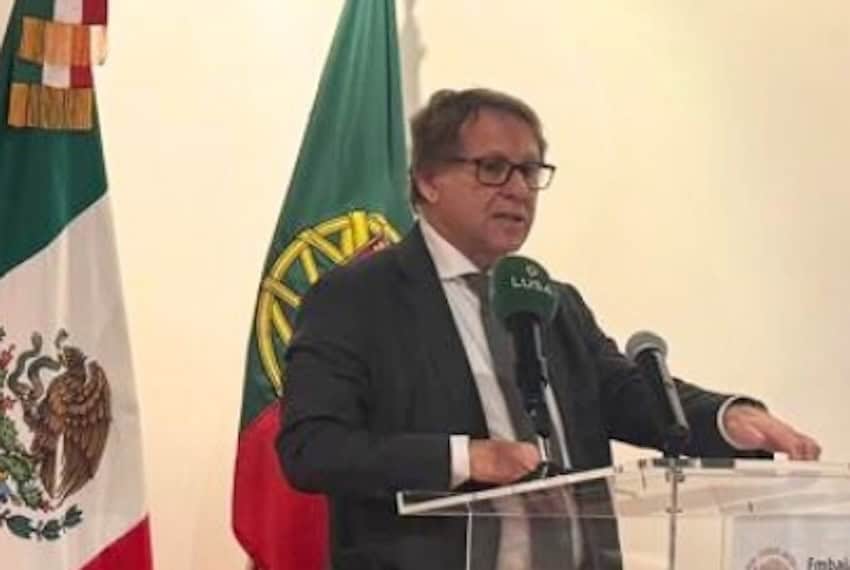
“This is the first restitution of pre-Hispanic archaeological heritage from Portugal to Mexico, reflecting institutional collaboration and a shared commitment to combating the illegal trafficking of cultural property,” Portugal’s Judicial Police said in a statement.
The handover took place Thursday during a ceremony at the Mexican Embassy in Lisbon, in collaboration with the Camões Institute for Cooperation and Language.
The pieces stand out for their historical, aesthetic, and symbolic value,” the Judicial Police acknowledged, adding that their recovery “facilitates the reconstruction of social and religious contexts for the history of Mexico.”
Although this is the first time Portugal has repatriated an artifact to Mexico, it’s not the first time a piece has been recovered from the European country.
In 2024, Mexico recovered a 2,000-year-old piece before it was auctioned at the Renascimento-Avaliações e Leilões auction house. As soon as Mexican authorities learned of the auction, the National Institute of Archeology and History (INAH) filed a complaint with the Attorney General’s Office (FGR), while thn Culture Minister Alejandra Frausto Guerrero sent a formal request to the auction house urging them to stop the sale of the piece.

In collaboration with embassies in both countries, the Renascimento-Avaliações e Leilões auction house returned the piece.
Illicitly traded cultural property is often sold either in illegal markets around the world or through legal avenues such as public auctions, including online.
Many of the artifacts that Mexico has recovered are the result of a federal government task force created in 2023 that works with local authorities abroad to seek judicial redress and halt auctions in New York, Paris and Rome. The task force also negotiates with academic institutions and museums to recover archaeological artifacts from abroad.
With reports from from Infobae