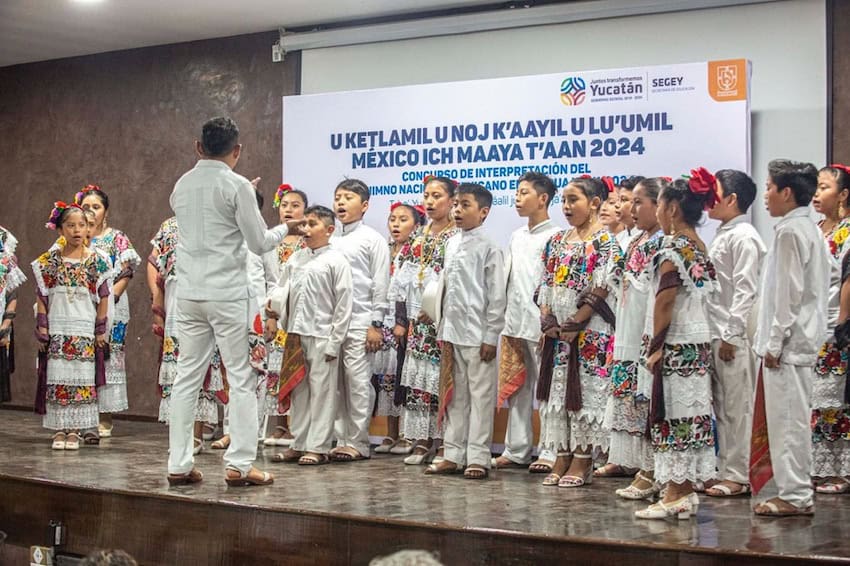
The Maya-speaking population in Yucatán has a language loss rate of nearly 60%, even though the state remains one of the main strongholds of the Maya language in Mexico.
During the Southeast-Gulf meeting of the National Network for Research on Indigenous Languages (Renili), officials warned that Yucatecan Maya is experiencing a significant process of linguistic shift, with six out of 10 children of Maya-speaking mothers no longer learning the language as their mother tongue.
Speaking at the event, Violeta Vázquez-Rojas, Mexico’s Undersecretary of Science, Humanities, Technology and Innovation (Secihti), explained that currently, use of the language is concentrated mainly among adults aged 30 to 40 or older, while in many rural communities the proportion of children who speak it is minimal.
Although in the broader state context, Maayat’aan (the Peninsular Maya language) is spoken by more than 500,000 people, this only accounts for 23% of Yucatán’s population.
The same pattern is seen across the peninsula — Yucatán, Campeche and Quintana Roo – in which authorities estimate that over 750,000 people — mostly adults — speak this Indigenous language.
This decline in intergenerational transmission is reflected in specific municipalities, such as Acanceh, a small town near Mérida where the percentage of the population that still uses the Maya language remains below a quarter of the total.

Locals in Acanceh, whose population of approximately 17,000 is predominantly made up of older people, communicate in the native Maya among their age group, but not with their children or grandchildren.
Participants at the Renili encounter offered that some of the reasons driving the decline are stigma, as parents often choose not to teach the language to their children to avoid discrimination; migration and urbanization; and low literacy rates.
In an interview with the local news organization Por Esto!, expert Aurelio Caamal said that the increase in women working out of their homes to help support their families has also led to a decline in their focus on childcare, negatively impacting intergenerational transmission of the Maya language.
According to Mexico’s national statistics agency INEGI, the number of Maya speakers in the state of Yucatán fell from 537,618 in 2010 to 519,167 in 2020, a drop of more than 18,000 people in one decade. Although a 2019 constitutional reform in Yucatán made Maya-language instruction mandatory at the elementary educational level, only 651 of the state’s 1,612 schools actually comply, according to the newspaper La Jornada.
With reports from Por Esto!, La Jornada and Tinta Pública Noticias