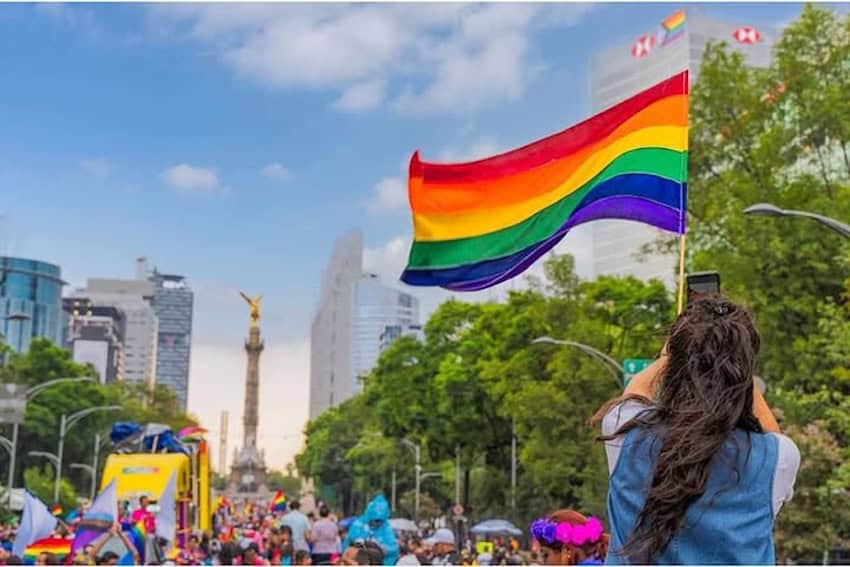
Mexico City will host one of Latin America’s largest Pride marches on Saturday, with authorities expecting hundreds of thousands of marchers and spectators to pour into the capital’s streets.
The 48th annual LGBT+ Pride March will again turn the city center into a focal point for both celebration and demands for equality.
🔴Comenzaron los preparativos para la Marcha del Orgullo LGBT+ de este sábado en la #CDMX. La instalación de un escenario y equipo de sonido a la altura de la calle 5 de Mayo mantiene cerrado el Eje Central Lázaro Cárdenas, por lo que la circulación es desviada por avenida Juárez… pic.twitter.com/AxU0jPPtDg
— W Radio México (@WRADIOMexico) June 26, 2026
After the march two years ago drew over 260,000 people, the attendance for 2025 shot up to approximately 800,000 people, according to Mexico City–based El Economista and other sources. The newspaper called it a record turnout and said the day “unfolded peacefully and concluded without incident.”
This year’s march is scheduled to begin at 10 a.m., with groups gathering at the Ángel de la Independencia and assembling along Paseo de la Reforma. The marchers will then move into the Historic Center en route to the Zócalo.
For a time, the parade’s traditional ending spot was a question mark, as the Zócalo is being used for a FIFA Fan Festival, where fans can gather to watch World Cup games on giant video screens.

Even so, government officials eventually said the marchers could end at the Zócalo and are welcome to attend the viewing party — but they couldn’t set up a closing stage there as in years past.
Instead, the stage will be on Eje Central Lázaro Cárdenas, next to the Palacio de Bellas Artes.
Mexico City’s Pride parade has grown into one of the largest in Latin America. Some guides and media say that it’s second only to São Paulo, Brazil, which drew 3-4 million people last year.
Last year’s Mexico City march underscored the event’s public health role. The Mexican Social Security Institute (IMSS) administered more than 1,500 free rapid health tests during the march, including screenings for HIV and hepatitis C — part of an effort that has become a recurring feature of Pride in the capital.
This year’s event “aims to advance demands related to identity, diversity, equality, and the eradication of violence against people of diverse sexual and gender identities,” according to an English-language article from CDMX Secreta.
“Don’t forget to bring your flag, banner, sign or message,” the lifestyle and events website added. “More than just a celebration, the Pride March remains a collective demonstration that seeks to build a more equal, inclusive and free society for everyone.”
The event takes place in the context of Mexico being identified as one of the most dangerous countries in Latin America for LGBTQI+ people, with the agency Sin Violencia LGBTI documenting scores of killings each year — including 80 in 2023, a 23% increase over 2022.
The agency noted that, in Latin America, reported killings of sexual and gender minorities in Mexico are second only to those in Colombia, and that at least one LGBTQI+ person is murdered every 24 hours in Latin America and the Caribbean.
The slogan of this year’s march is “Ante los ojos del mundo: mi lucha es tu lucha. ¡Igualdad, paz y solidaridad!” — which translates to “In the eyes of the world: my struggle is your struggle. Equality, peace and solidarity!”
With reports from Milenio, El Economista, Dallas Voice and Infobae