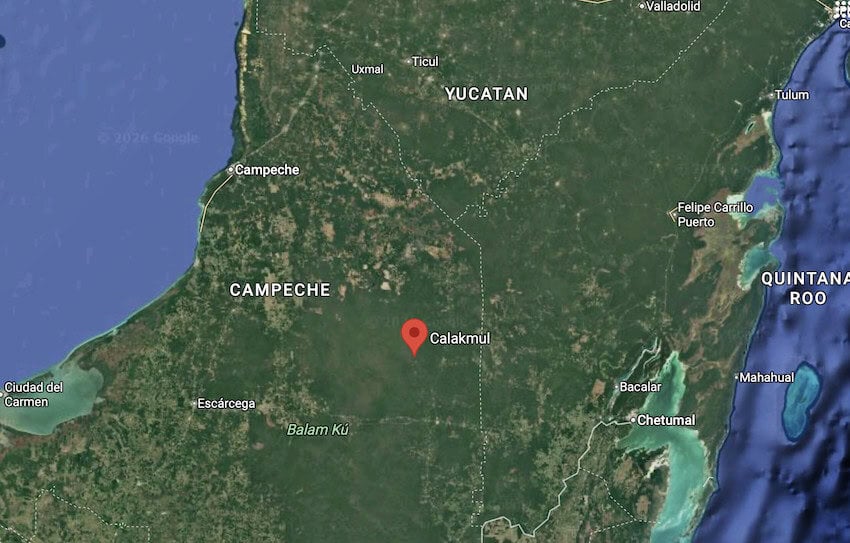
The digital reconstruction of a charcoal mural discovered more than two decades ago in the ancient Maya city of Calakmul, Campeche, has revealed the earliest known evidence of calendrical writing in Calakmul, the National Institute of Anthropology and History (INAH) reported.
Until this discovery, there was no evidence of early written communication in Calakmul, as most of its known inscriptions date from the Classic period (250-900 CE).
“Now, we can include Calakmul as one of the places where these types of manifestations exist,” head of the research project Daniel Salazar Lama said in a press conference.
Measuring 1.90 meters wide by 1.70 meters high, the painting depicts the mythical Maya hero Juun Ajaw hunting a creature in the water. Next to him is a symbol corresponding to a day marker within the 260-day ritual calendar cycle known as Tzolk’in.
The mural could represent an episode in the life cycle of the maize god, likely a propitiatory or renewal ritual, Salazar explained, adding that the calendrical date appears to have been drawn after the main scene, commemorating the hunting and sacrificial episode featuring Juun Ajaw.
Salazar said that this discovery places Calakmul at the “center of the cultural explosion of the Maya Lowlands during the Late Preclassic period [400 BCE-250 CE],” alongside cities such as San Bartolo, El Mirador and Tikal — all in Guatemala — recognized for their monumental architecture and early writing.
New technologies shed light
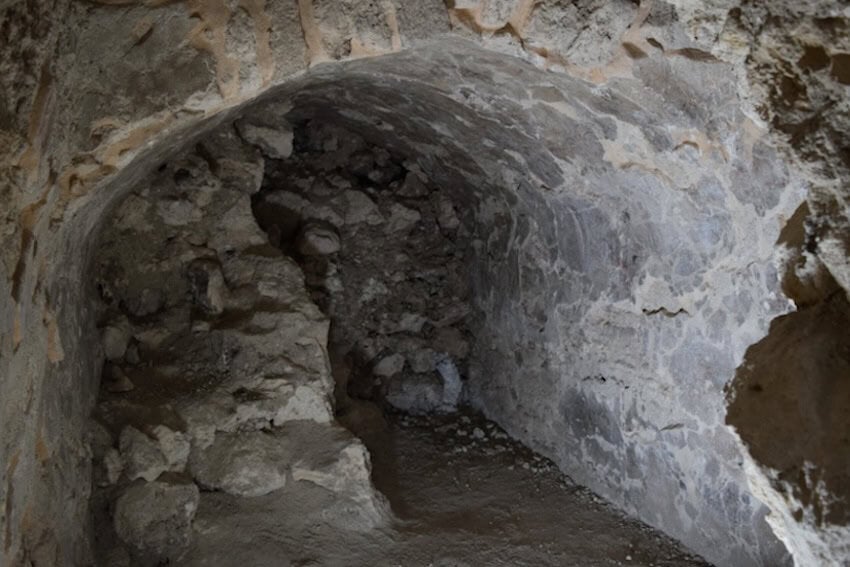
The mural was found inside an arched vault at Calakmul, as part of the Calakmul Archaeological Project led by archaeologist Ramón Carrasco Vargas, after which it was transferred to the National Coordination for the Conservation of Cultural Heritage in 2005 for study and conservation.

Because the painting was in poor condition upon discovery, scientists had been unable to appreciate the scene with the naked eye. But modern techniques, including photogrammetry and digital drawing, made it possible for researchers to finally reconstruct the artwork.
The new technology also provided new evidence about the mural’s age.
The building housing the mural was originally thought to have been built between 400 and 390 BCE, but scientists now believe it dates from between 400 and 200 BCE. The drawing style itself also supports this theory. However, further samples are needed to pinpoint the date.
Archaeologists also determined that the chamber containing the mural was deliberately designed to evoke the interior of a cave, a space of profound cosmological significance for the Maya.
Mexico News Daily