There is little doubt that Mexico has become a giant in world culture, declared President Andrés Manuel López Obrador upon inaugurating the Gran Museo Maya de Chichén Itzá (Chichén Itzá Maya Museum) on Wednesday.
The new museum houses 1,000 pieces, 400 of which are original, across its 2,800 square meters of exhibition space. It also has scale model replicas of Maya architecture and a number of interactive displays.
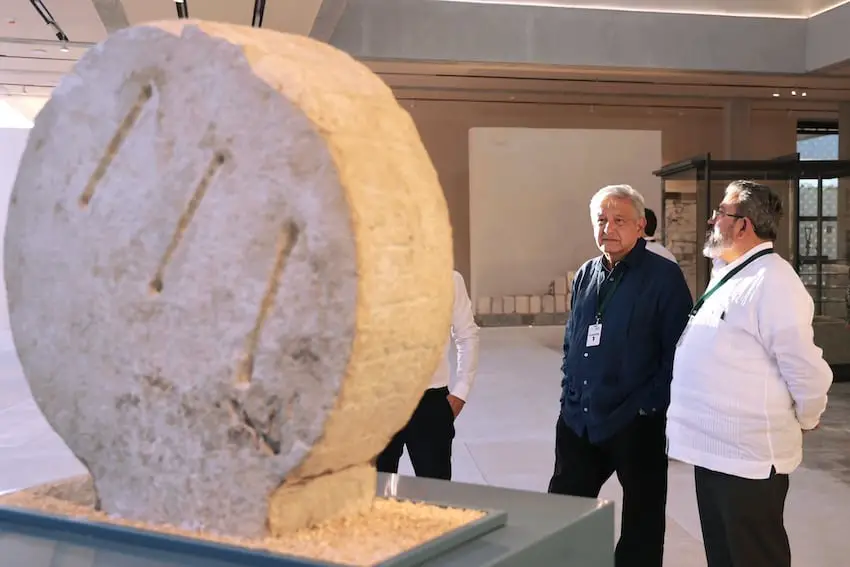
President López Obrador lauded the collaboration of the Culture Ministry (Sectur) and the private sector in developing the site, and praised the leadership of Diego Prieto Hernández, director of the National Institute of Anthropology and History (INAH), for his role in the finished product.
“This is a great day for Mexican archaeology,” Prieto said. “Finally, the archaeological site of Chichén Itzá … has a museum to present the splendor and greatness of this Maya city.”
“We needed a museum to display, much more intensely and fully, the wonder of the civilization that flowered in this great city-state of the Maya of the past [and] which is still a great example for the Maya peoples of today,” Prieto said of the project, which is the iconic archaeological site’s first full-scale museum.
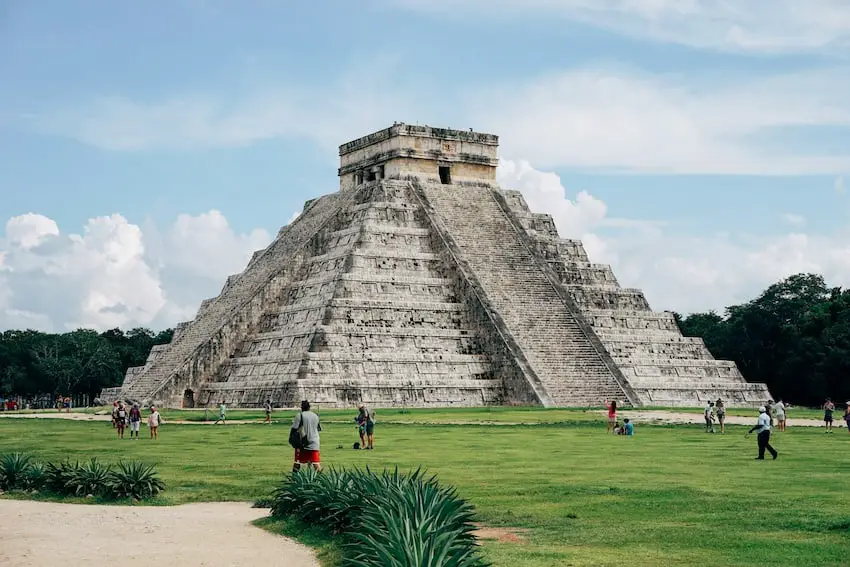
Visitors will be able to see some of the treasures that were uncovered during the construction of the Maya Train at the new museum as well as elaborate models of the Sacred Cenote at Chichén Itzá and of “El Castillo,” the majestic Temple of Kukulcán that dominates the site’s main plaza.

The exhibit of the temple’s interior features replicas of archaeological findings that visitors cannot see in person due to conservation issues, including jaguar images in frieze, a Chac Mool sculpture and the jade- and conch shell-encrusted Red Jaguar Throne.
After touring the museum with López Obrador and Prieto, Yucatán Governor Mauricio Vila said the museum will help broaden knowledge of and appreciation of Maya culture, enhancing the experience for tourists as well as local residents.
The Gran Museo Maya de Chichén Itzá opens to the public on Friday and will be accessible from the Chichén Itzá station of the Maya Train. Prieto anticipates 3 million visitors to Chichén Itzá in 2024, making the Maya city the most visited archaeological site in the Americas.
Chichén Itzá dominated the Northern Maya Lowlands of the Yucatán Peninsula from roughly A.D. 900 to 1200. Its name translates as “at the mouth of the well of the Itza.” The Itzá, whose name may be translated as “water sorcerers,” were the Maya group who founded the city. The majority of their descendants today live in Guatemala and Belize.
With reports from Milenio and Forbes México