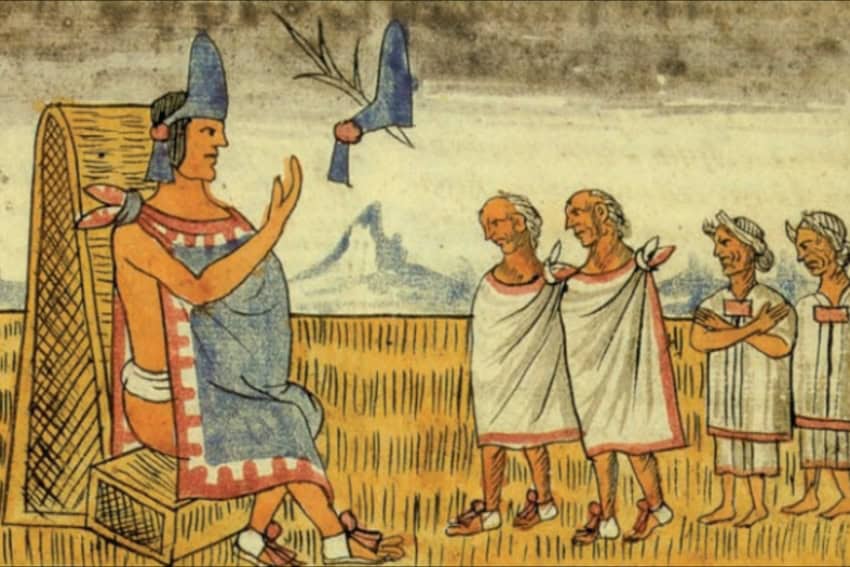
Despite the historical distance that separates us from the Conquest, a hazy aura surrounds Moctezuma Xocoyotzin’s predictions. As the last tlatoali (or emperor) of México-Tenochtitlán, he recorded eight ominous portents before the European invasions in Mesoamerica. Between natural disasters, astronomical phenomena and the appearance of supernatural creatures, it is said he foretold the fall of his imperial capital city.
Given the descriptions of those who survived the conquest, the conquistadors dismissed these events from their Western perspective as blasphemous and contrary to the Christian path. For this reason, they remained unstudied for centuries, relegated to the realm of the unreasonable — and even satanic. In order of appearance, as documented by UNAM’s Institute of Historical Research (IIH), these were the events that baffled the last tlatoani of Mexica:
A fiery ear of corn in the sky
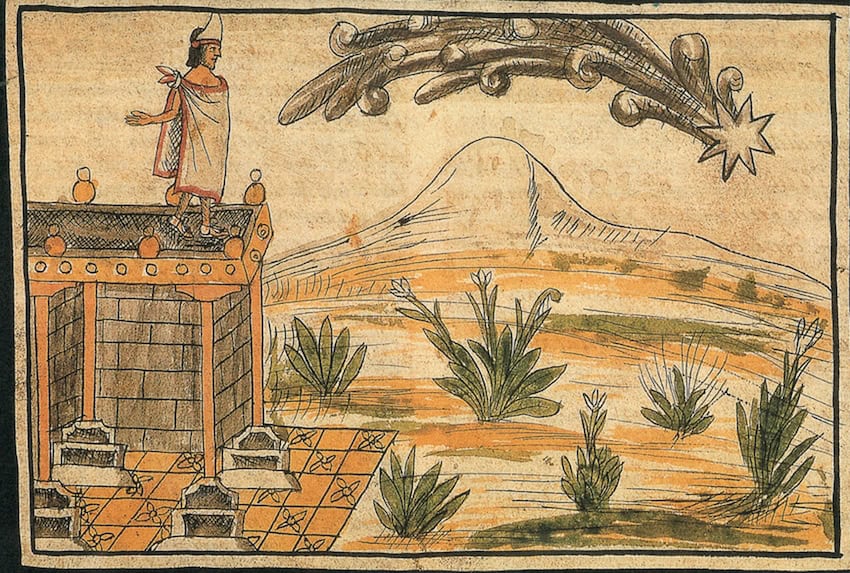
The surviving records of the first ominous omen date back 10 years before the invasion of México-Tenochtitlán, per the IIH. According to descriptions preserved in the surviving codex, “an ear of fire, like a flame, like dawn” flashed across the celestial vault one night, as if “piercing the sky.” It’s worth noting that any record of Moctezuma’s predictions was documented by conquistador and chronicler Bernardino de Sahagún in his “General History of the Things of New Spain“ (1540—1585), following his arrival in the imperial capital.
Destruction of the Temple of Xiuhtecuhtli
In the Mexica worldview, the action of representing events symbolically was often referred to as tetzahuitl. From the tetzahuia, this was the action of being “greatly astonished or horrified.”
Such was the reaction of the Mexica when they witnessed a lightning strike on the temple of Xiuhtecuhtli, known as the “Lord of the Years,” or the god of fire. The temple was instantly destroyed by uncontrollable flames.
Fire at the House of Huitzilopochtli
Bernardino de Sahagún described Moctezuma’s predictions as “signs and omens that appeared before the Spaniards came to these lands or before there was any news of them,” as documented by UNAM’s Institute of Aesthetic Research. The second disaster was the fire at the House of Huitzilopochtli, the Mexica god of war.
Despite the sacred nature of the space, the fire could not be extinguished. It ignited spontaneously during the night, even though the temple was built of stone. Historical accounts say that the more efforts were made to put out the flames, the more intense they became.

A shower of fiery stars
The fourth of Moctezuma’s predictions has been interpreted as an unstoppable meteor shower, seemingly bringing a deluge of fire upon the earth.
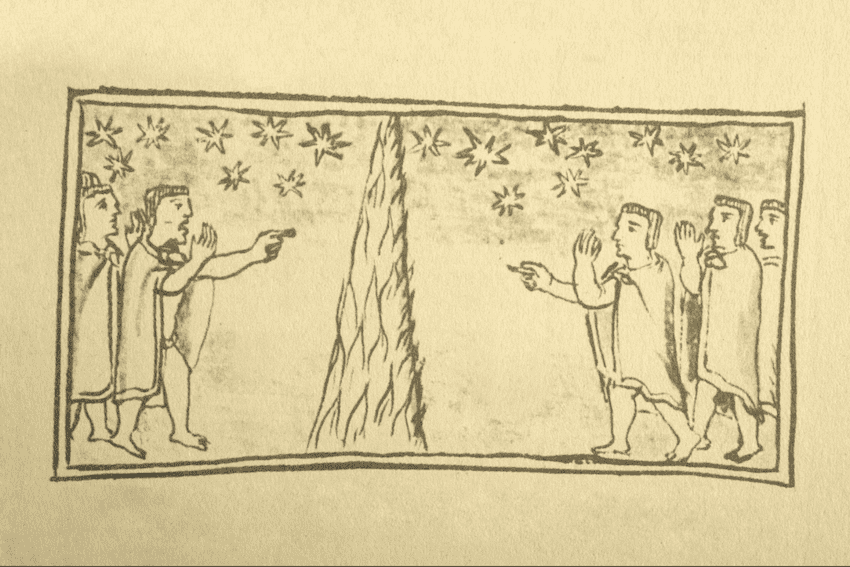
Amid the chaos, according to surviving descriptions, an immense star sent trails of smoke in its wake. Afterward, a rain of fire descended. What most astonished those who witnessed the catastrophe was that it occurred in broad daylight.
A flood of boiling water
Following the rain of fire, the temperatures of Lake Texcoco rose to the boiling point. As it overflowed, it reached the houses and buildings of ancient México-Tenochtitlán, burning everything in its path. “It reached the beginnings of the houses, and the houses were destroyed and flooded with water. This was due to the lake that is next to us,” noted Bernardino de Sahagún in his chronicles.
The voice of a woman weeping for her children
The cries appeared in the night, among the streets, across the sky, beneath the earth. This was recorded in the codices of the time: “Many times it was heard: a woman was weeping; she went about screaming through the night; she went about giving great cries: ‘My little children, we must go far away!’” Several historians agree that this is the origin of the legend of La Llorona.
More contemporary interpretations link this recurring figure in Mesoamerican narratives to Malintzin, the woman Cortés married during the Conquest. There is sufficient evidence that they were not only married but also had children together who later held administrative positions in New Spain. Other interpretations suggest that they could be those women raped by the conquistadors, who were forced to give birth to those unwanted children.
A crane with a star-shaped head
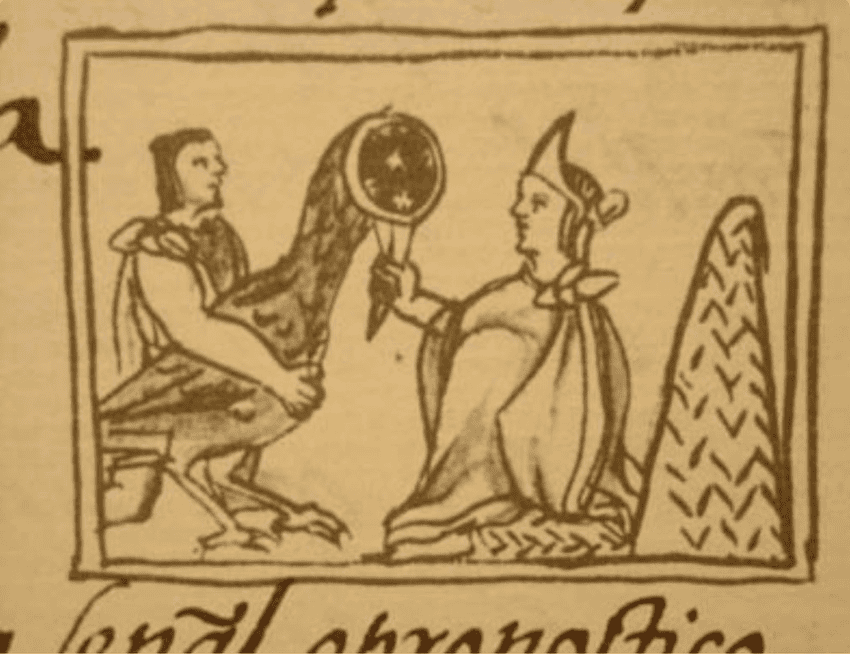
As if guided by a divine force, a flock of birds unearthed a gigantic crane from Lake Texcoco. When it was presented to Moctezuma, the tlatoani marveled because, instead of a face, it had a piece of obsidian embedded in its head.
According to the narratives of the time, interpreted by Sahagún, stars could be seen in the stone, as well as the reflection of anyone who dared to look it in the face. In Mexica mysticism, obsidian was considered the stone of Huitzilopochtli. At that time, it was believed to be the material of the heart of the ancient god of war. If you looked inside it, you could see the contents of your own soul.
Appearance of strange creatures
The last of Moctezuma’s predictions alludes to the appearance (and sudden disappearance) of two-headed men, hybrids of animals and “monstrous people.” They would appear before the tlatoani and, after looking him directly in the eyes, vanish into thin air, as if they had never been there.
By then, the political leader of México-Tenochtitlán was already under considerable pressure. After seven ominous events, which he identified as portents foretelling a catastrophe, these persecutory hallucinations seemed all too real. Even so, there is no record of what the origin of these visions of deformed specters might have been.
Andrea Fischer contributes to the features desk at Mexico News Daily. She has edited and written for National Geographic en Español and Muy Interesante México, and continues to be an advocate for anything that screams science. Or yoga. Or both.