In a recent article, we looked at how Agustín de Iturbide went from soldier to becoming Emperor of Mexico. We now review his short reign.
On July 21, 1822, General Agustín de Iturbide was escorted into Mexico City’s cathedral to be crowned Emperor Agustín I. The young country would go into independence still under a monarchy, but instead of being ruled by the king of distant Spain, they would give their allegiance to a man who had come up through their own land-owning class. The coronation was the grandest ceremony ever staged in the New World. Four bishops attended, one of whom, the Bishop of Puebla, quoted from the Bible’s book of Kings: “Surely you have seen him whom the Lord has chosen, that there is none like him amongst all the people.” Even Congress was swept away by the occasion and declared the post would be hereditary, with all of Emperor Agustín I’s family acquiring grand titles.
Emperor for 10 months
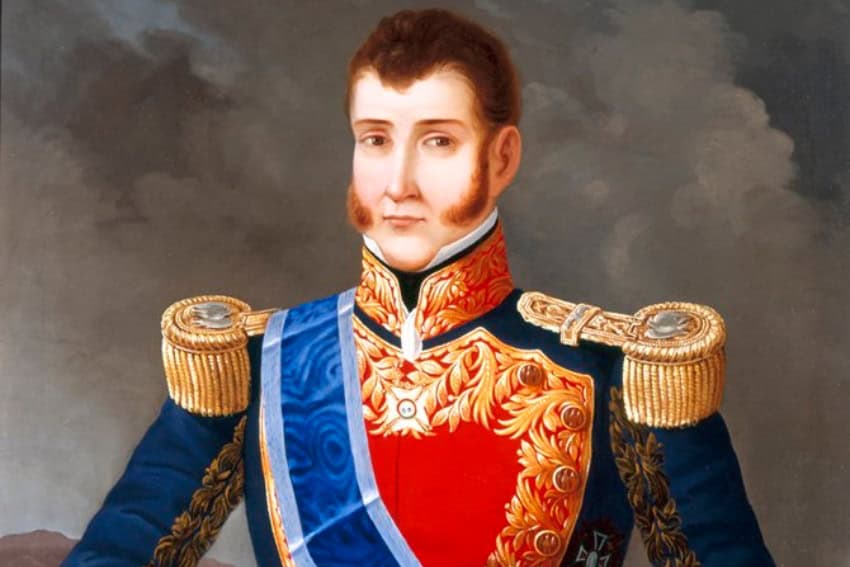
The new emperor was 38 years old, Mexican-born of Spanish stock. He was, as any man of his social rank, something of a dandy, and when he sat for portraits, he favoured the braids and bands of a military uniform. The uniform was not just for show, for Emperor Agustín had proved himself the country’s most effective general in the various wars that had eventually brought him to the throne. At this stage, he enjoyed support from the army, the church and a portion of the population who felt that living under a king was what god had always intended for mankind. Yet, within a year, he would be on his way to exile in Europe. What went so wrong so quickly?
A question of money
The problem at the heart of everything was that years of war had left Mexico bankrupt. Even here, on this day of the ceremony, the extravagance of the coronation service was questioned. Then there were grumbles over the establishment of a lavish court, thought necessary to both create the impression of monarchy and to reward those who had helped get the general into this position. Some 130 people, from pages to ladies-in-waiting, to physicians, were placed on the emperor’s new staff. The expectation of favors did not stop there, with every officer who had fought alongside the emperor expecting promotion and reward.
Congress, many of whom were republicans at heart, balked at the cost of the monarchy, which quickly included the lavish refurbishment of several of the emperor’s private homes. This exposed another weakness in the system. This had not been just a change of government, but the end of a colonial period that had lasted three centuries. Nobody had determined exactly how the new monarchy would work, and Emperor Agustín and the Congress clearly had different views concerning the extent of royal power. These differences exposed a second problem. The new emperor responded poorly to criticism, and the press was soon facing censorship.
Three issues came into focus. Did Iturbide have the right to appoint members to the Supreme Court? Could he veto legislation as could the Spanish king? And could he control troublesome provinces by establishing special courts made up of military officers and lawyers, a source of authority that could be easily misused to persecute political opponents. As the grumbling increased, Emperor Agustín took that well-trodden path of dictators and blamed foreign spies for all the problems.
Suspicions of conspiracy and dictatorial decrees
In his defense, this had an element of truth. Just a few weeks after coming to power, there were rumors of a conspiracy to overthrow the Emperor. This plot (if it existed at all) had been encouraged by the minister from Colombia, his country a center of revolution against Spain and the monarchy. There was a spy embedded in the rebel group, and 66 people were arrested for plotting a coup, including 15 members of Congress. There had to be at least a suspicion that the Emperor had used the incident to imprison some of his critics.

Meanwhile, the financial situation continued to decline. Attempting to bring in money, the government first requested and then forced loans. The property tax was increased, and paper money was printed. Government employees now received one-third of their wages in paper money, which they would be lucky to get any shopkeeper to accept. On Oct. 31, the emperor announced that, as Congress had neglected its duties of writing a constitution, instead putting its energy into attacking him, it would be dismissed and replaced by a new junta.
Santa Anna races from Xalapa to the city of Veracruz
With the emperor and Congress squabbling and the economy crumbling, the provinces moved towards rebellion. The focus point was Veracruz, where Spanish troops still occupied Fort San Juan de Ulúa, which was situated on a small island off the coast. The local leader of the imperial forces was General Antonio López de Santa Anna. He was at Xalapa when he received a letter from the emperor recalling him to Mexico City. Correctly guessing that the emperor was about to remove him from office, Santa Anna ignored the letter, raced to Veracruz, and declared his support for the republican cause.
The rebellion intensifies
The situation in Veracruz was serious but containable, but on Jan. 3, several generals, including Vicente Guerrero and Nicolás Bravo, rode out of Mexico City to start a rebellion in the south. Large areas of the country had slipped from the emperor’s control, but the majority of the army remained loyal, and on Jan. 13, 1823, imperial forces under José Gabriel de Armijo won a major victory over the southern rebels at the Battle of Almolonga. This stabilized the situation in the south and, with that, the worst of the crisis seemed to have passed. Iturbide now sent the trusted General Echávarri to subdue the small rebel forces in Veracruz.
However, instead of confronting the rebels, Echávarri and several other imperial officers deserted the Emperor and joined with General Antonio López de Santa in proclaiming the Plan of Casa Mata. This decoration denounced the First Mexican Empire and called for a new Congress. One by one, regional councils in Puebla, San Luis Potosí and Guadalajara declared for the Plan of Casa Mata and a military junta was formed in Xalapa to represent the growing rebel faction.
Mexico was now divided into three power blocks. There was the emperor and his shrinking number of supporters in the capital, members of the disbanded Congress, still influential men but lacking a platform, and the rival junta in Xalapa, with considerable support in the provinces. On March 7, 1823, Iturbide reconvened Congress, but as he addressed the body, he saw from their silence that he lacked their support. Fearing his imminent overthrow, he summoned Congress to an extraordinary session and presented his abdication. The emperor left for Europe, eventually landing in Italy.
The death of an emperor
Spain still had dreams of regaining its lost colony, and the deposed emperor received a polite but cool reception from Europe’s monarchs. Fearing assassination, he brought his family to England. Back in Mexico, the economy was still floundering, with supporters of centralism, federalism, the surviving monarchy platform, the church and the various secret societies all competing for power and influence. With so many problems, people were looking for somebody to blame, and the Spanish families that had remained in Mexico were becoming the target of public anger.
Iturbide saw an opening. He wrote to the Mexican Congress, offering to return not as emperor, but as a soldier ready to save the country. His proposal was dismissed, and he was declared a traitor in his absence, as was anybody helping him. However, by July, believing “the people” wanted him back, Iturbide secretly sailed from Southampton. He arrived in Mexico in Tamaulipas, where he met with provincial politicians and dignitaries. They were undecided how to react, and for a while there was some expectation that the monarchists might triumph and that provincial forces put at Iturbide’s disposal. Instead, he was arrested by General Felipe de la Garza, the local military commander, tried and sentenced to death. Agustín de Iturbide, the first Emperor of Mexico, was executed by firing squad on July 19, 1824.
Bob Pateman lived in Mexico for six years. He is a librarian and teacher with a Master’s Degree in History.