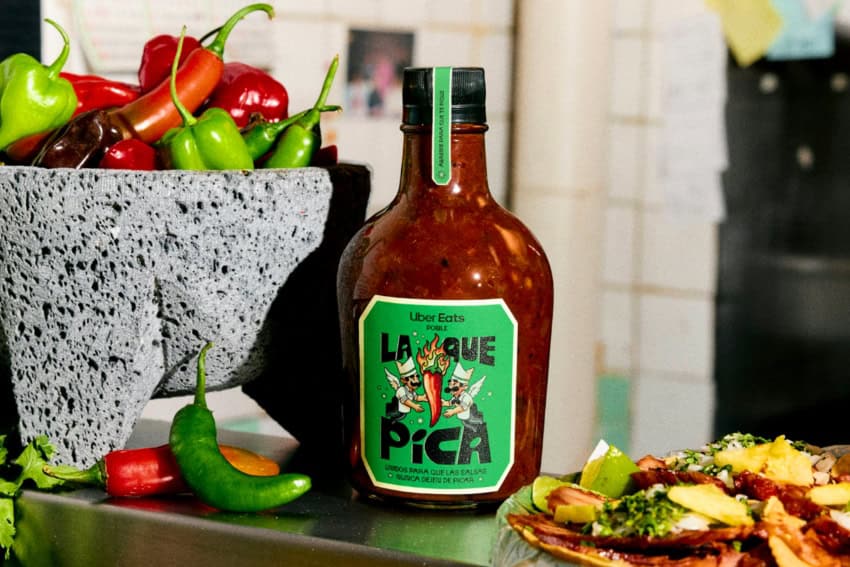
In recent years — amidst the spread of mass tourism and gentrification in Mexico City — there have been rising instances of taquerias “de-spicing” their salsas in order to appease foreigners with tamer palates.
In 2024, The New York Times reported that at least a few taqueros have admitted to lessening the kick in some of their salsas — completely removing serrano chiles from a recipe or adding less habaneros, for example — while others have introduced new salsas to the table as a failsafe option for customers who “would sometimes send tacos back because the salsas had burned their mouths.”
What spicy salsas are meant to be
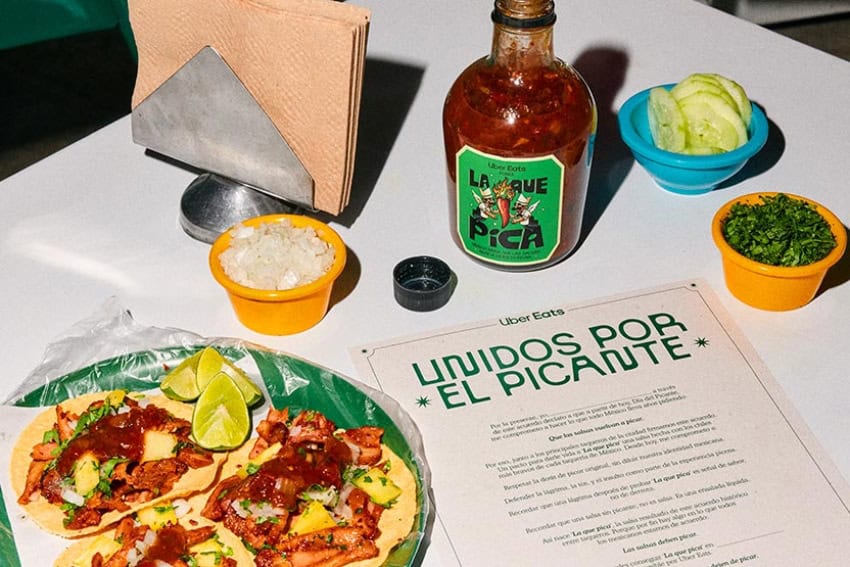
The New York Times article also revealed that more taquerías have started to clearly label the spice levels of each salsa, something that is generally unheard of in Mexico, where you simply find out the spiciness of anything by tasting it. You know it’s spicy when your nose starts to run or your eyes begin to water up. If you made the wrong choice, you unceremoniously rotate to the next multicolored salsa on the table and take another spin of spice roulette.
Of course, this issue isn’t only about salsas. It’s about maintaining a certain pride and identity of regional Mexican cuisine, globally renowned for its complex heat and wide-ranging varieties — a veritable art form composed from an array of chiles that are native to the vast North American territory, prepared in countless ways.
If it’s spice-less food foreigners are looking for in Latin America, they should maybe check out a country like Costa Rica, Argentina or, ironically, Chile, where the ingredients are relatively less explosive and nowhere near as spicy as what you’ll encounter at a taquería worth its salt (or, in this case, its salsa) in Mexico.
‘La que pica’
Removing the spice from Mexico’s salsas is, in essence, equivalent to deadening its culinary magic. And for many Mexico City locals, the war on salsa has understandably become a source of ongoing frustration — particularly in a shifting city that is already dealing with aggressive changes around rents, the cost of living and transportation.
So in response to it all, Uber Eats, of all saviors — a food delivery app which recently teamed up with FIFA as an official sponsor of the World Cup, and is also a sponsor for the Mexican national soccer team and Liga MX — has now announced the launch of their latest campaign in Mexico: La que pica. Or, roughly translated, “the spicy one.”

The effort involves bringing together 60 taquerías throughout Mexico City, all united under the same Uber Eats branding, to promote the spiciest salsa available at their particular eatery. Whatever in-house salsa that those taqueros have deemed their spiciest gets clearly demarcated in a snazzy bottle that, rightfully, reads: La que pica.
Anti-spicers beware
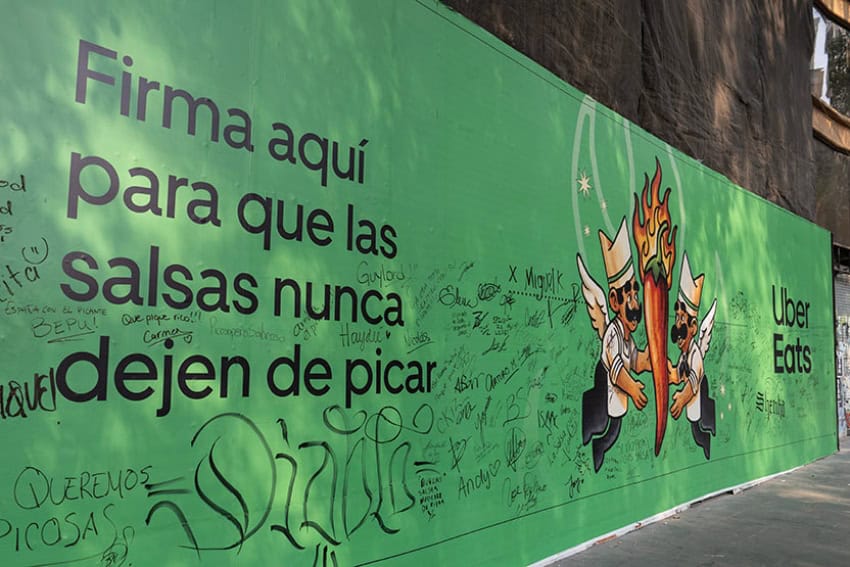
With messaging like “unidos por el picante” (“united by the spice”) and a street-level billboard on a wall in Mexico City that invited the public to sign their names if they agree that “salsas nunca dejen de picar” (“salsas should never lose their spice”) — accompanied with a cartoony mural of two taqueros carving a trompo (the classic tacos al pastor vertical spit ) that is aflame — Uber Eats seems to be leading the charge against any anti-spicers.
“In Mexico, spice is not an extra; it is identity. With La que pica, we did something bigger than launching salsas. We brought together more than 60 taquerías to defend heat the way it deserves and give it back the place it has always had,” said Emiliano Cortez and Alejandro Rattenbach, Creative Directors at Wieden+Kennedy Mexico, the agency that Uber Eats partnered with for the Mexican-centered campaign.
A spicy manifesto
In a rare act of citywide solidarity, the taqueros agreed to all use the same bottle provided by Uber Eats that, on the back side, extensively denotes its purpose and unapologetically hot manifesto.
Originally printed in Spanish, it reads as translated: “Here ‘the spicy one’ is actually spicy. Not a little spicy or barely spicy, but spicy as it’s meant to be: to give it flavor. When you ask for ‘the spicy one’ at this taquería, you are also asking to sweat, to curse, to tear up. This is a salsa born from taqueros who are tired of tomato sauces disguised as salsas. From those who decided, ‘This needs to be crazy spicy.’ Now enjoy your salsa however you like, sweating or cursing, as this salsa will not disappoint you.”
Milenio reports that the 60 partner taquerías include a mix of neighborhood haunts — Las Cebollas and Bigos Tacos, for instance — as well as famed attractions that celebrities like Katy Perry have been spotted at — Atarantados, El Califa, Copacabana. They’re not confined to the brick-and-mortar locations, either: You can have the special salsas delivered as part of your Uber Eats order.
Marketing initiative set to coincide with the FIFA World Cup in Mexico
The marketing initiative was originally launched on Jan. 16 — International Spicy Food Day, which honors spicy foods worldwide and also Wilbur Scoville, a U.S. pharmacist and chemist who invented the Scoville Heat Test in 1912 to measure the force of every pepper’s bite.
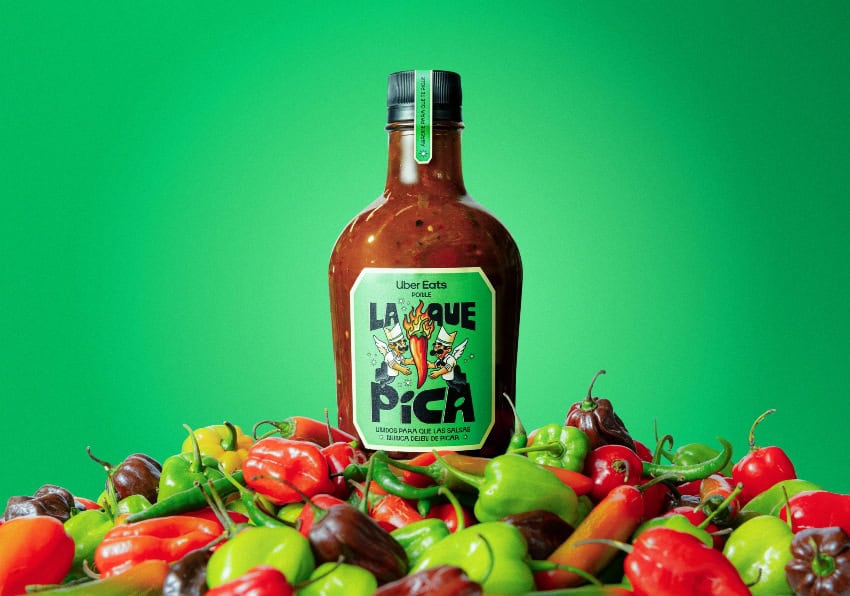
Perhaps more taquerías will join the battle as time goes on. With the World Cup slated for this summer, tourists will likely flood Mexico’s streets in record numbers — with Jurgen Mainka, director of the FIFA Office in Mexico, reporting no fewer than 500 million ticket requests to date.
To be sure, those visitors should all be greeted in the most Mexican way possible: with unrelenting heat on the tongue.
Alan Chazaro is the author of “These Spaceships Weren’t Built For Us” (Tia Chucha Press, 2026), “Notes from the Eastern Span of the Bay Bridge” (Ghost City Press, 2021), “Piñata Theory” (Black Lawrence Press, 2020), and “This Is Not a Frank Ocean Cover Album” (Black Lawrence Press, 2019). He is a graduate of June Jordan’s Poetry for the People program at UC Berkeley and was selected as a Lawrence Ferlinghetti Poetry Fellow at the University of San Francisco. His work can be found in NPR, The Guardian, SLAM, GQ, L.A. Times, and more. He is currently based in Veracruz.