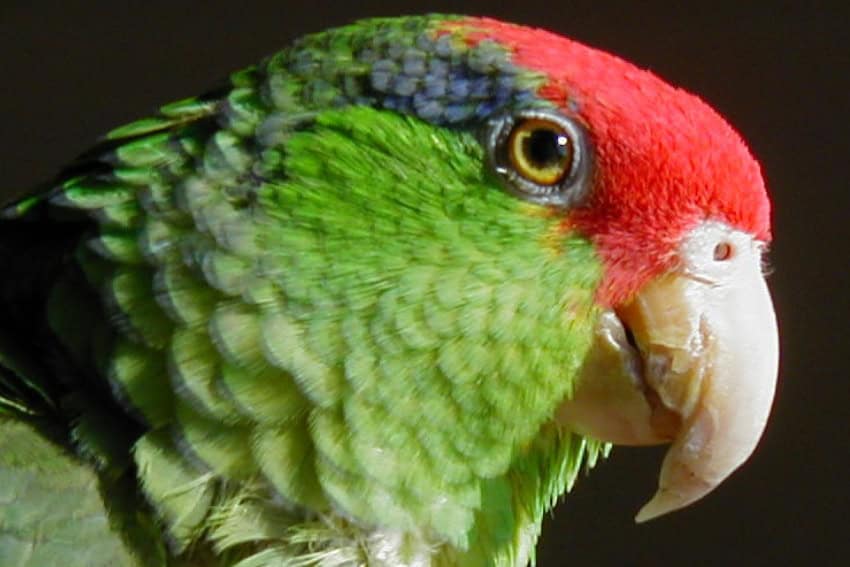
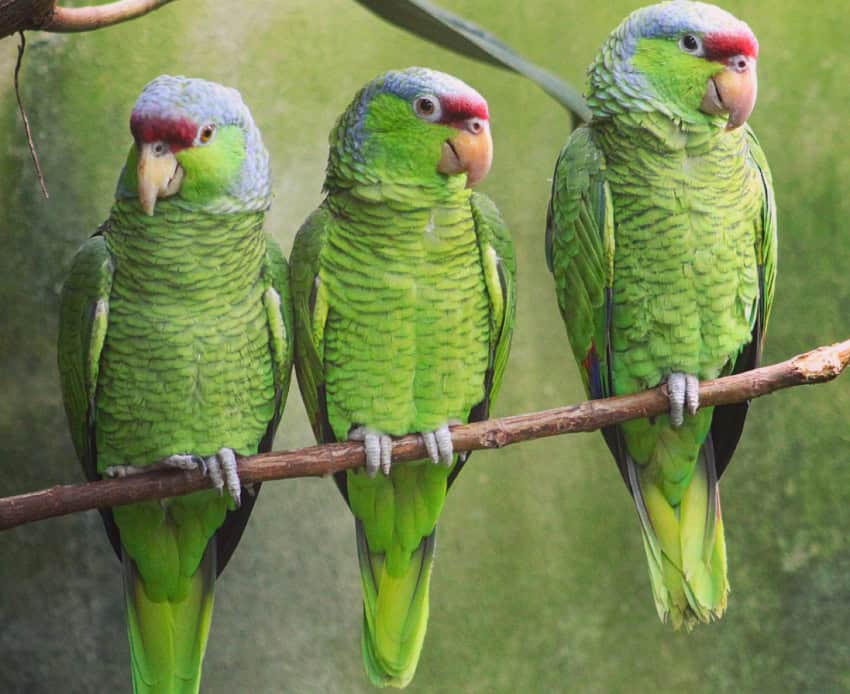
The red-crowned Amazon (Amazona viridigenalis) — a chunky green bird with a bright-red forehead and crown, a dark-blue streak behind the eyes and light-green cheeks that’s endemic to Mexico’s lowland forests and floodplain areas — has in recent years lost between 50% and 85% of its original habitat, causing a population decrease as well. But the current exact numbers of this species of parrot are uncertain.
The International Union for Conservation of Nature (IUCN)’s Red List, the bible for information on endangered animals, notes that there has not been a survey of the red-crowned Amazon since 1994, when there were estimated to be between 3,000 and 6,500 birds in existence, with 2,000 to 4,300 breeding adults. Numbers have probably declined since then, but there is an urgent need for an up-to-date survey.
A bird cursed by its own popularity
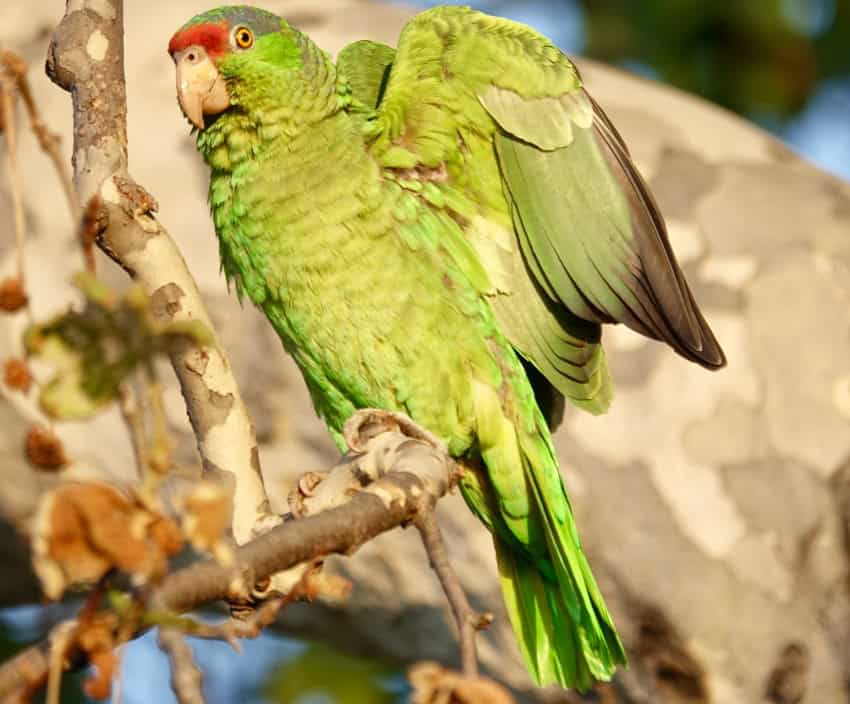
The IUCN lists the species as endangered, and any detailed survey in the future is more likely to bring bad rather than good news. Case in point: A 2021 report based on causal observations suggested the wild Mexican population was concentrated in three areas. When a small population of any animal fragments in this way, that is usually taken as a danger sign. However, during the nonbreeding season, the red-crowned Amazon is known to wander over large areas, and it is hoped that the three populations might still interact.
Over many decades, the population in Mexico had been hit by a one-two punch of habitat loss and the capture of the birds for the pet trade. It is a curse of the red-crowned Amazon that it makes a very good pet. It can live for over 50 years in captivity if properly cared for, and it is an affectionate and playful bird, as well as an excellent mimic.
When the pet trade in parrots reached its peak between 1970 and 1982, around 16,000 red-crowned parrots were legally imported into the United States. The species lived at the northern extent of the parrot’s range, relatively close to the U.S. border, making them a favored target for the illegal trade; this may have removed an additional 5,000 birds a year from the wild population. Nestlings were the easiest to capture, and this led to a particularly high mortality rate. For every bird that made it to the U.S., another had probably died along the way.
The banning of the parrot trade
The Mexico parrot trade was banned in 2008, which helped considerably. The easiest way to smuggle any rare animals is to create false documents and then openly take them across borders; that option was now closed.
Ironically, it is the pet trade that might yet save the bird from extinction. Several parrots have escaped or been released when their owners grew tired of them, and many of these intelligent and adaptable birds have survived in the wild. There are now populations of red-crowned Amazons in Texas, Hawaii, Puerto Rico, Florida and Southern California. Altogether, the total U.S. population is estimated at roughly 4,700 birds, which probably outnumbers the Mexican population, which inhabits parts of Eastern Mexico: Southern Tamaulipas, Eastern San Luis Potosí and Northern Veracruz, with sightings also in Nuevo León.

A Brownsville favorite
One colony is based around four cities in southern Texas — Brownsville, Harlingen, McAllen and Weslaco — where it is not uncommon to see large numbers of the parrots gathered in gardens and parks. Texas was the first stop in the U.S on the transport route for both legal and illegal parrots, and several probably escaped while being brought over. This might include many illegal birds released if the truck they were being carried in looked in danger of being stopped by the authorities.
Of all the species’ adopted homes, Brownsville has developed a particular soft spot for the bird, and the Joe & Tony Oliveira Park — a civic space with athletic fields and courts, picnic areas and a skateboard park — is famous for the evening gathering of squawking parrots. In 1992, the red-crowned Amazon was declared Brownsville’s official bird.
An introduced species often harms the native wildlife, but these parrots present a happier story. They are dependent on resources that, like themselves, have been introduced to Texas. They feed on the seeds of imported ornamental plants and prefer to nest in another nonnative tree, the palm. This means that they do not compete with native birds for resources.
Red-crowned Amazons in Texas can be found in parks, large gardens and even the parking lots of big shopping centers where shade trees have been planted. The parrot’s dependence on palm trees is perhaps the reason that the steady growth in numbers over many years appears to be leveling out. The dead palms that the birds nest in are considered unsightly and possibly dangerous and tend to be removed. In parts of Texas, the red-crowned Amazon may have reached the limit of suitable nesting sites.
A migration mystery
The reason the Texas population is so interesting is that there is some debate about whether all the red-crowned Amazons in this part of the U.S. were brought there by humans. Some 25 species of parrots have formed self-sustaining populations in 23 states across the country, and, in most cases, the distance from their natural home leaves little doubt that these colonies originated from escaped pets. However, in the case of the red-crowned Amazon population in Texas, the matter is not so certain.
The distance to their Mexico homelands is roughly 180 kilometers, and while red-crowned Amazons do not make annual migratory flights, times of stress, such as severe winter weather or drought, can see them appear outside their normal range. Newspaper reports suggest flocks of parrots, likely to be red-crowns, were seen in Texas during the late 1880s, and those birds almost certainly got here on their own wings. Those birds did not establish a permanent colony, however, and the present population dates back to around the 1970s.
Theories on red-crowned Amazon populations in Texas
One theory, however, is that the historic freeze of 1983–1984 might have forced some of these birds to leave their Mexican home and fly north, where they joined escaped birds already established in Texas. The same cold winter might have killed many palm trees, the soft decaying wood helping the new arrivals find nesting sites. In June 2019, the U.S. Fish and Wildlife Service weighed the evidence and announced that the red-crowned Amazon should be considered a native bird to the Rio Grande Valley.
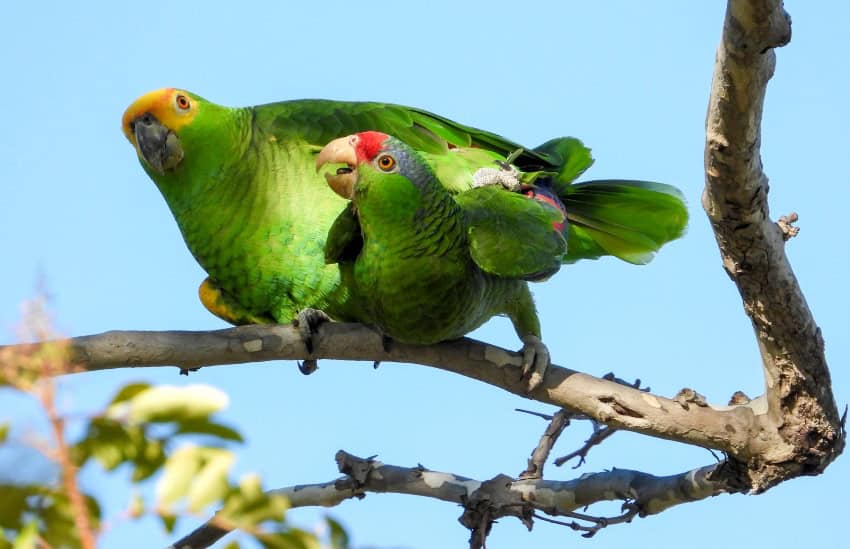
In Mexico, the parrot has seldom made the move into urban areas, although there are noteworthy exceptions. Monterrey has a significant population of parrots, as does the smaller Nuevo León community of Hidalgo. As in the U.S., these populations might well have been formed by escaped pets. But in the U.S., the bird is only found in towns and does not seem to have been tempted into the countryside.
Threats to Mexico’s red-crowned Amazon population
There are problems for the U.S. parrots: Cats might take young birds, but they probably face fewer predators than in the wild. But in Mexico, beyond habitat loss — in Tamaulipas, for example, the Global Forest Watch organization reported in 2021 that 80% of the state’s lowland forest had been cleared for agriculture and pasture — another real extinction danger the parrots face in Mexico is altogether more complex: potential hybridization.
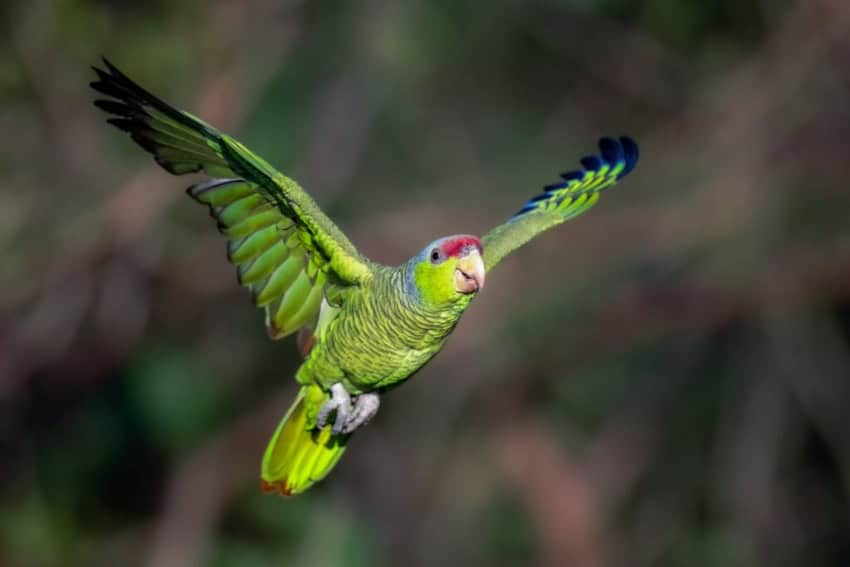
The lilac-crowned is another Mexican parrot that has escaped and established itself in the United States. The two species are so similar in size and color that even experts can sometimes have a tough time telling them apart. The lilac-crowned and red-crowned Amazons have a common recent ancestor but for 2 million years have been separated, with the lilac settling along the Mexican Pacific Coast and the red-crowned Amazon the Atlantic. In Texas, the birds are seen together in the same flock and probably interbreed. Hybridization is not a major issue in the U.S., but it might undermine future attempts to increase the Mexican population by introducing birds from California or Texas.
Continued dangers from the illegal parrot trade
The illegal trade from Mexico has continued, although on a far smaller scale than in the past. The breeding of birds in captivity has helped to lower the price, although sadly, parrots brought in from Mexico are cheaper than those bred as pets, so the trade has not been totally eliminated. Between 1992 and 2005, 3.67% of the total Mexican parrots seized by the authorities were red-crowned Amazons. That represents about 59 birds.
While this is a vast improvement on the situation of 40 years ago, these birds have been taken from a far smaller population. Each case brings its own level of suffering. In May 2025, 17 parrots of various species, including two red-crowned Amazons, were seized by the U.S. Fish and Wildlife Service Office of Law Enforcement. The birds were found bound and hidden under a car seat.
Other dangers in Mexico
Much of their Mexican home is located in noted cartel strongholds, and there is little up-to-date information on the birds’ status. While poaching has declined in the wild, the destruction of the birds’ natural habitat continues — a practice that might well have changed in nature in recent years. Much of the forest clearance is now thought to be linked to the drug trade, with trees being cut down to make growing fields and landing strips. Any future crackdown on the drug trade is likely to push growers further into the hills and is likely to endanger the birds’ last refuges.
The red-crowned Amazon is a wonderful example of Mexico’s unique bird life. It is sad to think that to see them in large numbers, we have to go to a city park in Texas!
Bob Pateman is a Mexico-based historian, librarian and a life-term hasher. He is editor of On On Magazine, the international history magazine of hashing.