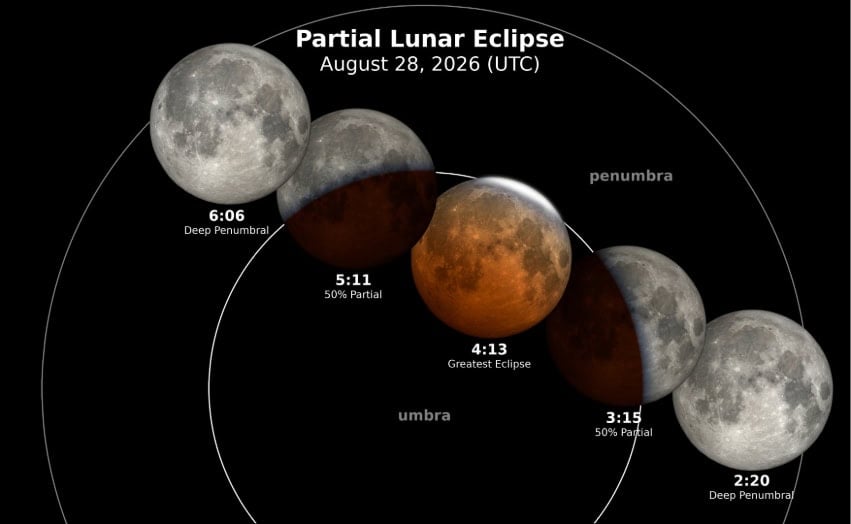
Mexico’s moon will lose much of its glimmer Thursday night as Earth’s shadow covers nearly all of it in a deep partial lunar eclipse.
The eclipse — which will darken 96.3% of the moon’s disk at its maximum — will be visible across much of Mexico, with clear skies being the deciding factor.
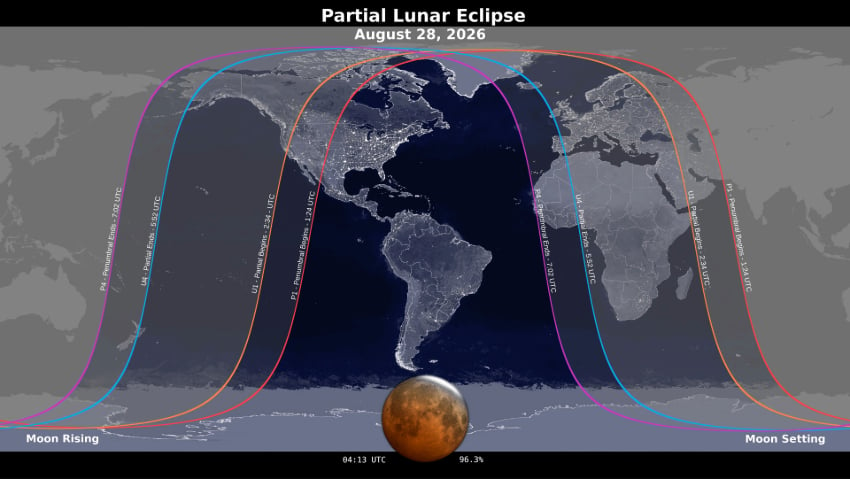
Its partial phase will begin tonight (Thursday) at 8:33 p.m. Mexico City time, reaching its maximum at 10:13 p.m. and ending at 11:52 p.m., according to NASA. The subtler penumbral phase will begin at 7:23 p.m. and continue until after midnight.
At maximum, only a thin, bright edge of the moon should remain outside the umbra, Earth’s darkest shadow.
A lunar eclipse occurs when Earth passes between the sun and moon, with sunlight filtered and bent through Earth’s atmosphere reaching the moon. Blue wavelengths scatter more readily, while red and orange tones reach and reflect from the moon, giving it a dim, coppery or reddish appearance.
Because tonight’s event is extremely close to being a total eclipse, Mexican news outlets are calling it a “luna de sangre,” or “blood moon.” The popular term describes the red appearance of a fully eclipsed moon, although it is often used loosely for deep partial eclipses.
While tonight’s spectacle is notable, it is not exceptionally rare.

Eclipses covering at least 85% of the moon’s diameter — which includes total eclipses as well as deep partial eclipses — occur somewhere in the world every two-and-a-half to three years.
In recent years, Mexico has seen total lunar eclipses in January 2019. March 2025 and March 2026 — and ordinary partial eclipses are even more frequent.
Mexico’s last major solar eclipse occurred in April 2024 and drew many international visitors, especially in the eclipse’s arc across parts of Sinaloa, Durango and Coahuila. With the moon positioned directly in front of the sun, there was nearly total darkness in those areas before the eclipse continued through the United States and Canada.
Unlike a solar eclipse, a lunar eclipse can be viewed safely with the naked eye; no special glasses are needed. Binoculars or a telescope can sharpen the view of Earth’s shadow crossing lunar craters and other features.
Expert eclipse-watching guidance in Mexico City
Mexico City residents can attend a free pre-eclipse program at the capital’s 300 PILARES community centers, where science educators will offer guidance to people who bring their own telescopes, plus other eclipse activities.
A la Luz de la Luna (By the Light of the Moon) will run from 5 to 8 p.m., ending about half an hour before the partial phase begins and more than two hours before the greatest eclipse.
Advance registration is requested via the PILARES page, where you can also locate the community center near you. PILARES says telescopes will be available for people who don’t bring their own.
With reports from El Financiero, Radio Fórmula, Wired en Español and Infobae