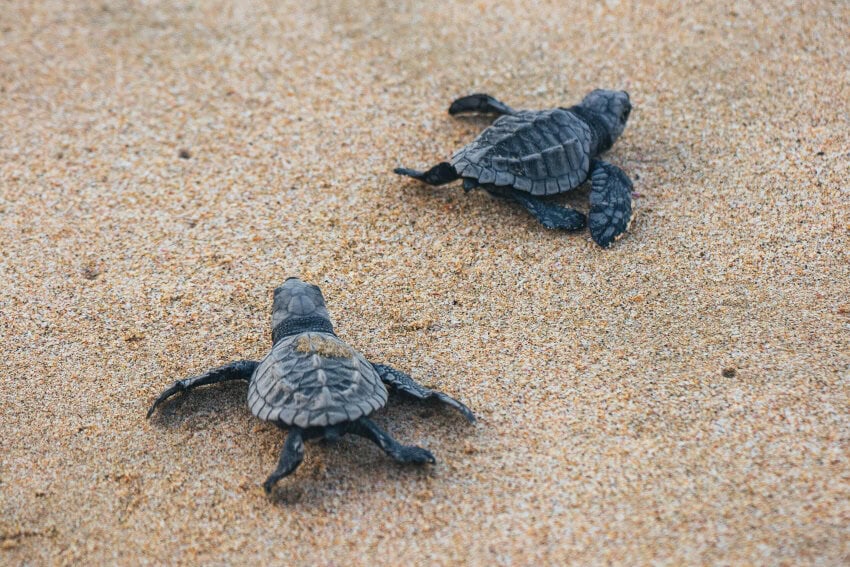
Turtle camps can be found all over Mexico’s coastline, including the Gulf Coast, allowing volunteers to liberate baby turtles.
With the fifth-longest coastline in all of Mexico — a country that is internationally known and beloved for its beach offerings — Veracruz is certainly a sea-loving state, boasting some 450 miles of Gulf Coast access. For the record, Baja California Sur, a peninsula surrounded by water on three sides, has the longest total coastline at more than 1,350 miles of beach.
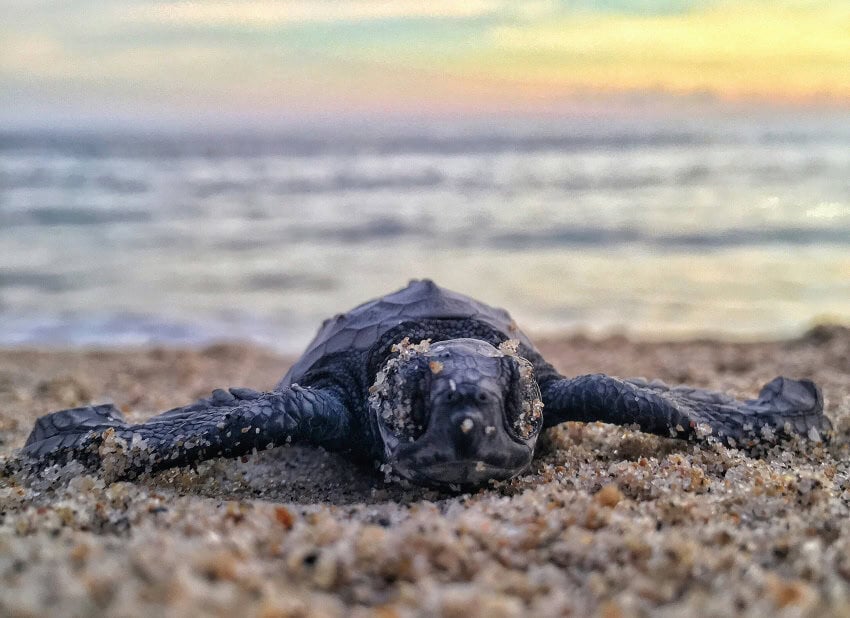
Historically, Veracruz is celebrated for its seafood and coastal tropics, as well as being the site of Mexico’s largest and oldest port with access to the Atlantic Ocean.
But what has been lost in the greater narrative is that, as part of its cultural significance along the Gulf Coast, Veracruz has also become one of Mexico’s leading states for turtle conservation.
The legacy of turtle conservationism in Mexico
The earliest federal efforts to focus on sea turtle nesting in Mexico began in 1962, led by the National Institute of Biological and Fisheries Research on both of Mexico’s ample coasts. In 1963, the Center for Turtle Culture opened on Isla Mujeres, Quintana Roo.
Record 34 million olive ridley turtles hatch on Oaxaca coast

Shortly after, in 1966, Rancho Nuevo — located in Tamaulipas, just north of Veracruz — was among the first turtle conservation camps to formally open in Mexico. The National Commission of Protected Natural Areas outlined the importance of these efforts from the mid-1960s; the investments significantly helped to maintain the growth of Mexico’s turtle populations by increasing local awareness and participation. During that time, the National Sea Turtles Conservation Program was founded as a result.
Rancho Nuevo, along with the other turtle conservation camps that would spring up all over Mexico’s beaches — from the Gulf to the Pacific — has become a crucial element of turtle protection efforts since then, utilizing a mix of dedicated turtle conservationists and public volunteers. Responsibilities include the protection of nesting sites via monitoring and safeguarding turtle nests, and assisting (or “liberating”) fresh turtle hatchlings to ensure they make it to the sea.
Milestones in national protection rights
Since the 1960s, Mexico has become a global leader in turtle conservancy; in 2025, Mexico was recognized as an exemplar for its turtle protection efforts. Currently, Mexico federally operates 26 turtle conservation centers, in addition to various independent organizations and nonprofits extending across 13 coastal states. Officials announced a record of more than 34 million newborn olive ridley turtles that reached the ocean in a single season, in Oaxaca’s Morro Ayuta region alone.
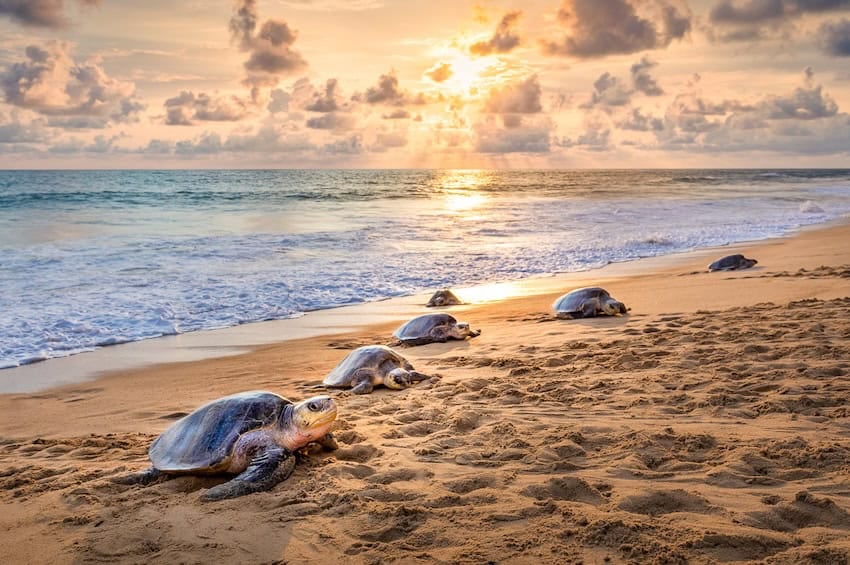
In 1990, federally backed turtle protection rights gained further ground when then-President Carlos Salinas de Gortari decreed an end to the commercial harvesting of all sea turtles and related products. The landmark move shifted former turtle hunting communities — such as areas in Mazunte, which had among the highest rates of turtle slaughter — into epicenters of turtle conservation. Mazunte opened the Mexican Turtle Center in 1991, aiding the area’s turtle population and ecotourism alike.
Mexico’s role as a sanctuary for sea turtles
According to a 2008 report from the Secretariat of Environment and Natural Resources (Semarnat), “Mexico is the country with the largest number of sea-turtle species worldwide. Seven of the eight species known … nest in Mexican beaches, both in the Pacific and in the Gulf of Mexico and Caribbean littorals: loggerhead turtle, white or green turtle, black turtle, hawksbill turtle, Kemp’s ridley, olive ridley and leatherback turtle. Two of them, Kemp’s ridley and black sea turtle, nest exclusively in Mexican beaches.”
A more recent investigation from 2023, published in Revista Mexicana de Biodiversidad, revealed that southeastern Mexico, including Veracruz, is the most diverse region for turtle conservation in the country: “According to our results, southeastern Mexico supports three-fourths of the families — and more than half of the genera — found nationwide in Mexico. These findings highlight southeastern Mexico as a region of high importance for the composition of land and freshwater turtles at the national level … Oaxaca, Chiapas and Veracruz stand out as the states with the highest species richness and endemism, respectively. These three states are located within the region considered the richest in total herpetofauna, a result of complex orography, diverse habitats and environments, and the biogeographic history of Mexico.”
Tamaulipas reports a strong nesting season for the world’s rarest sea turtle
An afternoon with turtle conservationists in Veracruz
Jeanne A. Mortimer, a world-renowned marine biologist known as “Madame Torti” who specializes in sea turtle conservationism, once wrote that “The importance of the central coast of Veracruz (for turtle nesting) may be attributed to the fact that the beaches are easily accessible from the ocean without great obstacles like rocks, pronounced slopes or coastal developments that prevent the movement of the adult females along the length and breadth of the beaches.”
It partially explains why Veracruz has been able to cultivate a long-lasting ethos and engagement around turtle protection, with civic initiatives like Fundación Yépez and the Veracruzano Center for Research and Conservation of the Sea Turtle having launched decades ago. Additionally, Veracruz boasts Veracruz Reef System National Park, which played a role in a major environmental ruling by Mexico’s Supreme Court to conserve sea turtle habitats by restricting the construction of industrial ports in endangered areas (although reports that the ruling hasn’t been properly enforced have been published).
Vida Millenaria is among Veracruz’s most prominent turtle conservation groups. The project began in Tecolutla in 1974 as a personal mission for Fernando Manzano, whom locals began to call “Papá Tortuga,” or Turtle Father. Over half a century later, his efforts have expanded to include other members.
To date, the nonprofit has protected and released thousands of baby turtles each year. Visitors arrive year-round to receive public education and help to release newborn turtles into the water along the beaches on the city’s northern outskirts, about a 20-minute drive from the town’s center, along a mostly deserted dirt path.
Camping under the stars in Tecolutla
View this post on Instagram
I personally drove out to experience it for myself. Depending on your budget, you can rent a group-sized or personal tent near the beach at a campsite that includes outdoor showers, bathrooms and a common area for campers and volunteers who arrive at different hours of the day to participate in the turtle release. The camp area is shaded by palm trees and is relatively cool due to the strong coastal breeze.
The camping experience adds a layer of memory-making, as you sleep beneath the moonlight on a private, mostly isolated beach while the waves wash ashore in the near distance. A rotation of Vida Millenaria workers takes turns patrolling the area on ATVs around the clock, mostly to keep an eye on the turtles and their nests. (Note: If you decide to camp overnight, be sure to bring plenty of supplies, water and food, as a one-way trip back into town requires more than 20 minutes of off-roading to reach the edge of Tecolutla). There, you can enjoy a paradisiacal beach to yourself, undisturbed, until the next day.
A volunteer brigade assembles
Early in the morning, around 7:30 a.m., volunteers of all ages begin to arrive and assemble at the center of camp. A local expert introduces the nonprofit’s history, and a musician plays music dedicated to sea turtles. Maps and visuals are used to show and explain a brief history of turtle conservation in the state, and an adult-sized turtle replica stands in as a faux mascot for guests to take pictures with.
Afterwards, participants are escorted to the nearby souvenir shop, where everything is turtle-related (of course) and handmade. Each purchase grants a set of baby turtles for group liberation — so the more things you buy, the more turtles you’re able to liberate (prices start around 150 pesos and include turtle plushies, stuffed animals, mugs, shirts, etc.). For breakfast, a local volovanero (a savory pastry vendor common in Veracruz) brings a freshly baked batch for about 50 pesos each.
Releasing hatchlings into the wild
Then, the finale: Everyone strolls down to the beach together, lines up, and is given baby turtles to release into the ocean together. It’s a spectacular sight to see upwards of 50 small creatures — more or less, depending on the volunteer group’s size that day — crawling their way into the waves for the first time. They are swept away, their tiny heads occasionally poking out from the shimmering waters before completely disappearing into the distance by the dozens.
Of course, if you’re nowhere near Veracruz, you can search for your nearest beach. You’ll likely discover a turtle conservation group awaiting your participation. It makes a memorable weekend trip — and most importantly, it helps to keep an essential part of Mexico’s ecosystem intact.
Alan Chazaro is the author of “These Spaceships Weren’t Built For Us” (Tia Chucha Press, 2026), “Notes from the Eastern Span of the Bay Bridge” (Ghost City Press, 2021), “Piñata Theory” (Black Lawrence Press, 2020), and “This Is Not a Frank Ocean Cover Album” (Black Lawrence Press, 2019). He is a graduate of June Jordan’s Poetry for the People program at UC Berkeley and was selected as a Lawrence Ferlinghetti Poetry Fellow at the University of San Francisco. His work can be found in NPR, The Guardian, SLAM, GQ, L.A. Times, and more. He is currently based in Veracruz.