
Here’s a dad joke I haven’t yet heard from a Mexican dad.
Setup: “Hey, can you tell me what time it is?”
Punchline: “Time for you to get a watch!”
Ha. Ha!
That, my friends, is what I call a classic dad joke. “Dad jokes,” of course, are the kinds of jokes that are so bad, they make you roll your eyes. But they also — don’t lie — make you smile. They’re not necessarily hilarious; they simply exist to help you loosen up. (And if you ask me, we could all use some loosening up.)

And guess what? Mexico’s got its fair share of dad jokes, too. And legitimately hilarious jokes. Funny is in the eye of the beholder, I suppose, but if you don’t find Mexican humor objectively hysterical, then you, my friend, are missing out.
The land of laughs
Mexico, as you surely know, is well known for its humor. Actually, it’s one of the things I love best about living here.

It’s true, there are situations in which people take themselves much too seriously. But overall, your average Mexican’s ability to crack a joke about pretty much anything is paralleled by few others in the world.
Many jokes are often a fascinating cross between hopelessly juvenile yet unexpectedly complex. They crack up the 12-year-old in you while making your adult brain work hard to connect the dots. All humor is “complex,” I suppose, but certain aspects of Mexican humor, like the albur, have been elevated to an art form. They even have competitions that make Eminem’s rap battle scene in “8 Mile” look like child’s play by comparison.

Participatory, competitive, hilarious battles of wit: sign me up! (Just to watch, though, not compete. I’m not quick on my feet and need 2-3 business days to come up with a single clever comeback.)
The art of humor in Mexico: los albures
Ask any Mexican about homegrown humor, and they’ll say the same thing. Nothing beats albures.
What are albures, you may ask? They all share these features: 1) they’re plays on words, i.e., have double meanings, 2) the funny meaning is always sexual, and almost always references a sexual organ (usually the penis, because machismo), and 3) you got to be real smart to catch them, and smarter still to answer them with an albur of your own.
Also important: you must remember this common wisdom: El que se enoja, pierde. (“He who angers, loses.”) You can’t be all intense and worked up about it. It’s for laughing. Laugh. Loosen up, relax those shoulders.
Just ease right on in. (See? I just did it in English! Kind of.)
Disculpe, ¿tiene huevos?
The most important thing to remember? It’s all about sex.

I mean, what isn’t, amiright? But to successfully tell or understand an albur, you must have a dirty mind. Imagining everything as phallic or … vagina-like? Do we have an equivalent to phallic? — is the first step (Editor’s note: The word you want is yonic).
For some reason, this is especially true with food. That’s why, too, you’ve got to be careful with what you say, lest you accidentally alburear.
Asking someone at the store or a market if they “have” eggs — or milk, or bananas or papaya — is going to get you a reaction. It might be a stifled laugh, it might be an incredulous ¿Ora? (“What did you just say?!”). The sky’s the limit!
If you don’t want to do that, might I suggest the verb haber (“there is/there are”). ¿Hay huevos? This is a good way to ask without inadvertently referencing the attendant’s genitals. You’re welcome!
Not all jokes
Believe it or not, there are a few jokes people tell that aren’t about sex. There is a lot about alcohol, too!
Here’s an example of one that people love to tell over and over again. If you have a sore throat, tequila (sometimes with lime and honey) is a suggested remedy. And they always add, Y si no se te cura, se te olvida! which cracks them up. (English translation: “And if it doesn’t cure you, you’ll forget about it!”).
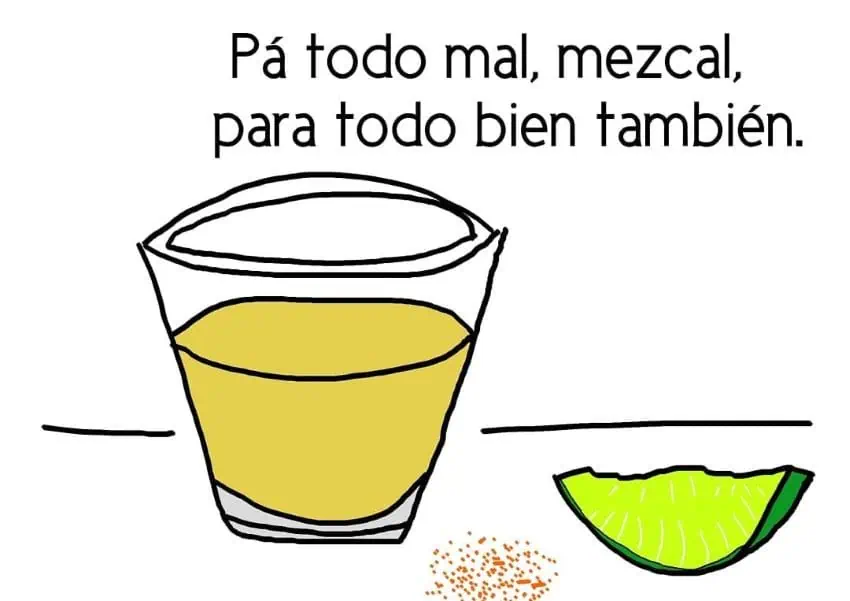
Another: Para todo bien, mezcal, y para todo mal, también. (“For good times, mezcal, and for bad times, too.”)
To wrap things up, here’s a more classic dad joke I recently saw. Dicen que para ser feliz hay que tener fé, pero entonces solo sería Liz. (“They say to be happy you have to have faith, but then I’d only be Liz.” The joke: fe-liz. Get it? Don’t let your eyes get stuck in your head when you roll them.)
This article was originally published in 2024. It has been lightly edited for updates and clarity.
Sarah DeVries is a writer and translator based in Xalapa, Veracruz. She can be reached through her website, sarahedevries.substack.com.