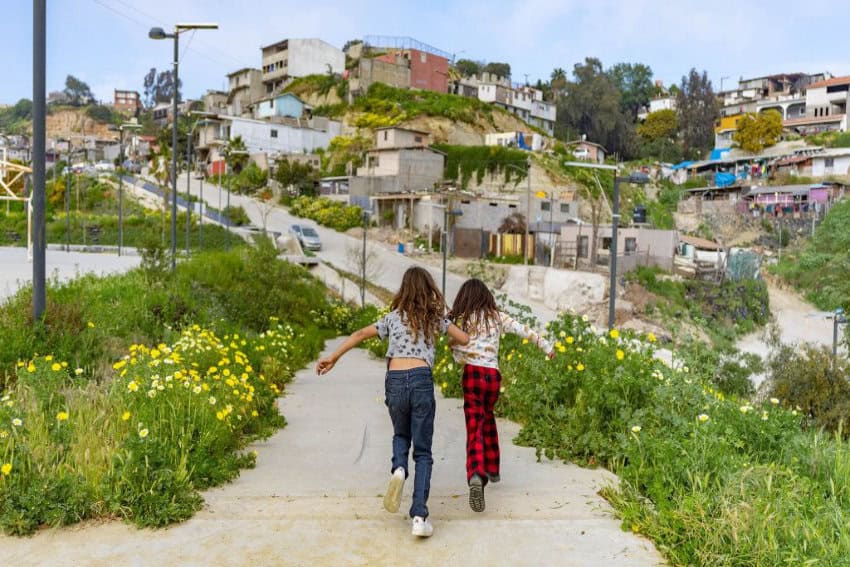
On the outskirts of Tijuana, in an unassuming residential area, sits Xicoténcatl Park, a community space opened in 2020 that’s been noticed worldwide as a best-practices urban renewal project — one that did what these sorts of projects should do, but don’t always: take into account the needs of the community that will use it.
That community is made up of about 5,000 former migrants from Central America, the Caribbean and Africa who were unable to cross the border into the United States and ended up settling in this marginalized area near the Mexico-U.S.border. Today, what started as an irregular encampment on empty land has grown to about 5,000 people inhabiting an urbanized area on a hillside populated by modest homes. Over time, the community began transforming a stream bed facing the community into a makeshift public space by filling it in with debris and leveling the ground for recreational use, a decision that marked the beginning of the park’s story.
A design pivot
Initially intending to simply improve urban blight and prevent flooding, Mexico’s Ministry of Agricultural, Territorial and Urban Development (Sedatu) had planned in 2019 to construct sidewalks here and clean the stream bed in order to channel stormwater runoff. However, the situation changed when the project’s contractors arrived and saw what the residents had done.
“We realized that tons of rubble had been dumped into the bed, altering the flow of water, dividing the community and creating areas of extreme violence,” explained Loreta Castro Reguera from Taller Capital, the firm that developed the project in collaboration with the School of Architecture at the National Autonomous University of Mexico (UNAM).
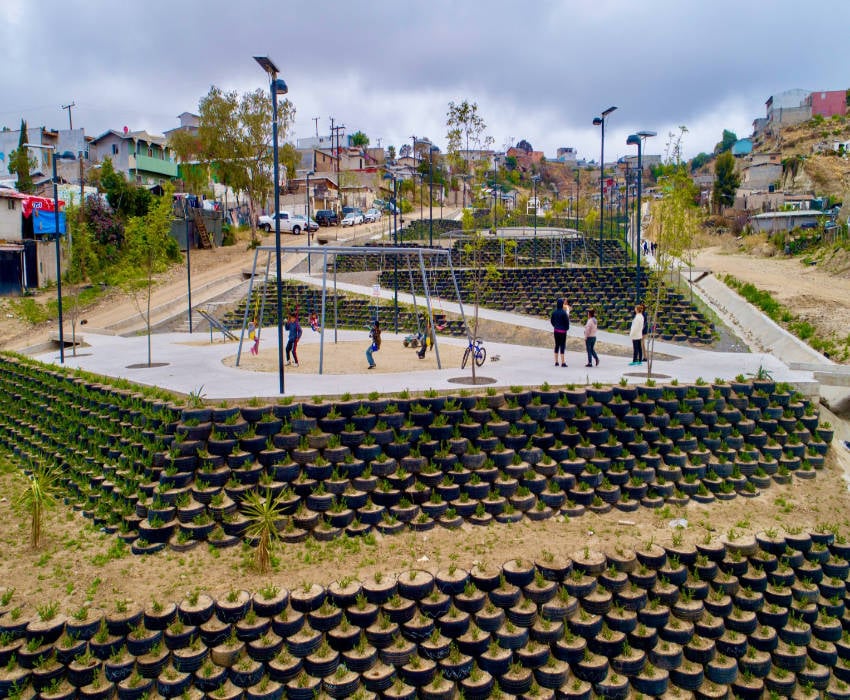
The designers proposed using some of the rubble in the ravine to transform it into a safer, more appealing park space by building platforms. They also championed a popular local construction method called llantimuro, which creates structures like retaining walls and fencing out of piles of used tires arranged in an aesthetically pleasing way.
Border cities like Tijuana receive millions of used tires imported from the United States each year, often abandoned in riverbeds and in marginalized areas in large, unsafe and unsightly piles.
“The tire-wall system supports the land where the platforms have been built. We created nine descending platforms that now function as public spaces, and these platforms help guide rainwater runoff straight to the sea and have formed one of the city’s largest gardens, connecting people on both sides of the stream,” Castro said.

A place for neighbors to meet and connect
Designers used the tires to construct a series of concrete and earth platforms, creating elevation changes of over 15 meters along a length of 390 meters. The tire wall also created habitats for at least 84 trees, 890 shrubs and 13,400 succulents, creating appealing landscaped green spaces.
The park features multipurpose courts, playgrounds, seating areas, a meditation area and walking paths. The project also constructed perimeter channels to divert rainwater runoff and keep streets clear of water by directing it downstream to less disturbed areas of the Xicoténcatl Stream.
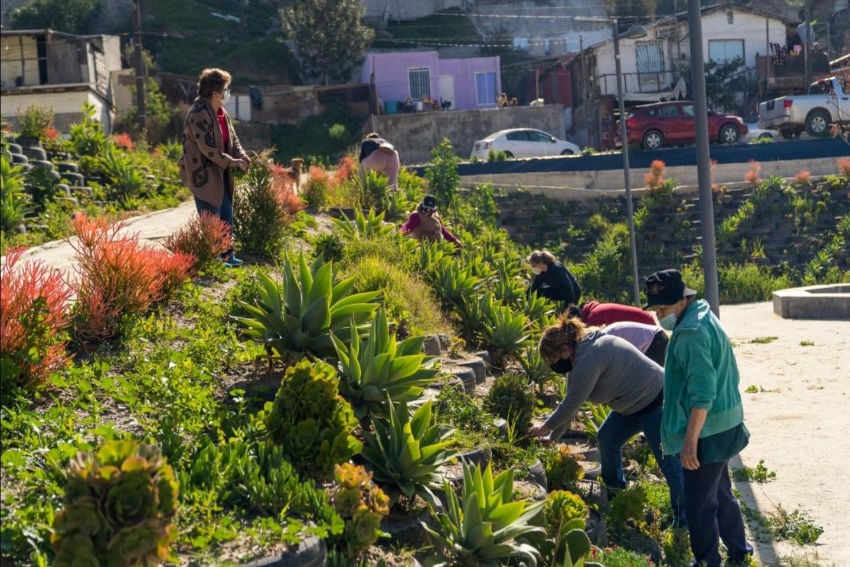
Also, importantly, Xicoténcatl Park by uniting the 5,000 residents living on both sides of the stream bed, has promoted social connections among neighbors.
“It has also fostered a sense of community responsibility for its upkeep,” Castro said.
A multi-award-winning park
Since Xicoténcatl Park’s opening in 2020, its unique context, inspiring story and numerous benefits to the community have earned it international attention.
The project has received eight international awards in countries as varied as Chile, Spain, Ecuador, the United States and the United Kingdom. These awards have included the 2020 Architectural League of New York Award, the 2020–2021 Architectural Review Emerging Architecture Award, the 2020 Quito Pan-American Architecture Biennial Award and the Ibero-American Architecture and Urbanism Biennial Award. It also won an honorable mention at the Seoul Design Award in 2023 and the Make It Circular Challenge, a Dutch competition organized by What Design Can Do in collaboration with the IKEA Foundation, which invited designers, creative entrepreneurs and start-ups worldwide to envision and build a circular society.
Tijuana’s Xicoténcatl Park project exemplifies how specific local needs can be addressed with innovative solutions — which, in this case, brought a better quality of life to one of Tijuana’s often-forgotten communities.
Ana Paula de la Torre is a Mexican journalist and collaborator for various outlets, including Milenio, Animal Político, Vice, Newsweek en Español, Televisa and Mexico News Daily.