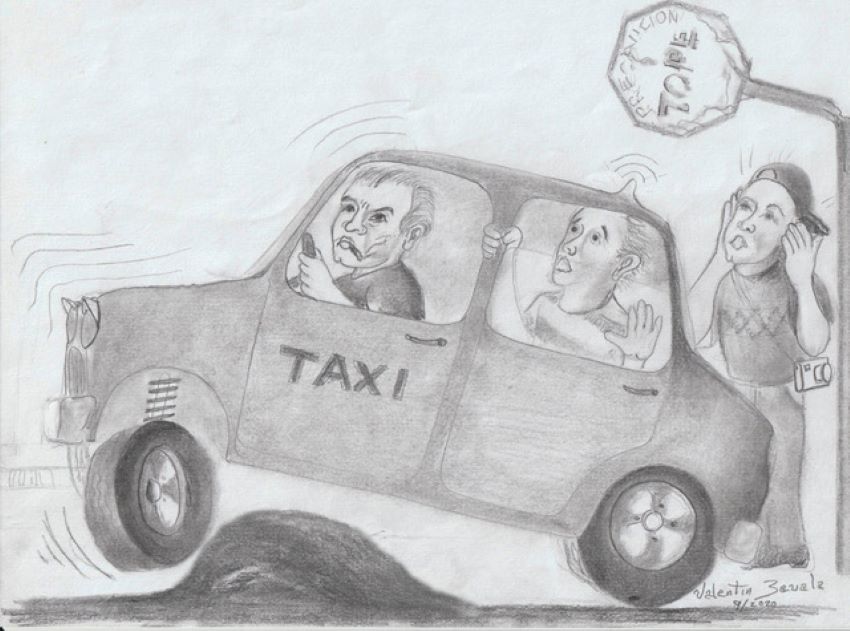
I want to meet the guy who came up with the idea for topes.
For those fortunate few who don’t know what topes are, they’re basically wider and higher speed bumps than you’re probably used to that are randomly placed on many Mexican roads for no apparent reason.
Well, that’s not fair. There are apparent reasons. Mexicans tend to drive like maniacs. The idea behind topes, I guess, is to get Mexicans to at least slow down. Getting them to drive safely is pretty much impossible.
The thing about topes is, they really don’t get drivers to slow down. What they get them to do is burn out their brakes and clutches.
This is the way it works: people drive at their normal reckless speed until they see a tope. Then they slam on the brakes, slowly climb over the tope and speed away.
There are some places where officials apparently have some kind of heart because they’ve put up warning signs that you’re approaching a tope or have painted the tope with white or yellow stripes to alert you. To be honest, the signs don’t give you a heck of a lot of warning, and the paint on virtually every tope I’ve ever seen has faded to worthlessness. That means that just after many topes you’ll often see cars pulled over with someone underneath trying to patch the undercarriage back together.
But if individual topes are bizarre, “tope zones” take it to a whole other level.

As their name suggests, tope zones are places that have several topes in a short stretch, often just a few feet apart. Driving through one of these zones is kind of like being on a demented amusement park ride.
As usual, a driver will approach a tope at top speed, slam on the brakes and then slowly drive over it. He will then accelerate to make it as quickly as possible to the next tope, where he’ll slam on his brakes again. This pattern is repeated until he’s finally out of the zone, at which time the driver may be incapacitated with a severe case of whiplash.
I guess topes are a noble first attempt to make the roads safer, but someone has to accept that they’re simply not working. I mean, we’re dealing with a nation of people who are in such a rush that they think nothing of passing a truck while going uphill on a blind curve on a two-lane mountain road — where there are no guardrails between you and the valley bottom several hundred feet below. This is not an exaggeration: I’ve been in vehicles doing exactly that.
So, does anyone really think that a lousy bit of raised asphalt slapped into the middle of the road will do all that much to change things?
I have my doubts.
Joseph Sorrentino is a regular contributor to Mexico News Daily.