THE MND MEXICO WELL-BEING SERIES
A data-driven look at well-being in Mexico
MND Intelligence · Part 2: Education
Last month, we launched the MND Mexico Well-being series, a collection of articles designed to complement — and more importantly, supplement — the MND Sheinbaum Index™ and the MND Economy Index™, both of which we publish on a monthly basis.
Part 1 of the series focused on eight key health and healthcare indicators.
In the inaugural article, we noted that the MND Mexico Well-being series would present a range of data that is directly relevant to Mexicans’ well-being, including indicators in the areas of education, healthcare, poverty, happiness and gender equality.
In this series, we draw on the most recent internationally comparable data, as well as data from the past decade, to compare Mexico to other countries and assess what has changed in Mexico during the eight years that the ruling Morena party has been in office.
As we previously noted, improving the well-being of Mexico’s most disadvantaged people is a stated priority of both Morena and President Sheinbaum.
Today, we continue the MND Mexico Well-being series with Part 2, which focuses on education. As with health and healthcare, there are numerous education indicators we could examine. For this article, we selected eight that we believe are among the most important.
Before we delve into the data, it’s worth remembering that the majority of Mexican primary and secondary school students (around 84% in the 2024-25 school year) are enrolled in Mexico’s public education system rather than the private education system.

Just as patients’ experiences can vary considerably within and between Mexico’s public and private healthcare systems, students’ experiences can differ widely within and between its public and private education systems, depending on the resources, facilities and teaching staff available.
One issue that causes periodic disruptions in education in Mexican public schools — particularly in some states — is teachers’ protests and strikes. For example, almost 20,000 schools across Mexico — including 95% of those in Oaxaca — closed for a period last year while CNTE union-affiliated teachers were on strike. Teacher absenteeism is another story, which MND has covered extensively over the years.
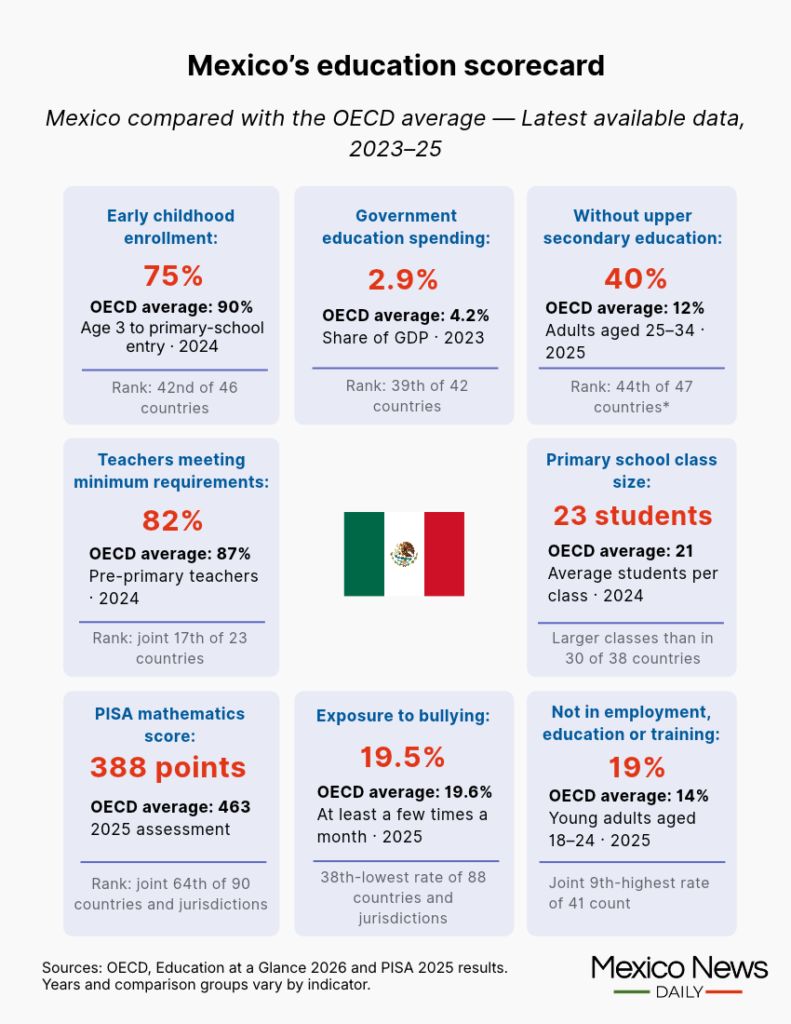
Below you will find a snapshot of education in Mexico. In parentheses after the subheading for each of the eight indicators we present is Mexico’s comparative position among the countries for which comparable OECD data was available, expressed as a decile where the size of the comparison group allows for one.
Before we look at each of the eight education indicators, a reminder that we are always interested in hearing about your views on the issues we cover. What do you think about education in Mexico? Please share your views or experiences in the comments section below.
* The data in this article comes from the OECD “Education at a Glance 2026” report, unless otherwise specified.
EARLY CHILDHOOD EDUCATION ENROLLMENT RATES (bottom decile)
According to UNICEF, “Decades of evidence show that the first few years of a child’s life are critical in supporting their physical, mental, and emotional development long-term.”
“Because of how quickly children’s brains and bodies are growing – particularly in the first three years of life – the experiences they have can have lifelong effects. One of the experiences that can help is high-quality early childhood education and care (ECEC),” UNICEF says.
Consequently, we chose to include Mexico’s ECEC enrollment rates in this report.
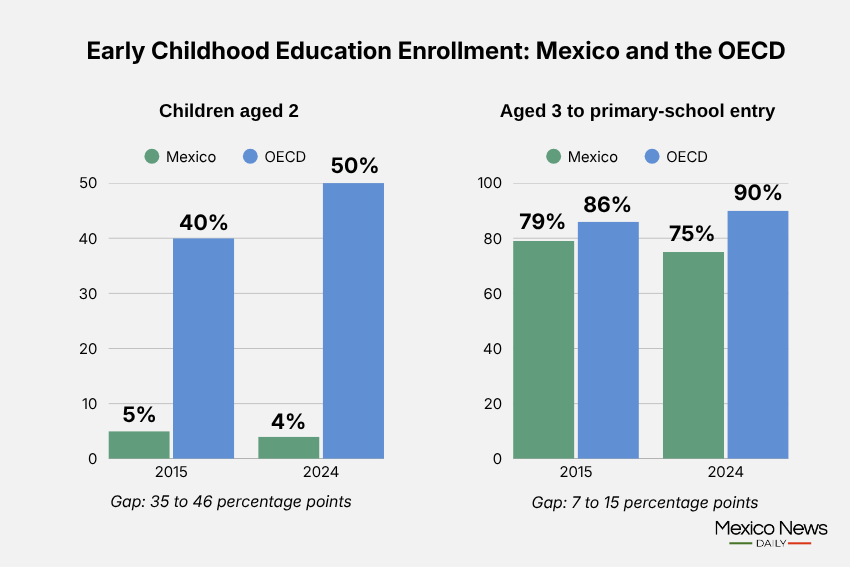
Among two-year-old children in Mexico in 2024, just 4% were enrolled in early childhood educational development programs that meet the criteria of the International Standard Classification of Education (ISCED) by combining education and care. The OECD average was significantly higher at 50%. Mexico ranked last on this measure among 30 OECD and OECD partner/accession countries for which comparable data were available.
Among children between the age of 3 and the starting age of primary education, 75% were enrolled in ECEC in Mexico in 2024. The OECD average was 90%. Mexico ranked 42nd on this measure among 46 OECD and OECD partner/accession countries for which comparable data were available. It was thus in the lowest decile among the countries assessed. The only countries with lower enrollment rates than Mexico in 2024 were Saudi Arabia, Turkey, Indonesia and Costa Rica.
According to a 2021 Inter-American Development Bank (IADB) report, public child care services in Mexico “are fragmented across various institutional agencies serving different population groups — largely children of formal workers, with different care modalities and different regulatory frameworks.”
In a country where more than half of workers are employed in the informal sector, “these many factors make coordination in the child care sector very challenging and exacerbate inequalities in access,” according to the IADB.
Has Mexico improved on these indicators over the past decade?
No.
The early childhood education enrollment rate was 5% among two-year-olds in Mexico in 2015, one percentage point higher than in 2024. The OECD average was 40% in 2015. The gap between the enrollment rate in Mexico and the OECD average widened from 35 points in 2015 to 46 in 2024.
The ECEC enrollment rate in Mexico among children between the ages of 3 and the starting age of primary education was 79% in 2015, four points higher than in 2024. The OECD average was 86% in 2024. The gap between the enrollment rate in Mexico and the OECD average widened from 7 points in 2015 to 15 in 2024.
EXPENDITURE ON EDUCATION AS A PERCENTAGE OF GDP (bottom decile)
In 2023, Mexico’s government spent the equivalent of 2.9% of GDP on education, well below the OECD average of 4.2%.
Among 42 countries included in the “Education at a Glance 2026” report, Mexico ranked 39th on this measure, placing it in the bottom decile. The only countries that spent lower proportions of their GDP on education in 2023 were Ireland, Romania and Japan.
Has Mexico improved on this indicator over the past decade?
No.
In 2015, Mexico spent the equivalent of 4.4% of GDP on education. Thus, Mexico’s expenditure on education as a percentage of GDP declined 1.5 percentage points between 2015 and 2023.
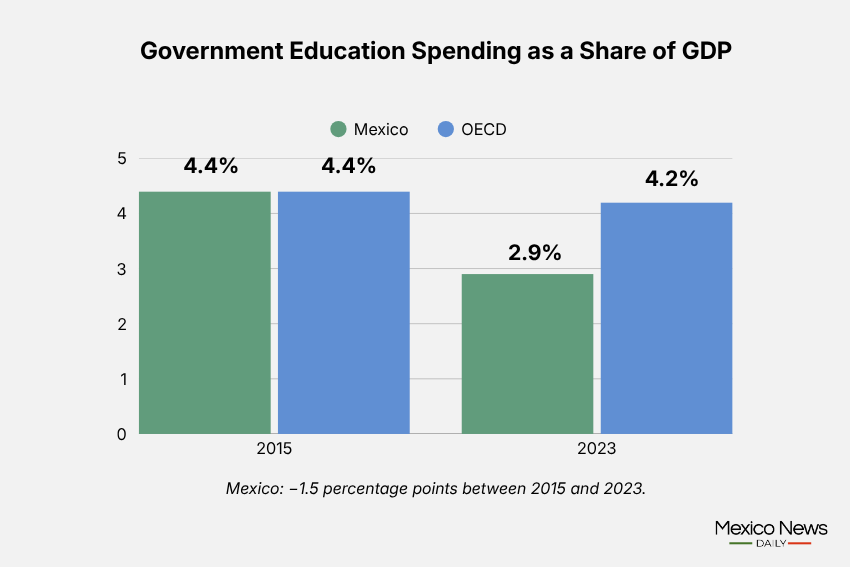
In 2015, Mexico’s expenditure on education as a percentage of GDP was on par with the OECD average, whereas in 2023, its spending was 1.3 points below the average.
The OECD noted that Mexico was one of various countries (including Brazil, Ireland and Bulgaria) that recorded a “notable” decrease in expenditure on education between 2015 and 2023.
EDUCATIONAL ATTAINMENT RATES (second lowest decile and below)
In 2025, according to the OECD, 40% of Mexicans aged 25-34 didn’t have an upper secondary education (prepa) qualification. That percentage is well above the OECD average of 12%.
Among 47 countries included in the “Education at a Glance 2026” report, Mexico ranked 44th on this measure, placing it in the bottom decile. The only countries with a higher proportion of 25-34-year-olds without an upper secondary education qualification were India (56%), Indonesia (42%) and South Africa (42%).
In 2025, 28% of Mexican men aged 25-34 had a tertiary education qualification, while the figure for Mexican women of the same age was 30%. The figure for men was 12 points below the OECD average. The figure for women was 24 points below the OECD average.
Among 45 countries included in the OECD report, Mexico ranked 39th for its tertiary attainment rate both among men and among women aged 25-34, placing it in the second lowest decile.
Has Mexico improved on these indicators over the past decade?
Yes.
In 2015, the share of 25-34-year-olds in Mexico without upper secondary attainment was 55% — 15 points higher than in 2025.
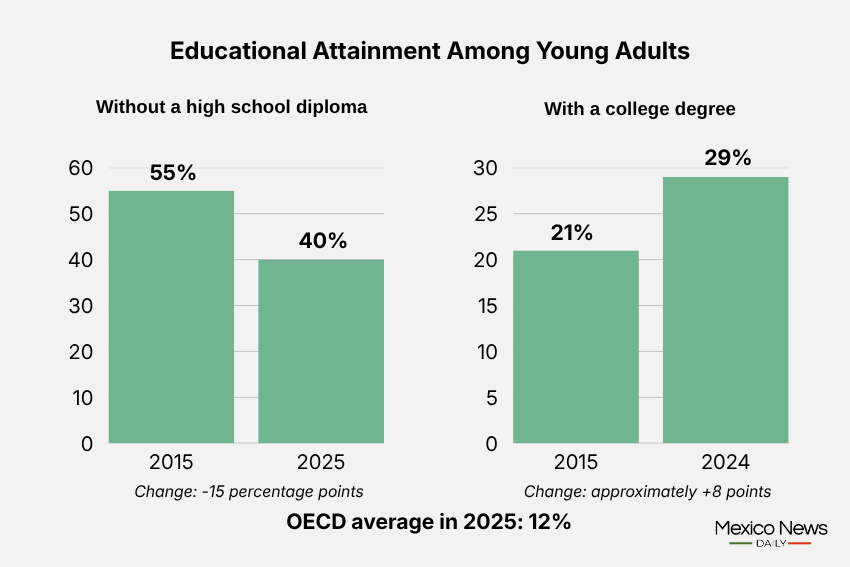
The gap between the share of Mexicans without upper secondary attainment and the OECD average was 38 points in 2015. The gap in 2025 was 28 points.
The OECD said that Mexico has made “significant progress” in reducing the percentage of the population without an upper secondary education qualification.
The percentage of Mexicans aged 25-34 with tertiary qualifications increased from around 21% in 2015 to 29% in 2025.
TEACHER QUALIFICATIONS (fourth-lowest decile and below)
Preschool, primary school and lower secondary school teachers in Mexico are supposed to have a bachelor’s degree or equivalent, but not all of them do.
In 2024, around two in ten pre-primary teachers in Mexico, and about one in ten primary and lower secondary teachers, didn’t meet the minimum national educational attainment requirements. The exact numbers were as follows:
- In 2024, 82% of pre-primary teachers in Mexico met the education attainment requirement, five percentage points below the OECD average of 87%.
- In 2024, 92% of primary teachers in Mexico met the education attainment requirement, four points above the OECD average of 88%.
- In 2024, 87% of lower secondary teachers in Mexico met the education requirement, two points below the OECD average of 89%.
For its share of teachers meeting national minimum educational attainment requirements, Mexico ranked equal 17th out of 23 countries at preschool level, 17th out of 27 countries at primary level and 27th out of 37 countries at lower secondary level.
These positions placed Mexico in the third-lowest decile for preschool and lower secondary school teachers, and the fourth-lowest decile for primary school teachers.
Has Mexico improved on these indicators over the past decade?
No.
The percentage of teachers meeting the bachelor’s-level educational attainment requirement fell from 87% to 82% in preschool, from 97% to 92% in primary school and from 93% to 87% in lower secondary school between 2017 and 2024 — declines of 5, 5 and 6 percentage points, respectively.
AVERAGE CLASS SIZES IN PRIMARY AND LOWER SECONDARY EDUCATION (second/third lowest decile)
According to the OECD, “Smaller classes are often perceived as allowing teachers to focus more on the needs of individual students and reducing the amount of class time needed to deal with disruptions.”
“They contribute to a better learning environment for the students, and to improved working conditions for teachers and staff,” the OECD says.
In Mexico, average class sizes in primary schools and lower secondary schools in 2024 were above the OECD average, but not by much.
Across all primary schools (both public and private), the average class size in Mexico was 23 students in 2024. The OECD average was 21 students.
Across all lower secondary schools (secundaria), the average class size in Mexico was 25 students in 2024. The OECD average was 23.
The average primary school class size in Mexico in 2024 was larger than those in 30 of 38 countries for which comparable data were published in the OECD report. Three other countries also had average primary school class sizes of 23 students: Australia, the Netherlands and Türkiye. Among the countries with larger average primary school class sizes in 2024 were Japan (26), the United Kingdom (26) and Chile (30). The United States was just below the OECD average, with an average of 20 students per class.
Mexico ranked in the second-lowest decile on this measure, on the basis that smaller class sizes are considered better.
The average lower secondary class size in Mexico in 2024 was larger than those in 27 of 38 countries. Spain and Brazil also had average secondary class sizes of 25 students. Among the countries with larger average lower secondary class sizes in 2024 were Colombia (27), Costa Rica (28), Chile (31), Japan (32) and Thailand (36). Once again, the United States was just below the OECD average, with an average of 21 students per class
Mexico ranked in the third lowest decile on this measure.
Has Mexico improved on these indicators over the past decade?
Yes and no.
The average primary school class size in Mexico in 2015 was 22 students, one fewer than in 2024. The gap between the average primary school class size in Mexico and the OECD average increased to two in 2024 from one in 2015. Therefore, Mexico did not improve on the primary school class size indicator.
The average lower secondary class size in Mexico in 2015 was 28 students, three more than in 2024. The gap between the average lower secondary school class size in Mexico and the OECD average declined to two in 2024 from five in 2015. Therefore, Mexico improved on the lower secondary school class size indicator.
PISA SCORES (sixth decile and below)
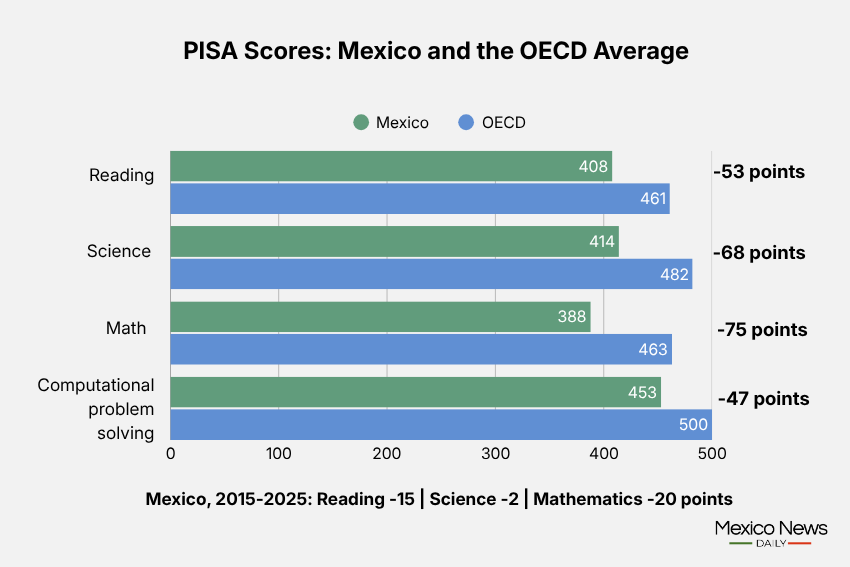
Mexican 15-year-old students performed below the OECD averages in reading, science, mathematics and computational problem solving, according to the results of the 2025 PISA (Programme for International Student Assessment) tests.
As Mexico News Daily reported when the results were published in September, Mexican students recorded the following scores:
- 408 points in reading, 53 points below the OECD average (461).
- 414 points in science, 68 points below the OECD average (482).
- 388 points in mathematics, 75 points below the OECD average (463).
- 453 in computational problem solving, 47 points below the OECD average (500).
In reading, Mexico ranked equal 52nd out of 90 countries and jurisdictions, placing it in the sixth (or fifth-lowest) decile. Albania and Brazil tied with Mexico, with all three countries scoring 408 points in reading.
In science, Mexico ranked equal 63rd out of 91 countries and jurisdictions, placing it in the seventh (or fourth lowest) decile. Colombia tied with Mexico, with both countries scoring 414 points in science.
In mathematics, Mexico ranked equal 64th out of 90 countries and jurisdictions, placing it in the eighth (or third-lowest) decile. Jordan tied with Mexico, with both countries scoring 388 points in math.
In the science/math/reading triad, 41.8% of Mexican students scored below the basic level. That percentage is more than double the OECD average of 19.7%.
Have Mexico’s PISA results improved over the past decade?
No.
Mexico’s scores in reading, science and mathematics were all lower in 2025 than in 2015.
The largest decline was in mathematics (-20 points), followed by reading (-15 points) and science (-2 points).
Mexico was by no means alone in recording lower PISA scores in 2025 than in 2015.
The OECD said that “over the most recent decade (2015-2025), the trend in performance has been negative in all three core subjects, on average across 35 OECD countries with available data.”
The declines in the OECD average PISA scores in reading, science and mathematics exceeded the decreases in Mexico. Thus, the gap between Mexico’s scores and the OECD averages narrowed between 2015 and 2025.
STUDENTS’ EXPOSURE TO BULLYING (fifth decile)
According to the OECD, “Bullying undermines students’ sense of safety and belonging at school and can have lasting detrimental consequences for learning and well-being.”
According to the 2025 PISA results, 19.5% of Mexican students aged 15 and 16 reported being bullied at least a few times a month at school. That percentage is just below the OECD average of 19.6%.
Mexico’s bullying breakdown was as follows:
- 10.7% of students said other students made fun of them.
- 3.5% of students said they were threatened by other students.
- 4.7% of students said they got hit or pushed around by other students.
- 12.1% of students said other students spread nasty rumors about them.
- 2.8% of students said that information about them that was upsetting was published online without their consent.
Out of 88 countries and jurisdictions for which bullying data is included in the latest PISA results report, Mexico has the 38th lowest bullying rate. Mexico is therefore in the fifth decile, with the first decile representing the lowest bullying rates and the tenth the highest.
The bullying rates in Vietnam and Hungary (19.9% in both countries) and in Canada (19.3%) in 2025 were similar to Mexico’s rate.
Has Mexico’s bullying rate declined over the past decade?
Yes.
In 2015, 20.2% of Mexican students reported being bullied at least a few times a month, according to the 2015 PISA results report. That is 0.6 percentage points higher than in 2025.
Mexico’s bullying rate was 1.5 percentage points above the OECD average in 2015 (18.7%).
As indicated above, Mexico’s bullying rate was 0.1 percentage points below the OECD average in 2025.
NEET RATE (third lowest decile)
According to the OECD, “Youth and young adults who are neither employed nor in education or training (NEET) are a key policy concern, as prolonged periods of inactivity at a young age can have lasting negative effects on socio-economic outcomes later in life.”
In Mexico, 19% of all 18-24-year-olds were NEET in 2025. That percentage was five points above the OECD average of 14%.
Young women were much more likely than young men to be NEET in 2025. The rate was 29% for women, compared to 10% for men.
People who aren’t studying or working are colloquially (or pejoratively) known as ninis (ni estudia ni trabaja) in Mexico.
In the “Education at a Glance 2026” report, the OECD says that “national averages often mask significant subnational variations, as regional disparities in labour-market conditions and access to education can create very different outcomes for youth within the same country.”
“… The most pronounced regional disparities in NEET rates are seen in Canada, Italy, Mexico, Romania and Türkiye, where the gaps between the regions with the highest and lowest NEET rates reach or exceed 20 percentage points,” the OECD says.
Among 41 countries for which the OECD published comparable data, Mexico had the joint ninth-highest NEET rate in 2025, tied with Chile and Greece. In other words, thirty of the 41 countries had lower NEET rates than Mexico, including Czechia (7%), Australia (10%), Canada (13%) and the United States (14%).
Among the countries with higher NEET rates than Mexico were Israel (20%), Brazil (22%), Colombia (26%) and South Africa (48%).
Has Mexico improved on this indicator over the past decade?
Yes.
In 2015, 23% of all 18-24-year-olds in Mexico were NEET, four percentage points higher than in 2025.
The gap between the NEET rate in Mexico and the OECD average declined to five percentage points in 2025 from seven percentage points in 2015.
The overall picture
Mexico’s education performance compares poorly with that of the other countries assessed across most of the eight indicators examined in this article. Early childhood education enrollment and government education spending as a share of GDP are well below OECD averages, while the proportion of young adults without an upper secondary qualification remains high, despite a significant decline over the past decade. Mexican students also score below OECD averages in reading, science, mathematics and computational problem solving.
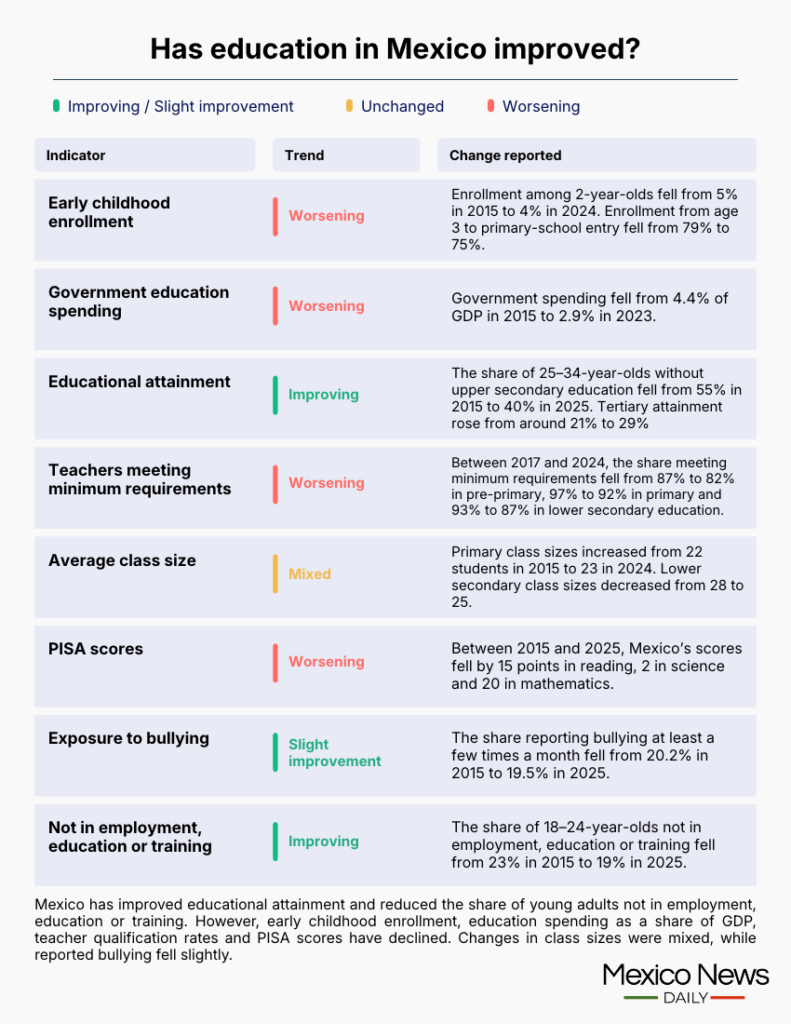
The data in this report reveal challenges at several stages of education, from limited participation in early childhood programs to weak learning outcomes among teenagers and relatively low tertiary attainment among young adults. Low public spending and declining shares of teachers meeting minimum educational attainment requirements add to the concerns. However, Mexico is close to OECD averages on some indicators: average class sizes are only modestly above OECD averages, while reported exposure to bullying is slightly lower than the OECD average.
The longer-term picture is mixed. Over the past 10 years or so, Mexico has made significant progress in reducing the share of young adults without an upper secondary qualification, while tertiary attainment has increased. The proportion of young people neither employed nor in education or training has also fallen, although young women remain much more likely than young men to be in that situation. Lower secondary class sizes have decreased, and reported bullying has declined slightly.
However, other trends are less encouraging. Early childhood enrollment rates and education spending as a share of GDP have fallen, as have the shares of teachers meeting minimum educational attainment requirements. Mexico’s PISA scores have also declined. Although the gaps with OECD average scores have narrowed, that reflects larger declines in OECD PISA score averages rather than improvements in Mexican students’ performance.
As with health and healthcare, the data in this report should not be read as a verdict on a single administration. The periods examined span several federal governments, and educational attainment among today’s adults reflects schooling received over many years.
A 34-year-old who was counted among Mexicans with a tertiary qualification by the OECD in 2025 was a pre-school student in the mid-1990s, when Mexico was still a virtual one-party state under the rule of the Institutional Revolutionary Party. That timeline underscores how educational success, or failure, reflects a combination of factors — including access to educational opportunities, family circumstances, teaching quality and policy choices — spanning decades and successive governments.
What is the federal government doing to improve education outcomes and education and training in Mexico?
Listed below are some of the education initiatives that have been implemented in Mexico in recent years or are currently in the process of being implemented. Click the links in the bullet points to read more about the different initiatives.
- President Sheinbaum announced in April that 350 billion pesos (about US $19 billion) would be allocated to school construction and improvement across all grade levels by the time her six-year term ends in 2030.
- The federal government has opened various new campuses of the Rosario Castellanos University, a public higher education institute originally established in Mexico City during Sheinbaum’s 2018-2023 mayorship in the capital. Sheinbaum said this month that enrollment in undergraduate degree programs would increase by 350,000 students in her six-year term.
- In light of Mexican students’ poor PISA results, Sheinbaum said in September that new textbooks for mathematics, reading and writing would be developed.
- In September, the government announced a ban on the use of cell phones and tablets in primary and secondary schools. Education Minister Mario Delgado blamed Mexico’s low PISA scores on “the excessive use of cell phones and computer screens” by students.
- The previous federal government (led by ex-president Andrés Manuel López Obrador) introduced a new education model called “La Nueva Escuela Mexicana.”
- The López Obrador administration introduced an education scholarships program that has been expanded by the current federal government.
- AMLO’s government introduced an apprenticeship scheme called “Youths building the future” that pays a monthly stipend to young people undertaking training with approved employers. The scheme continues to operate, with close to 200,000 young people currently enrolled.
- The Sheinbaum administration created the Bachillerato Nacional (National High School Diploma), which, according to the president, “integrates and harmonizes” high-school education systems across Mexico’s 32 federal entities.
- On Teacher’s Day on May 15, the federal government announced a 9% pay increase for public school teachers. Education Minister Delgado said in June that with the 9% pay rise, teachers’ salaries would increase, on average, to 20,351 pesos (about US $1,100) per month. “There is wage recovery for teachers with the governments of the transformation,” Delgado said, referring to the “fourth transformation,” or 4T, political movement previously led by AMLO and now led by Sheinbaum. Many teachers are still not satisfied.
- The federal government is proposing to spend 1.3 trillion pesos (around US $70.5 billion) on education in 2027, an increase of around 7% compared to this year.
As the case with recent healthcare programs and policies, the success and wisdom of the various education initiatives outlined above are debated in some cases. As expected, the government defends them while opposition parties have been critical of some of the initiatives.
FURTHER READING:
- The OECD’s “Education at a Glance 2026” country note for Mexico includes additional education indicators not included in this report.
- In 2024, Mexico News Daily published an opinion article by a Mexican educator headlined “The importance of PISA for the future of education in Mexico.”
- In January 2026, MND published an article headlined “Mexican universities and the myth of global educational excellence.”
- This X post by the think tank México Evalúa includes an infographic that shows the average number of years of formal education of residents of all 32 federal entities, ranging from almost 12 in Mexico City to just over eight in Chiapas.
Mexico News Daily