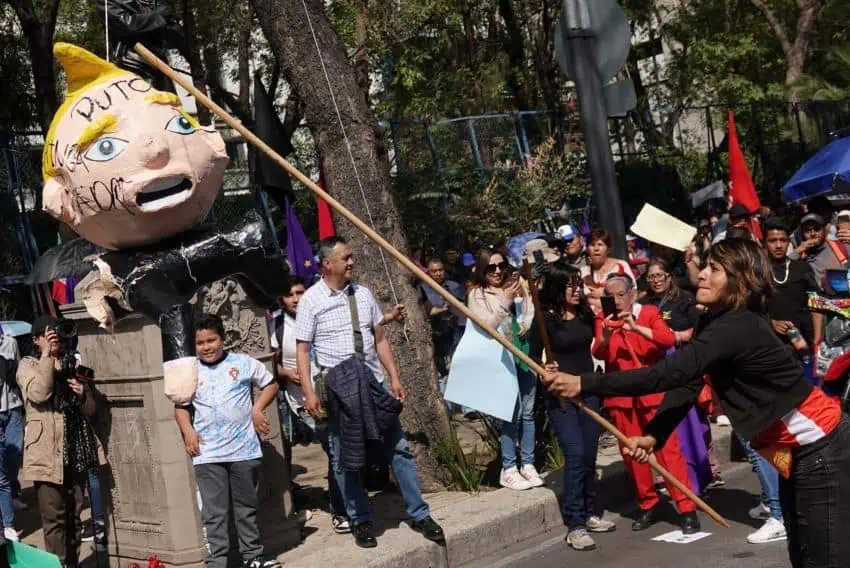
Dozens of activists held a demonstration on Monday outside of the United States Embassy in Mexico City, where they beat and burned a piñata resembling Donald Trump, which eventually went up in flames.
The activists told the news agency EFE that this gesture represents their rejection of the anti-immigration and protectionist policies of Donald Trump, who assumed a new presidential term in the U.S. on Monday.

The protesters said Trump’s policies go against the human rights of migrants, describing his intended plans as “abusive and inhumane.”
María García, one of the activists, told EFE that burning a Donald Trump piñata has become a symbol of protest since his first term as president between 2017 and 2021. In 2020, protesters at the U.S.-Mexico border burned piñatas resembling Trump and a Border Patrol agent in response to rising migrant deaths.
García added that in light of the potential threat of mass deportations, Mexico will implement a comprehensive program involving civil society organizations and all three levels of government. She also acknowledged the sense of hopelessness some migrants feel due to Trump’s rhetoric.
“All these programs are already functioning,” García said. “The countryman card (tarjeta paisano) will open the door [for Mexicans returning from the U.S.] to have medical service, access to a job, their documentation, etc. It is a complete program. We had never seen something like it.”
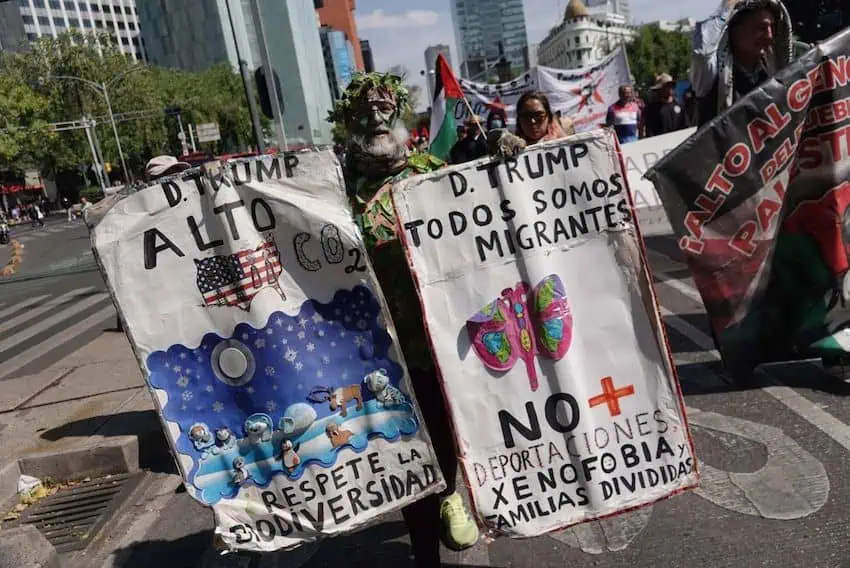
Marsha Beya Rubyn, migrant human rights activist and president of the “Orgullo Diverso de México” collective, told EFE that these policies have created unity among migrants of various nationalities.

“Our migrant brothers contribute great work and taxes to the United States economy and therefore they are migrant heroes, both those from Mexico and Latin America,” Rubyn said. “Donald Trump has not realized that he is achieving something [unintended]: the unity of all migrants in the world,” Rubyn stressed.
Meanwhile, other protesters marched through the main streets of Mexico City, chanting slogans in defense of human rights. They demanded a halt to discriminatory policies that, they claim, affect both migrants and bilateral relations between Mexico and the U.S.
The march partially flooded Paseo de la Reforma, Mexico’s landmark avenue, and finished outside of the U.S. Embassy on the same street.
Earlier this month, President Claudia Sheinbaum expressed confidence that she would have a good relationship with Trump. However, Mexicans are split over whether that will be the case. According to a recent poll by the newspaper El Universal, 46% of Mexicans believe Sheinbaum will have a good relationship with Trump, while 44% expect the two to have a bad relationship.
With reports from EFE