
A major reform to Mexico’s long-established legal rights protection law known as the amparo, has been approved by both chambers of Congress.
The reform, proposed by President Claudia Sheinbaum, has generated intense political and legal debate, with opposition parties claiming it will accomplish the opposite of its intended objective of facilitating access to amparo protection.
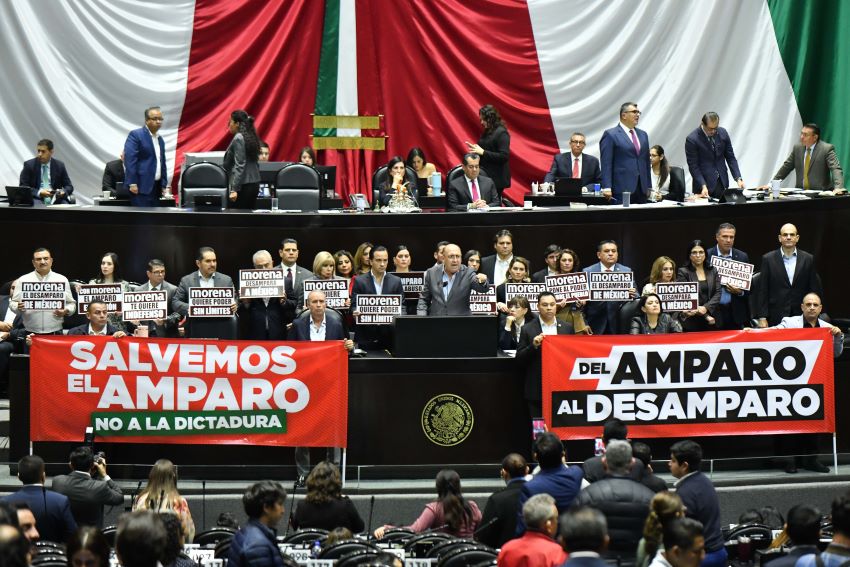
But the comfortable majority enjoyed by the president’s party (Morena), along with its congressional allies (the Green Party and Labor Party), resulted in Senate passage by a vote of 81-37 after a quick but winding journey through the two chambers. The Senate approved the presidential initiative on Wednesday on a fast-track basis, bypassing committees, after the Lower House gave its approval early Wednesday morning, with a key amendment that remains controversial.
The Amparo Law is the regulatory norm for Articles 103 and 107 of the Constitution that establishes the rules for amparo proceedings. It is a legal mechanism designed to protect individuals against laws, acts, or omissions of authorities that infringe upon their human rights.
The reform was introduced in the interest of efficiency and fairness, but also in response to concerns about the difficulty in collecting outstanding tax payments. Its supporters contend that abusive use of injunctions has been increasing by wealthy individuals to avoid paying taxes.
Thus, according to Sheinbaum, the bill will allow for the release of more than 2 billion pesos (US $108 million) in tax credits held up in court due to protracted litigation via successive injunctions.
Other approved changes include allowing digital technology in the proceedings, including to file for an amparo; time limit on judges to issue rulings; and making it difficult to receive amparo protection for a case previously decided.

Critics have said that the new law compromises access to justice. For instance, under the new terms of the law, a general concern or indirect damage are no longer sufficient cause to file an amparo lawsuit. Another concern includes the new scenarios in which a provisional suspension (halting the allegedly abusive act of the government while the case is being resolved) will not proceed.
One proposed change that experts expected to be removed was in fact amended. Legislators had included a clause that allows the new law to be applied retroactively, affecting cases already initiated under the previous law. This retroactive application was widely criticized and deemed unconstitutional when it was first proposed, as it violates the principle of non-retroactivity of laws in Article 14 of the Constitution.
Critics from the opposition are skeptical that the amended version actually solves the retroactivity question. They warn about a possible “disguised retroactivity” that could be applied at an individual judge’s discretion during an amparo trial already underway.
Arturo Zaldívar, general coordinator of policy and government in the president’s office and a former minister of Mexico’s Supreme Court, insists that the final bill does not violate the retroactivity principle. The new wording, he says, establishes that all concluded amparo proceedings are final and cannot be modified in any way. Only in phases of a current trial yet to commence will the new legal framework apply.
With reports from El País and El Financiero