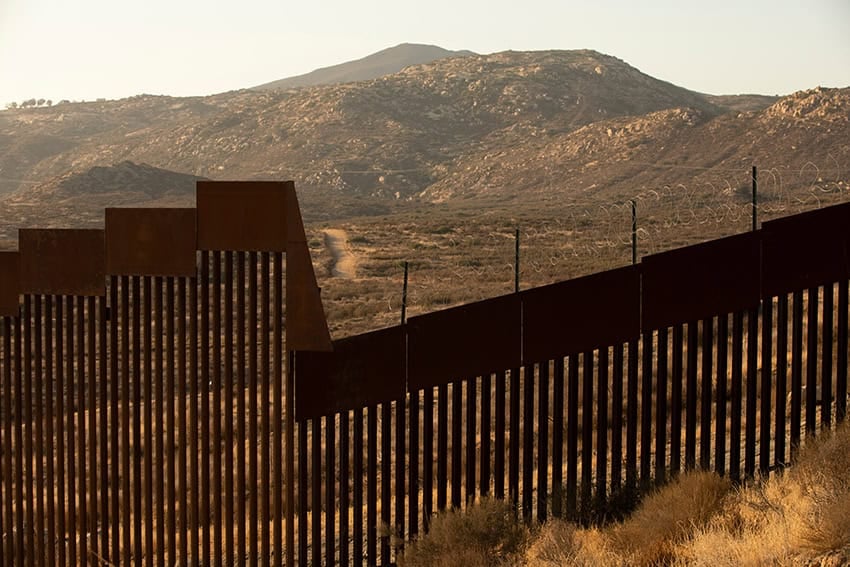
To facilitate the construction of a section of wall on the border between the United States and Mexico, the U.S. government has been using explosives on a sacred hill, angering the Kumeyaay Indigenous people.
The explosions on the rock-covered Cuchumá Hill (also known as Tecate Peak) began in early April and have continued during the past week, according to residents of Tecate, a municipality in Baja California that borders California.

Authorities in Mexico and Kumeyaay people say that the blasts are causing major damage to the hill, which straddles the U.S.-Mexico border just west of the Baja California city of Tecate. A 35-meter-high carved monolith that is considered sacred was reportedly damaged by one detonation.
“They’re destroying it,” Indigenous rights advocate Norma Meza Calles said of the hill, which is considered intangible cultural heritage in Mexico and has been on the United States’ National Register of Historic Places since 1992.
“It’s very sad because that mountain is very important to us,” Meza told the news agency EFE.
“We’re taught to respect the mountain because for us there are no churches, so we used to go there to sing and concentrate. … For you, it’s just a mountain; for us, it’s our church,” she said.

Another Tecate resident, Juan Saldaña, described Cuchumá Hill as the “faithful guardian of Tecate.” The Kumeyaay people have carried out rituals and ceremonies there for as long as anyone can remember, practices that are now under threat from the border wall construction. Tecate residents reportedly received no prior warning that the U.S. government would use explosives on the hill.
Claudia Cota, a Kumeyaay woman and a councilor with the Tecate municipal government, told KSDY Channel 50 that the detonations by U.S. authorities “have altered the natural environment of the hill.”
“We know that there are a lot of small animals that live there. There is flora, there is subterranean water that circulates and maintains the aquifers,” she said.
Explosives are reportedly being used to help clear the way for a new section of border wall between Tecate and San Diego County. The Trump administration overrode laws that protect the environment, archaeological sites, water, flora and fauna to forge ahead with construction of the wall in the area, the newspaper El Universal reported.
Tecate Mayor Román Cota Muñoz told EFE that he has chosen not to not to “interfere” with the work U.S. authorities are doing as it is taking place within U.S. territory. However, he noted that “the hill’s location means any modification on one side has visible effects on the entire environment,” according to EFE.
For their part, state authorities in Baja California have arranged a meeting with the U.S. consul in Tijuana to speak about the situation. The meeting — at which Kumeyaay representatives from both sides of the border and Mexico’s consul in San Diego will also be present — is scheduled for this Friday.
Alma Delia Abrego Ceballos, Baja California’s culture minister, said that Cuchumá Hill represents “resistance and spirituality” for the Kumeyaay people. Isaul Adams Cuero, a Kumeyaay man, told El Universal that the hill is considered sacred because it was formerly a place where “wise” members of the Indigenous group passed on life lessons to their students.
Gilberto Herrera Solórzano, a deputy who represents Tijuana in federal Congress, has called on the federal Culture Ministry to investigate and disclose the damage that has occurred on the hill. He has also urged the Ministry of Foreign Affairs to push for the suspension of the use of explosives in the area.
President Claudia Sheinbaum said last week that the ministries of Culture and Foreign Relations were already looking at the issue.
The US has also blasted a border site near El Paso
On March 16, the El Paso Sector of the U.S. Border Patrol posted a video to social media showing a series of detonations on Mount Cristo Rey, located just west of El Paso in Sunland Park, New Mexico.
“Conducting another controlled blast to clear the way for vital infrastructure and strengthen homeland security,” the El Paso Sector said in the post. “El Paso’s Mt. Cristo Rey area is known for unexpected crossings — we’re on the ground to keep everyone safe. Border security is national security.”
Mount Cristo Rey straddles the U.S.-Mexico border near the Mexican city of Ciudad Juárez.
Conducting another controlled blast to clear the way for vital infrastructure and strengthen homeland security. El Paso’s Mt. Cristo Rey area is known for unexpected crossings—we’re on the ground to keep everyone safe. Border security is national security. pic.twitter.com/C5jSicINNf
— El Paso Sector Border Patrol (@USBPChiefEPT) March 16, 2026
The Puente News Collaborative reported that last June, “then-Homeland Security Secretary Kristi Noem waived more than two dozen laws … to expedite construction of the wall across the mountain.”
There are significant concerns about the impact the construction of a border wall will have on Mount Cristo Rey, which is home to a statue of Christ and dinosaur footprints — which are reportedly not threatened — and frequented by animals such as coyotes and lizards.
In public comments to U.S. Customs and Border Protection “more than 80 people expressed concern for Mount Cristo Rey’s prized environment,” Puente News Collaborative reported.
“The agency’s summary statement, in response, explained that a biological survey yielded no federally listed threatened or endangered species,” the news outlet said.
The CBP also said it has “determined there is minimal impact to vegetation and behavioral patterns of wildlife since the project area is flanked by existing barriers and an active patrol road.”
Puente News Collaborative summed up the situation this way: “Blast by blast, border wall construction is coming for Mount Cristo Rey.”
The same thing could be said for Cuchumá Hill.
With reports from La Jornada, EFE, El Universal and El País