The higher minimum wage for the northern border area announced this week by the federal government will apply to 43 municipalities in six states.
Labor Secretary Luisa María Alcalde announced Monday that the minimum daily wage in the border zone would rise to 176.72 pesos (US $8.80) on January 1, whereas a new rate of 102.68 pesos (US $5.10) will apply to the rest of the country.
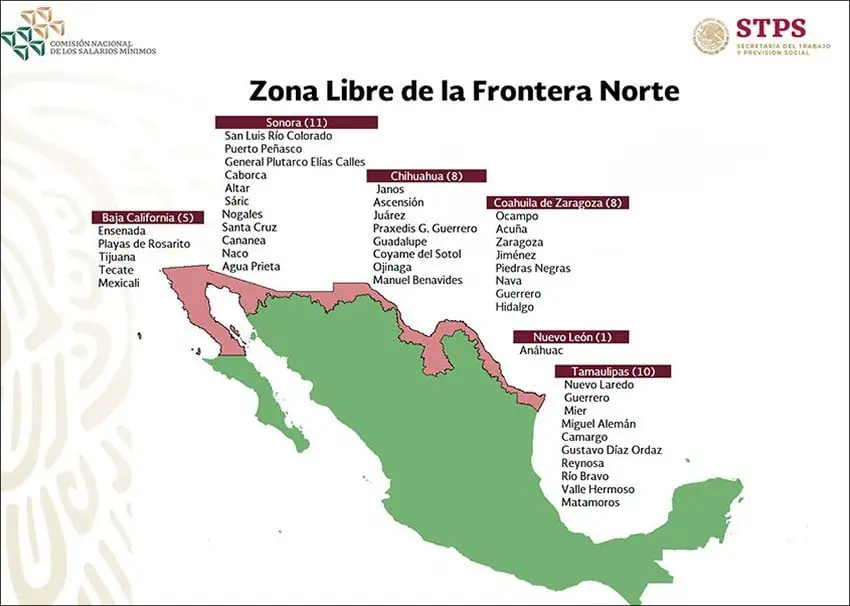
All municipalities that adjoin the United States border in Baja California, Sonora, Chihuahua, Coahuila, Nuevo León and Tamaulipas will be included in the higher wage zone.
Workers in Ensenada and Playas de Rosarito, which are located farther south of the border, will also benefit from the new arrangement.
The two municipalities will also be included in the northern border free zone, where lower income and value-added tax rates will come into force on New Year’s Day.
President López Obrador has justified the creation of the zone by saying that the border area is the “last curtain of development to keep our compatriots in Mexican territory.” He waxes often that migration “should be optional, not obligatory.”
Meanwhile, Baja California Sur (BCS) Governor Carlos Mendoza has expressed his disappointment that the state he governs was not included in the free zone and higher wage area.

“[It’s] regrettable that BCS hasn’t been included in the free zone proposal like the rest of the [Baja California] peninsula. Not only will we not benefit from a lower IVA [value-added tax] and ISR [income tax], we won’t benefit from the minimum salary rise either. We demand reconsideration!” he wrote on Twitter.
The 43 municipalities included in the free zone and higher wage area are:
Baja California: Ensenada, Playas de Rosarito, Tijuana, Tecate and Mexicali.
Sonora: San Luis Río Colorado, Puerto Peñasco, General Plutarco Elías Calles, Caborca, Altar, Sáric, Nogales, Santa Cruz Cananea, Naco and Agua Prieta.
Chihuahua: Janos, Ascensión, Juárez, Praxedis G. Guerrero, Guadalupe, Coyame del Sotol, Ojinagua and Manuel Benavides.
Coahuila: Ocampo, Acuña, Zaragoza, Jiménez, Piedras Negras, Nava, Guerrero and Hidalgo.
Nuevo León: Anáhuac.
Tamaulipas: Nuevo Laredo, Guerrero, Mier, Miguel Alemán, Camargo, Gustavo Díaz Ordaz, Reynosa, Río Bravo, Valle Hermoso and Matamoros.
Source: El Universal (sp), BCS Noticias (sp)