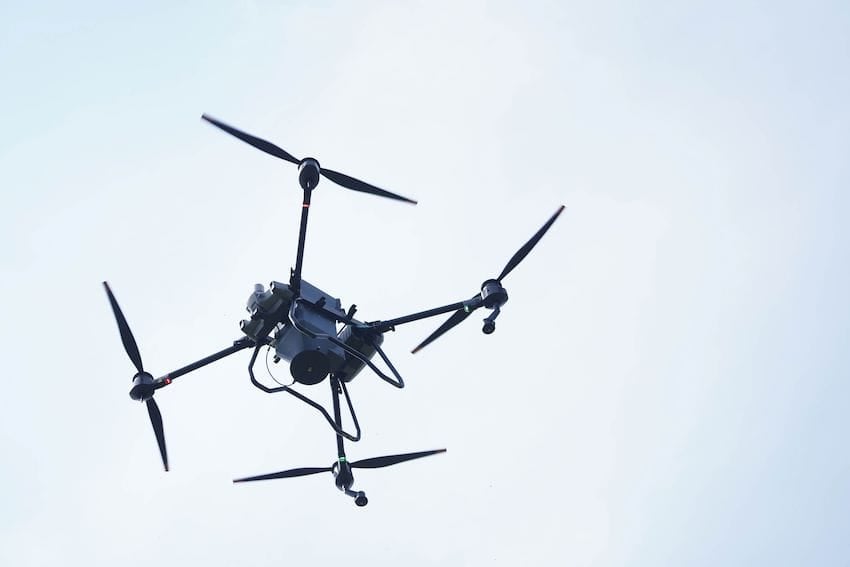
Sinaloa Governor Rubén Rocha Moya acknowledged on Tuesday that drone attacks have recently been carried out in Badiraguato, a municipality in Sinaloa where convicted drug lord Joaquín “El Chapo” Guzmán Loera was born and grew up.
He noted that the attacks have generated fear among residents of Badiraguato and forced some families to leave their homes to seek refuge in safer places.
Some of the attacks reportedly targeted a property in the village of La Tuna where Guzmán Loera’s deceased mother formerly lived.
There are no reports of the drone attacks having caused fatalities or injuries.
Speaking at a press conference on Tuesday, Rocha said that state and federal authorities had responded to the situation and seized “a lot of drones.”
Citing unnamed security sources, Aristegui Noticias reported that authorities have seized seven drones as well as material used in the manufacture of improvised explosive devices.
🔴Miedo en #Sinaloa: “La gente se han ido desplazando de esta zona de Badiraguato porque temen que les caiga un bombazo”, dice José Luis Montenegro (@montenegrojluis) tras viralizarse un video sobre un ataque con dron contra la casa de la madre de ‘El Chapo’, donde estaría ‘El… pic.twitter.com/TPwbzcVKN8
— Azucena Uresti (@azucenau) October 29, 2025

Rocha didn’t specify when the drone attacks took place. However, displaced residents said they began in September.
The governor said that displaced residents have received assistance from the Sinaloa Welfare Ministry.
Rocha didn’t say who was responsible for the drone attacks, but they could be linked to a long-running and very bloody battle between rival factions of the Sinaloa Cartel.
One of those factions, Los Chapitos, is controlled by two of the sons of “El Chapo” Guzmán. Two of the notorious trafficker’s other sons are in custody in the United States, as is Guzmán, who was sentenced to life imprisonment on a drug trafficking conviction in 2019.
The mountainous municipality where he was born in 1957 has long been associated with the drug trade in Mexico.
Cartels’ use of drones
Mexican cartels have been carrying out attacks with explosive-laden drones for several years. The Jalisco New Generation Cartel has allegedly used the unmanned aerial devices to carry out attacks in the state of Michoacán, while La Familia Michoacana has reportedly used drones in Guerrero.
Earlier this month, a crime group in Tijuana used three drones to launch a crude improvised explosive device attack on the Baja California attorney general’s offices in the northern border city.
In July, a senior Trump administration official said that it was “only a matter of time” before Mexican criminal organizations carried out drone attacks against U.S. citizens and law enforcement authorities.
“Nearly every day, transnational criminal organizations use drones to convey illicit narcotics and contraband across U.S. borders and to conduct hostile surveillance of law enforcement,” said Steven Willoughby, a high-ranking official in the U.S. Department of Homeland Security.
In September, The New York Times reported that drug smugglers and cartel gunmen in Mexico are using “improvised explosive devices to kill their rivals and modifying drones bought online to make attack drones, loaded with toxic chemicals and bombs.”
“… Just as drones, cheap and easy to modify, have proliferated in the battlefields of Ukraine, their use by cartels — for surveillance and precision bombing — has surged drastically in recent years,” the Times reported, citing government officials, security experts and analysts.
With reports from Milenio, Aristegui Noticias, El Universal and CBS