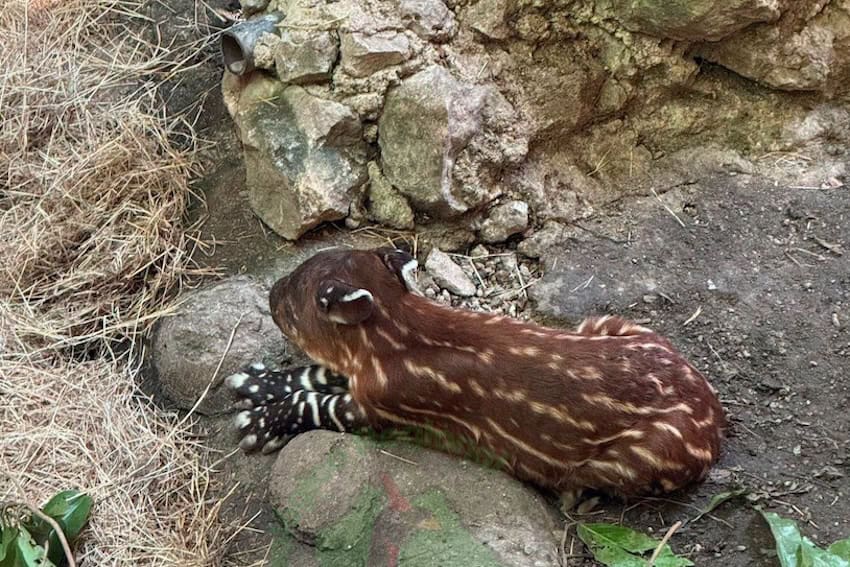
The Miguél Álvarez del Toro Zoo in Tuxtla Gutiérrez, Chiapas, is celebrating the birth of a male Baird’s tapir, a mammal that is classified as endangered.
The birth of the calf is the result of the Central American Tapir Conservation and Reproduction Program, carried out in coordination with Mexico City’s Chapultepec Zoo.

The zoo, known as ZooMAT, announced the arrival of the baby tapir in a Facebook post:
“Our little one was born weighing 8.4 kilograms and remains with his mother, Coco, who is caring for him naturally and has already allowed him to have his first colostrum feedings, essential to strengthen his immune system and provide him with protection during his first stage of life.”
Zoo officials cautioned that the first few weeks are critical for the development and survival of any wild species, while reporting that “the progress observed so far is favorable.” Meanwhile, the zoo is maintaining remote monitoring and 24-hour security.
ZooMAT said the birth — the second in the zoo’s controlled breeding program — “represents a new hope for the conservation of the Central American tapir.”
There are four species of tapir — a large, herbivorous mammal with a distinctive flexible, prehensile snout — three of which can be found in the Americas, stretching from southern Mexico, through Central America and into northern South America.

About five years ago, experts estimated that there were fewer than 4,500 mature tapirs in the wild and fewer than 230 in the Sierra Madre de Chiapas, according to The Revelator magazine).
The Baird’s tapir (Tapirus bairdii) — known as the “gardener of the forest” because it eats a diversity of plants, fruits and seeds, dispersing the latter in its dung and helping forests regenerate — is threatened by severe habitat fragmentation and deforestation, poaching, vehicle strikes and slow reproductive rates.
Reproduction of tapirs in zoos is considered rare. ZooMAT biologist Carlos Guichard said the current program came about after an exchange of specimens two years ago when the Chapultepec Zoo loaned a breeding male to ZooMAT in exchange for another specimen not in reproductive condition.
The first birth — a female — occurred late last year.
With reports from El Heraldo de Chiapas, Uno TV and El Universal