More than 600,000 formal and informal sector businesses are at risk of closing permanently due to the coronavirus pandemic, according to the bank BBVA.
The bank’s research division said that according to a survey conducted by the national statistics agency Inegi, 311,000 formal sector businesses and 313,000 informal sector ones are currently closed due to coronavirus restrictions and therefore have no income.
Reopening is likely to be difficult for a lot of them.
Given the large number of such businesses, it is “very probable” that permanent closures due to the pandemic will increase, BBVA Research said.
According to the Mexican Social Security Institute, just under 10,000 formal sector businesses were forced to close for good in April and May as a result of the coronavirus crisis, while Inegi found that almost 12,000 informal sector businesses have also closed permanently due to the pandemic.
BBVA Research predicts that those figures will rise in the coming months even as Mexico takes tentative steps to reopen the economy.
Employees who lose their jobs will cause unemployment to rise, BBVA Research said, noting that some formal sector workers will try to find employment in the informal economy.

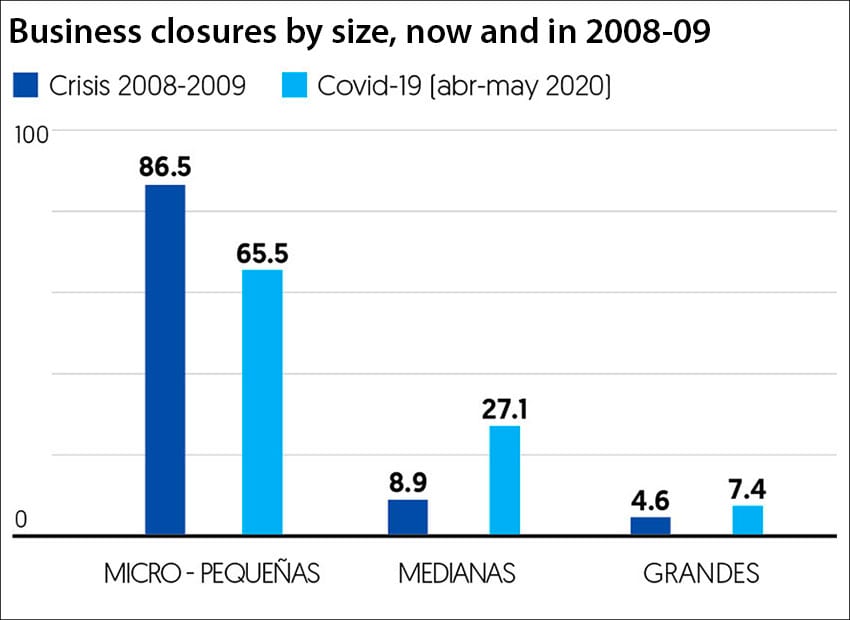
Most of the businesses that will close will be very small ones. Of the more than 300,000 formal sector businesses currently closed, 81% are so-called micro-businesses while in the informal sector, the figure is 98%.
BBVA also noted that about 1 million formal sector jobs have already been lost as a result of the pandemic and predicted that the labor market will not recover until 2024 at the earliest.
It said that jobs recovery will be held back by the coronavirus-induced economic downturn, the uncertainty surrounding the economic reopening, and the lack of government support.
The bank highlighted that the tourism and construction sectors have recorded the biggest declines in employment.
Gabriela Soni, chief investment officer of financial company UBS México, told the newspaper El Financiero that the number of jobs lost between March and May – some 1.03 million – is triple the number created in all of 2019.
She said that was “concerning” but added that the new North American free trade agreement, set to take effect on July 1, could help to boost employment. Soni said that the United States-Mexico-Canada Agreement will particularly benefit the manufacturing sector.
“When the United States starts to demand products, we have to produce to export them,” she said.
However, with the United States – and the world – also going through an economic crisis, demand for a lot of consumer goods is likely to remain below pre-pandemic levels for months if not years to come.
While demand for Mexican-made products remains low in the United States, Mexico’s biggest trading partner, the economy’s ability to recover will remain hamstrung.
According to a new growth forecast published Wednesday by the International Monetary Fund, Mexico’s economy will contract 10.5% in 2020, a decline of 3.9% compared to its April prediction.
Source: El Financiero (sp)