President Claudia Sheinbaum inaugurated on Saturday the new Cancún Nichupté Vehicular Bridge, which connects the city’s residential area with its hotel zone, cutting commuting time by as much as 50 minutes.
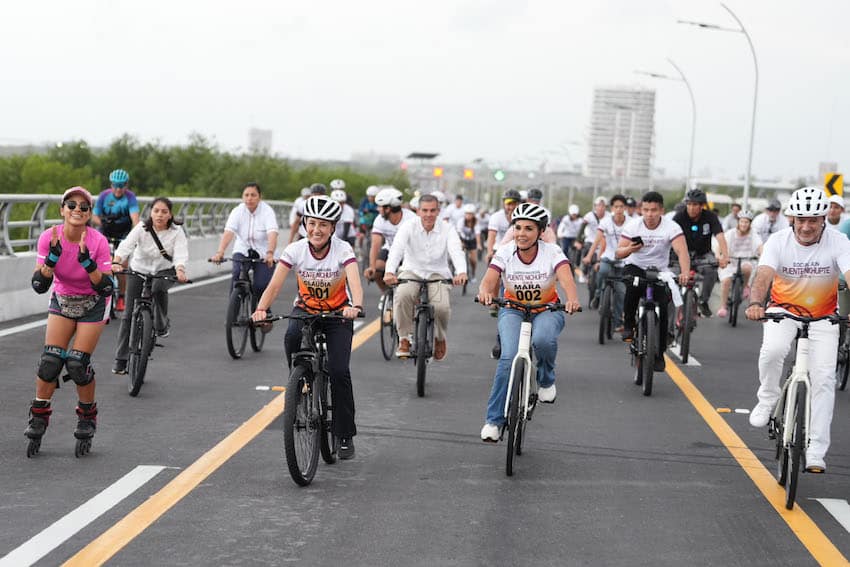
During the opening ceremony, President Sheinbaum and Quintana Roo Governor Mara Lezama rode bikes across the bridge alongside hundreds of locals.
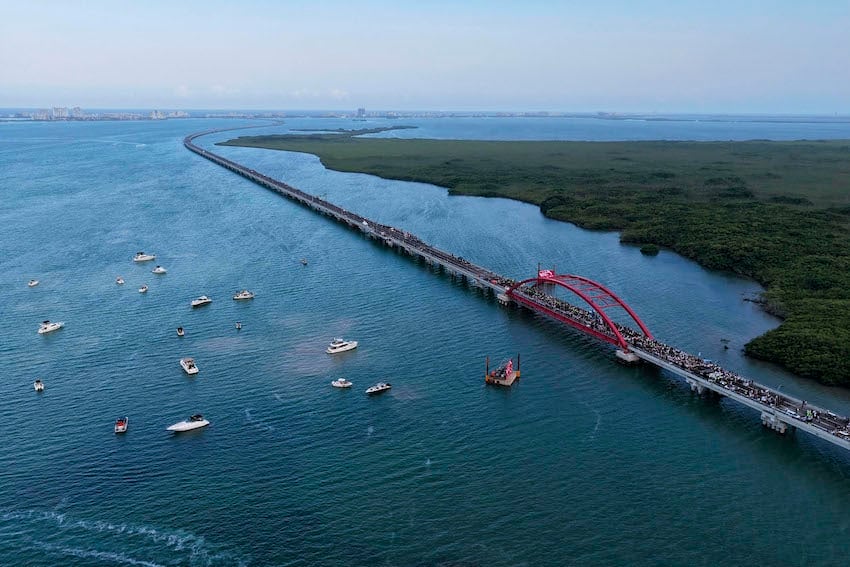
The 11.2-kilometer bridge, whose launch had been expected three years ago, cost 10.3 billion pesos (US $588 million), 115.8% higher than the original budget when the project was awarded to Mexican construction firm ICA in 2022.
The bridge, which is free for all users, will handle an average daily traffic of 12,000 vehicles. It consists of three lanes — one in each direction and a third that can change direction depending on traffic — as well as the two-way bike path that the president and governor tried out. It also has a 5-meter clearance structure in the navigation channel for the passage of vessels.
In addition to cutting daily commuting time from around an hour to just 10 minutes, it is expected to strengthen evacuation capabilities in an emergency, such as a hurricane.
The project forms part of the government’s development strategy for southeastern Mexico, initiated by the administration of former President Andrés Manuel López Obrador and continued by Sheinbaum’s government. Its stated aim is to reduce inequality in the region by enhancing connectivity, which the government cites as examples the construction of the Maya Train and the opening of the Tulum airport.
The president chose to promote that approach during her remarks at the opening event. “Past governments built inequality, corruption and hatred; the fourth transformation builds equality, love for the people and love for the country,” Sheinbaum said, referring to her Morena party’s name for its administrations.

“Governing means making decisions that will continue to make sense when we are no longer here to explain them,” Governor Lezama said during the ceremony. “In a few years, this bridge will no longer be a novelty, but it will have already become indispensable. And its greatness lies in the improved daily life it brings.”
Lezama also mentioned the sustainable construction practices she said were used during the building of the bridge. Those practices, she said, minimized the environmental impact on the Nichupté lagoon system, through measures such as mangrove protection, water reconnection and the use of a “top-down” construction technique.
With reports from Reportur and El Economista