The northern state of Sinaloa has a new governor after Rubén Rocha Moya’s request for temporary leave was approved by state Congress, following the unsealing of a U.S. federal indictment charging him with drug trafficking and ties to the Sinaloa Cartel.
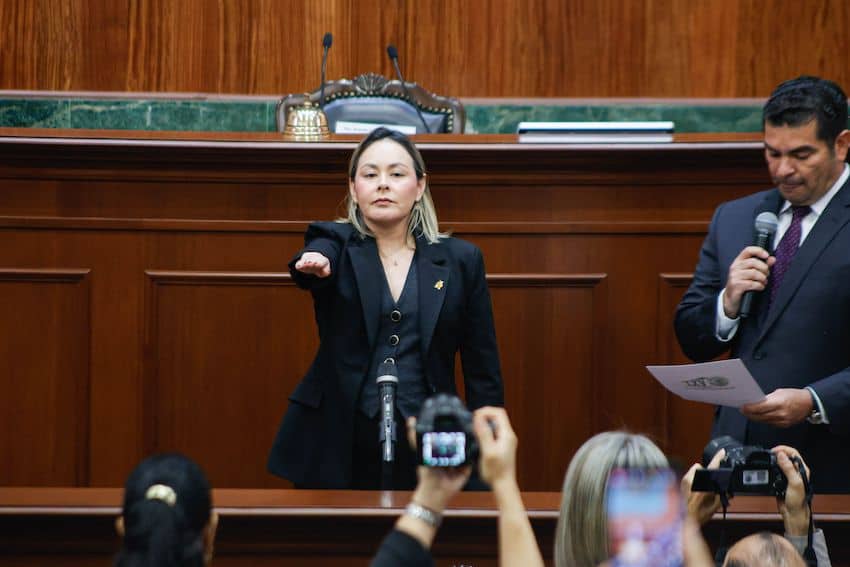
Yeraldine Bonilla Valverde was sworn in as interim governor of Sinaloa on Saturday. Bonilla, a 33-year-old former state lawmaker, was serving as general secretary of the Sinaloa government before her appointment as interim governor.
The unicameral Sinaloa Congress — dominated by the Morena party and its allies — approved her appointment after authorizing Rocha’s request for “temporary leave for more than 30 days.”
Bonilla is the first woman to serve as governor of Sinaloa.
Rocha, who represented Morena as governor, announced his intention to step down on Friday night, two days after the unsealing of a U.S. indictment that accuses him and nine other current and former Sinaloa-based officials of drug trafficking and related weapons offenses. U.S. prosecutors allege that the “Los Chapitos” faction of the Sinaloa Cartel — led by sons of convicted drug lord Joaquín “El Chapo” Guzmán — helped Rocha get elected in 2021, and that as governor, he allowed the criminal cell to operate with impunity. Rocha, who has served as governor since 2021, promptly rejected the accusations against him.
The Federal Attorney General’s Office is assessing a U.S. request that the governor and nine other defendants, including the mayor of Culiacán and a Morena party federal senator, be provisionally arrested for the purpose of extradition. Special prosecutor Ulises Lara said last week that the FGR would “launch an investigation to gather all the necessary information to determine whether there is evidence establishing a reasonable likelihood that the charges brought by U.S. authorities have a legal basis for requesting arrest warrants.”
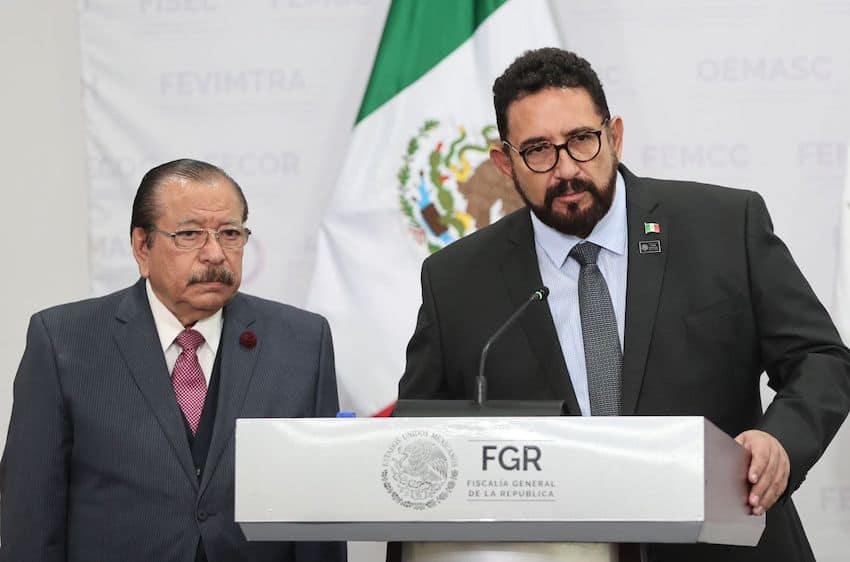
He said that the U.S. request for the provisional arrest for extradition purposes of the 10 suspects was “not accompanied by sufficient probative elements that provide conclusive evidence” against Rocha and the other defendants.

President Claudia Sheinbaum has endorsed the determination that there is insufficient evidence to arrest and extradite Rocha and the other nine men accused of drug trafficking by U.S. prosecutors. Sheinbaum, a staunch defender of Mexican sovereignty, has stressed that Mexican authorities — not U.S. prosecutors or the U.S. government — will make the final decision about whether Rocha and others have questions to answer in the United States or not.
On Monday, Security Minister Omar García Harfuch said that federal authorities had no suspicions about Rocha.
With a ‘clear conscience,’ Rocha announces decision to take leave
Rocha, a 76-year-old former senator and university rector, announced his decision to take temporary leave as governor of Sinaloa in a two-minute message broadcast on Friday night.
“I address myself to the people of this great state to express the following: I have a clear conscience — a life of work backs up my words. I say it clearly and forcefully: the accusations that have been made against me are false and fraudulent,” he said.
After declaring that he has never betrayed — and will never betray — the people of Sinaloa or his family, Rocha declared that he would prove his innocence to Mexican authorities.
He also said he wouldn’t allow himself to be “used” to “harm the movement to which I belong” — i.e., the “fourth transformation” political movement led by Sheinbaum.

In that context, Rocha announced that he had requested temporary leave as governor for as long as the FGR investigation lasts. He said that his decision was also aimed at “facilitating” the investigative work of Mexican authorities.
Culiacán Mayor Juan de Dios Gámez Mendívil, a Morena party politician, also decided to go on temporary leave after he was accused of colluding with the Sinaloa Cartel on a drug trafficking conspiracy. He too denies the U.S. accusations against him. Ana Miriam Ramos Villarreal, a former bank employee, was appointed interim mayor of the capital of Sinaloa, one of Mexico’s most dangerous cities.
Does Rocha lose his immunity from prosecution by stepping down as governor?
In a social media post on Saturday, former Supreme Court Chief Justice Arturo Záldivar — now a high-ranking government official — wrote that a governor on leave loses their immunity from prosecution and therefore can be arrested like any other person.
“What certain media outlets have published in the sense that a governor and mayor on leave continue having ‘fuero’ [immunity] is incorrect,” he wrote.
“Procedural immunity, misnamed ‘fuero,’ is a guarantee for a certain category of public officials to prevent them from being criminally prosecuted without the Chamber of Deputies issuing a declaration of proceedings that lifts the procedural immunity under the terms of Article 111 of the Constitution,” Zaldívar wrote.
“Fuero protects the role, not the person. Whoever obtains leave no longer exercises the role, therefore, they can be detained like any person, since they no longer enjoy procedural immunity. There are precedents from the Federal Judiciary in this regard,” he wrote.
However, the newspaper El Financiero reported that “according to the Political Constitution of Sinaloa,” Rocha retains his fuero despite taking leave as governor. Similarly, The New York Times reported that Rocha’s “leave of absence could allow him to step down from his position while retaining his immunity, though some legal experts,” such as Zaldívar, “say it would not apply.”
With reports from El Universal and El Financiero