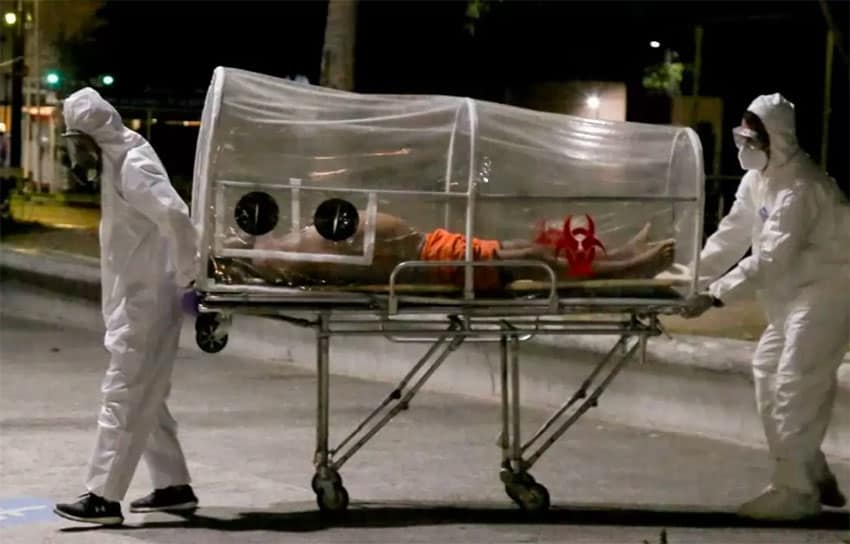
Some parts of Mexico and certain industries are emerging from the coronavirus lockdown on Monday but there is no certainty that the partial reopening of the economy won’t trigger new outbreaks of Covid-19.
The federal government announced on Saturday that 324 coronavirus-free municipalities can reopen starting today, adding 55 municipalities to an original list of 269.
The government said that residents of those municipalities can return to their normal economic and educational activities from today on, although the authorities in some states vetoed the decision.
Still, the majority of the so-called “municipalities of hope” – about two-thirds of them are in Oaxaca – will take their first steps on Monday into what is being called “the new normal.”
Under pressure from the United States to restore the North American supply chain, auto part manufacturers in some states including San Luis Potosí, Coahuila, Aguascalientes and Yucatán will resume operations today.
Some automakers and aerospace, mining and construction companies will also reopen their plants today with strict health measures in place to prevent the spread of Covid-19.
But the reopening carries risks.

Among those who have expressed concern about the decision to allow a partial economic reopening even as the coronavirus pandemic worsens is National Autonomous University (UNAM) epidemiologist and professor Malaquías López.
In an interview with the newspaper Milenio, López described the partial reopening as a risky “experiment,” asserting that it could lead to an increase in both case numbers and deaths in the next two to three weeks.
Some people think that the increase could be worse than “what we’ve [already] been through,” he said.
López, spokesman for the UNAM Covid-19 Commission, said that a serological survey in Spain – which has recorded almost five times as many confirmed coronavirus cases as Mexico – found that only 6% of people had Covid-19 antibodies, meaning that the vast majority of the population remains susceptible to infection.
In Mexico, he added, no serological testing has been done.
“We haven’t done anything here but if [the pandemic] hit a lot harder there than here, and they have a large number of susceptible people, what can we expect in Mexico? There are also a lot of susceptible people [here] and when we start to interact with each other infections will break out,” López said.
The epidemiologist said that a large wave of new Covid-19 infections would nullify the effects of the coronavirus mitigation measures that have now been in place across the country for almost two months.
The decision to lift restrictions in some municipalities and on some industries is “an experiment,” López said, because there is a lot of uncertainty about what effect it will have on the development of the pandemic.
“How do they know that nothing will happen? I think that there is a lot of risk,” he said.
The governors of several states agree that the risk of reopening the economy now, even in municipalities with no confirmed cases of Covid-19, outweighs the benefits.
Jalisco Governor Enrique Alfaro said that 23 municipalities in that state that were given the green light to reopen by the federal government would not be resuming normal activities today. He said that opening up some municipalities while others remained closed could be counterproductive.
Located about 130 kilometers southwest of Guadalajara, Tapalpa is one that has not recorded any coronavirus cases and which doesn’t border any with confirmed infections.
However, opening up the economy in Tapalpa – the municipal seat is one of 121 Pueblos Mágicos, or Magical Towns – could result in a flood of visitors from Guadalajara, Alfaro said.
“Imagine … the danger for the people of Tapalpa. This idea of opening some municipalities and not others is a serious mistake, … it won’t happen in Jalisco,” he said.
Guerrero Governor Héctor Astudillo said that none of the 10 coronavirus-free municipalities in that state will reopen today because the “appropriate conditions” to do so don’t exist.
He said coronavirus mitigation measures will remain in place in all of Guerrero’s 81 municipalities until at least June 1, the starting date for the federal government’s color-coded “stoplight” system, through which each state’s readiness to reopen will be assessed.
Authorities in Chihuahua, Yucatán and Puebla indicated that they wouldn’t allow coronavirus-free municipalities to reopen today either while only one of four “municipalities of hope” in Tamaulipas will resume normal activities.
Authorities in several states have also indicated that they will not reopen schools this academic year even if they are given the green light by the federal government to do so.
President López Obrador has said that municipal and state authorities will not be punished for not following federal government recommendations with regard to reopening the economy, although they are likely to come under pressure from business and many citizens if they delay the return to the “new normal” amid the sharp economic downturn.
Mexico is predicted to suffer a deep recession in 2020 but Finance Ministry officials have expressed confidence that the economy will bounce back quickly after the economy reopens.
However, reopening the economy too soon in a country where more than 5,000 people have already lost their lives to Covid-19 could have a devastating effect, making any financial gains pale into insignificance when compared with the decision’s human cost.
Source: Milenio (sp), El Financiero (sp)