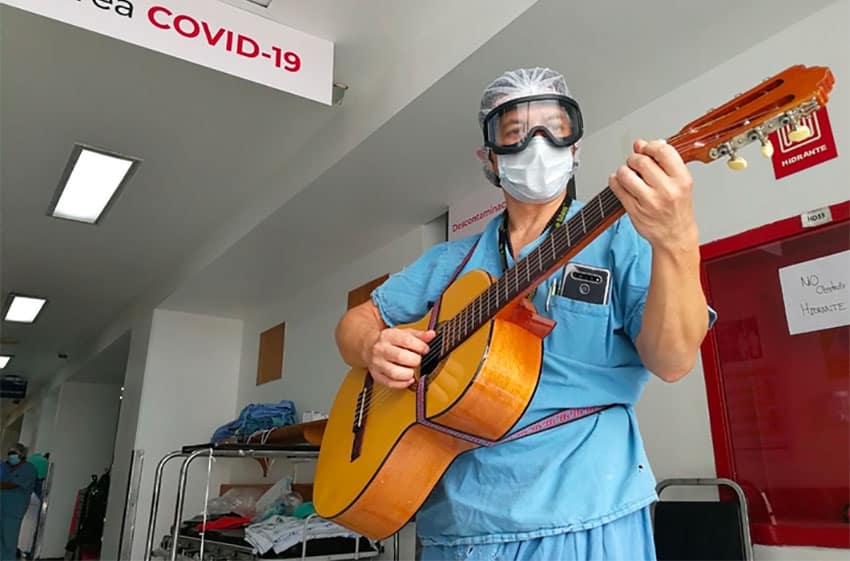
They say that laughter is the best medicine, but in Mexico City’s Juárez Hospital, psychologist Javier Coss is using the power of his guitar to serenade patients, doctors, and staff in the Covid-19 ward with classic songs to reduce stress levels.
“I carry my guitar with me, and I play music for the doctors, for the nurses, for the patients in the hallway because it’s a way in which I can … change the tense atmosphere, and if possible, give them a moment of contemplation.”
Coss’s song selection varies from Cuban singer-songwriter Silvio Rodríguez to the international pop-rock band Caifanes. Staff apparently appreciate the value of his music therapy: at one point, he said, a nurse asked to borrow his guitar so she could play a song while Coss sang along, “so that she could just ease her stress a bit and connect with herself,” he said.
Coss, part of a team of psychologists assisting the staff and patients with psychological counseling, has worked at the hospital for three years. In addition to providing therapeutic assistance and music performances, he and his team also manage patients’ communication with their families via videoconferencing calls. He sees it all as part of a package of strategies to keep patients’ motivation up as they try to recover from an illness that isolates them from everyone.
“We have to achieve this emotional closeness with the patients because somehow or other we must keep them motivated,” he said.
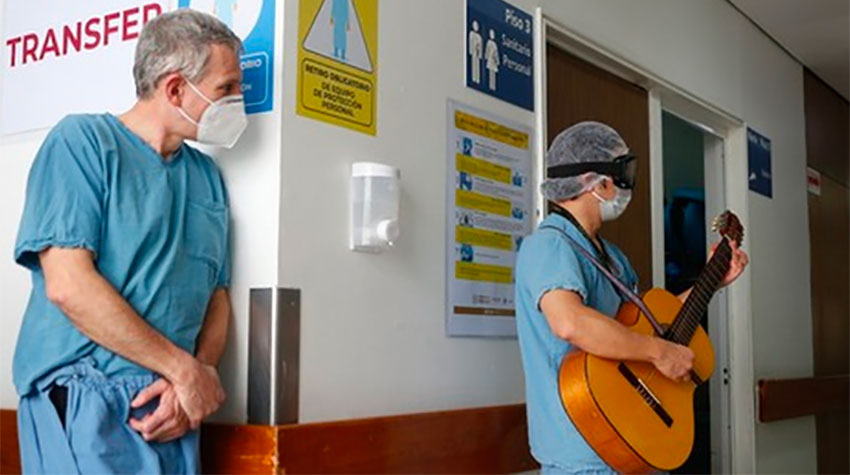
Hospital Juárez is one of the nation’s biggest hospitals. On a daily basis, it attends to hundreds of Covid-19 patients. Despite having seen a recent decrease in coronavirus patients, the medical and administrative staff have been working through Mexico City’s worst pandemic and many are suffering from chronic stress and burnout.
Coss himself is not immune. When he began working in the Covid-19 ward, he was scared. He had to completely change the way he dressed and wear gloves, two or three layers of masks, and a shield. Outside of work he has had to change his socialization patterns — not seeing his parents and reducing his interactions with his children. But once he felt he could safely enter the ward with adequate protection, he began to lose his fear.

He says he now feels proud to be working at the hospital because it’s made him realize the importance and interconnectedness of each of the hospital’s departments. Before the pandemic, he said, he thought of all the staff as being in their own isolated spheres doing their own tasks but all are in fact connected and integrated.
Source: Milenio (sp)