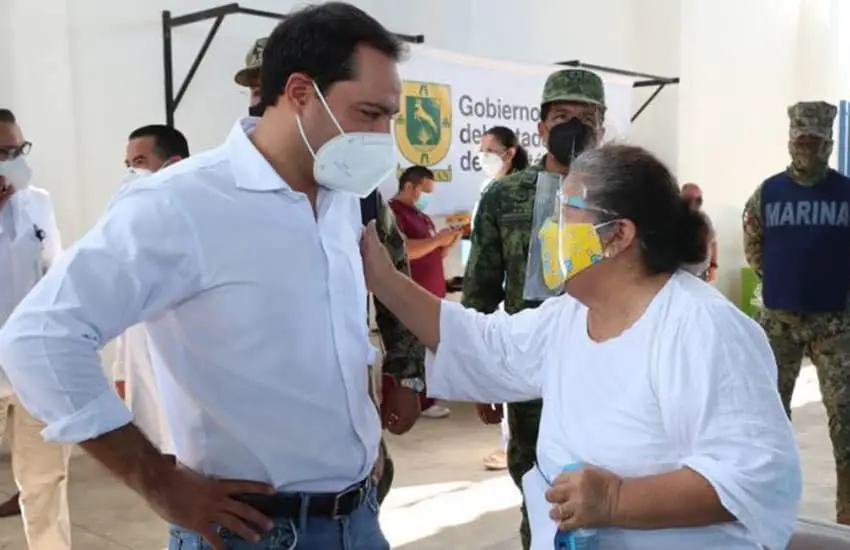
Yucatán will switch to medium-risk yellow on the state’s coronavirus stoplight map for the first time on Monday, Governor Mauricio Vila announced Thursday.
Yucatán is currently high-risk orange on both the state and federal stoplight maps. The federal Health Ministry will present an updated map at Friday night’s coronavirus press briefing.
Yucatán was medium-risk yellow on the federal map between November 23 and December 7 last year but state authorities decided last June that they would make their own decisions about coronavirus restrictions according to their own stoplight system.
“We have decided that decisions about Yucatán will not be made in Mexico City,” Vila said at the time.
The risk level in Yucatán, which has recorded more than 36,000 confirmed cases and over 3,600 Covid-19 deaths, has remained fixed at orange on the state stoplight map since June 8, 2020.
As of Monday, however, restrictions on the circulation of vehicles between 11:30 p.m. and 5:00 a.m. will not apply Sunday through Wednesday. But the ban on driving between those hours will remain in place Thursday through Saturday.
Vila also announced that restaurants will be permitted to remain open until midnight Sunday to Wednesday starting next week. They have been required to close at 10:00 p.m. for almost a year since reopening to in-house diners.

Also starting next week, the maximum capacity at restaurants, stores, shopping centers, supermarkets and hotels will increase to 75%. Cinemas and theaters will be limited to 50% of normal capacity.
Children’s playing areas and sporting facilities in public parks will reopen Monday, while university students will be permitted to resume professional work placements on May 15.
Social events such as weddings will also be permitted as of May 15, but people hosting and attending will be required to comply with strict health protocols. Attendance will be capped at 100 for indoor events and 200 for outdoor ones.
The governor warned that authorities will close down any events at which health protocols are being violated.
Yucatán took the decision to switch the risk level to yellow based on data showing that 30.5% of critical care hospital beds set aside for coronavirus patients are occupied and 51.6% of all beds allocated for such patients are in use. The infection rate and the positivity rate are both on the wane.
As of Thursday, there were an estimated 562 active cases in the state, according to federal data, and 27,408 across the country.
Mexico’s accumulated case tally currently stands at just under 2.32 million while the official Covid-19 death toll is 214,095.
Source: Milenio (sp)